Every cold email list decays 2-3% per month. People change jobs, domains die, inboxes fill up. Send to a six-month-old unverified list and you're mailing 15-20% dead addresses. Here's what verification actually does, and when the free tools are enough.
What a real verifier checks
- Syntax: is it even shaped like an email? Trivial, but catches typos.
- MX records: does the domain have mail servers? Catches dead domains.
- SMTP handshake: the big one. Connect to the mail server and ask whether this specific mailbox exists, without sending mail.
- Catch-all detection: some domains accept mail for any address, so the mailbox can't be confirmed. That's "risky".
- Disposable and role detection: temp-mail domains and role inboxes (info@, admin@) that never convert.
Why bounces are so expensive
Mail providers score sender domains continuously. A hard bounce says "this sender doesn't know their recipients", which is the defining trait of a spammer. The thresholds are brutal:
- Under 2% bounce rate: healthy.
- 3-5%: reputation damage begins. Some sends flow to spam.
- 10%+: domain-level spam routing within days. Recovery takes weeks of warm-up.
One unverified 1,000-contact list with 12% dead addresses can undo a month of warm-up. Verification is the cheapest insurance in outbound.
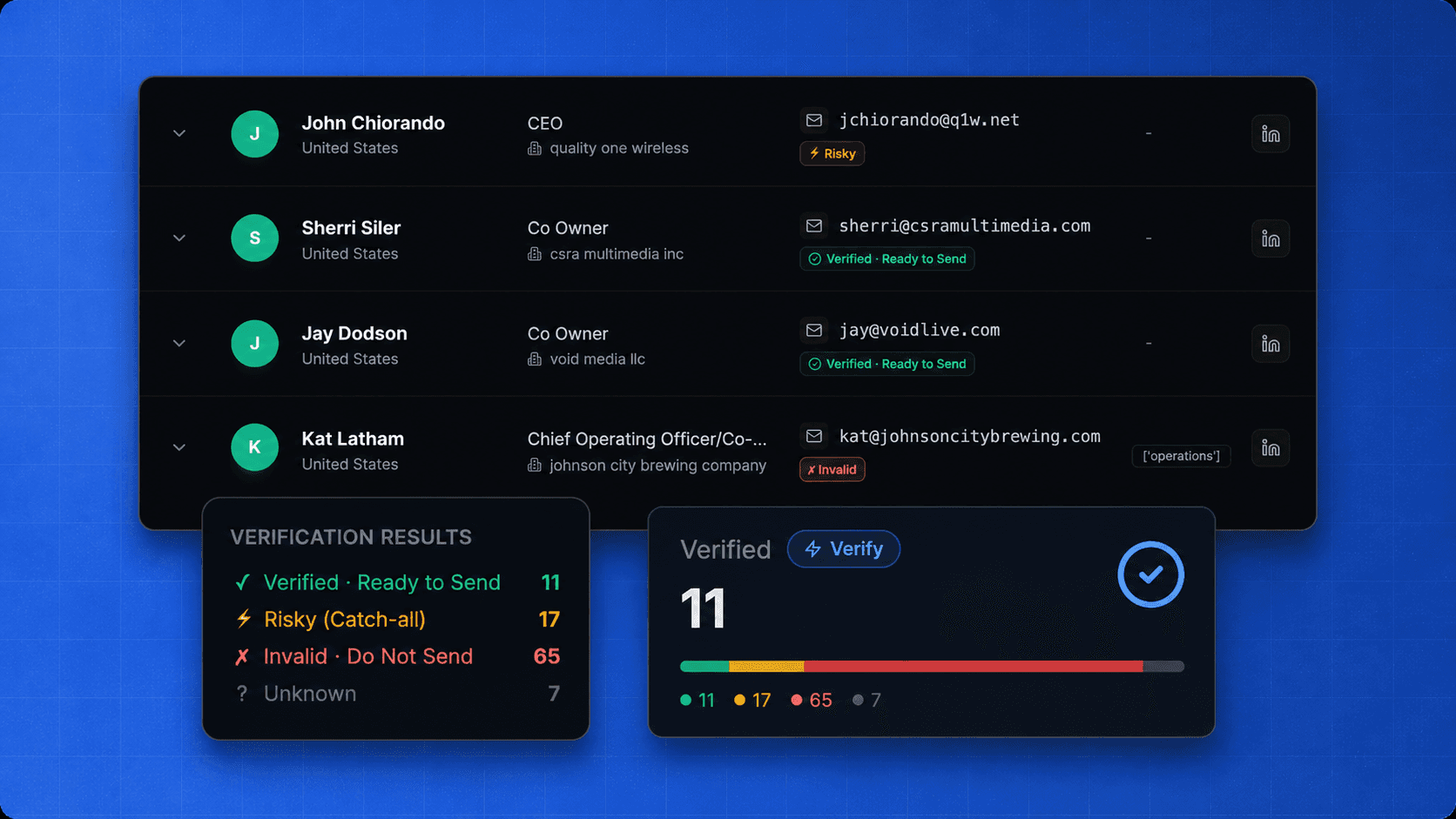
Interpreting results
- Deliverable: mailbox confirmed. Send freely.
- Undeliverable: remove immediately. Never "try anyway".
- Risky (catch-all): the domain accepts everything. Send only if the contact data is fresh and the account matters. Keep risky sends under 20% of any campaign.
- Unknown: the server didn't answer definitively. Re-verify in 24 hours.
Free vs bulk verification
For spot-checking a reply-to address or a handful of prospects, a free email verifier (10 checks/day) is plenty. For lists you need bulk verification. Getlead includes unlimited-scale SMTP verification in every plan, so every scraped or imported list is cleaned automatically before it ever reaches a campaign.