ON THIS PAGE
By Efe Berke Colaker, Founder at GetleadReviewed by the Getlead editorial team for accuracy. Last updated August 2026.
Ecommerce lists are easy to build and easy to build badly, because the platform is detectable while the business behind it may not exist any more.
The useful skill is filtering, not collecting, and the filters that matter are about trading activity rather than technology.
How stores are detected
Shopify leaves consistent public traces, which is why every technographic dataset covers it well and why the detection step is not where the difficulty lies.
- Page source markers, which identify the platform directly from public HTML.
- DNS and hosting patterns, which corroborate the detection.
- Public app and theme markers, which reveal the stack around the store.
- Domain registration and DNS activity, which separate live sites from parked ones.
- Public storefront signals such as product counts and recent updates.
A live store is a definition rather than a fact, and different providers use different ones. That single choice explains most of the disagreement between published counts.
Why the published counts disagree
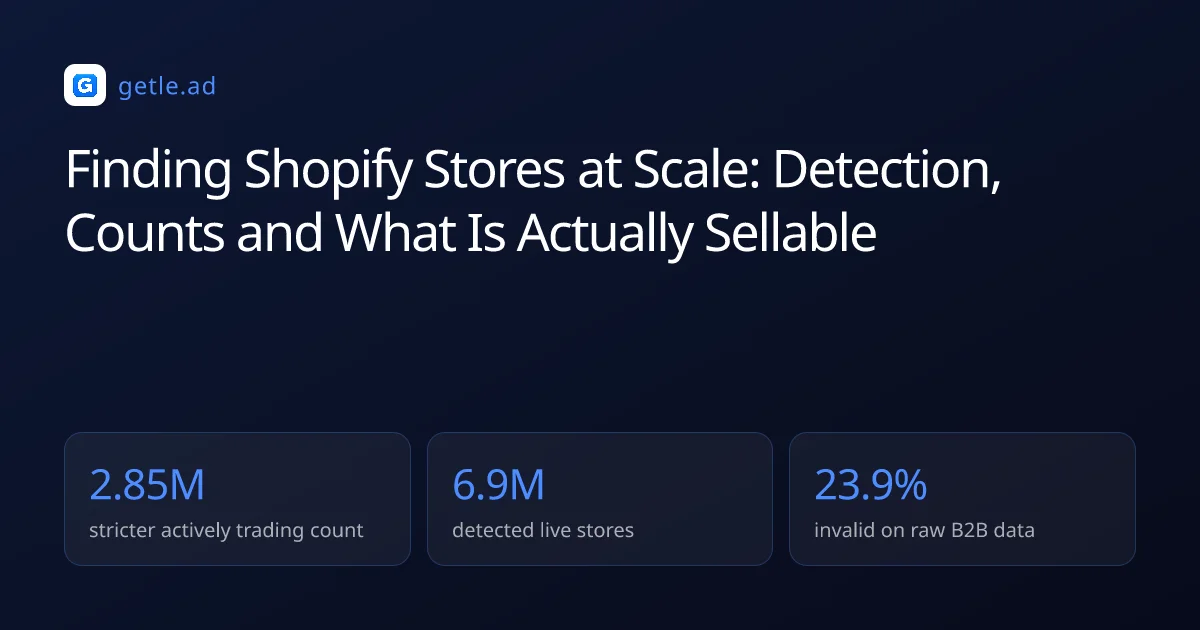
Reported 2026 tracking puts detectable live stores near 6.9 million while a stricter actively trading count sits closer to 2.85 million, with roughly 7.2 million created since launch.
For example, a list of one hundred thousand detected stores could be more than half abandoned projects, which is why store count is a vanity metric and trading signals are the real filter.
The filters that separate a business from a hobby
Almost everything worth targeting shows up in public storefront behaviour rather than in platform detection.
- Recent product or content updates, which prove somebody is still running the store.
- Product count and catalogue depth, which separate a serious operation from a test.
- Paid apps installed, which indicate willingness to spend on tooling.
- A custom domain rather than the default subdomain, which signals commitment.
- Working checkout and shipping policies, which distinguish trading from dormant.
Applying those filters cuts a raw list dramatically, and that is the point. A smaller list of trading stores outperforms a large list of abandoned ones on every metric that matters.
From store to contact
The hard step is the one scrapers rarely solve: turning a domain into a named person who can decide.
Storefront contact pages generally list role addresses such as info@ or support@, which reach a queue rather than an owner and behave poorly in cold outreach.
In our verification of 383,368 raw B2B addresses, 23.9% were invalid. Scraped ecommerce contact data is a reliable contributor, because store contact pages are updated rarely.
Where the legal line sits
Collecting public storefront information from logged out pages sits on the defensible side of the line in the US, and that position has limits worth understanding.
The hiQ holding that scraping publicly accessible data does not violate the federal computer access statute is reported as still standing, while contract and privacy claims are a separate matter entirely.
Do not log in and then collect against accepted terms, and treat personal data inside a storefront record under the same rules as any other sourced contact.
Sources and method
First-party data (Getlead, 2026): the verification split of 43.4% confirmed valid, 23.9% invalid, 16.7% catch-all and 16.0% unknown comes from 383,368 addresses analyzed through live SMTP verification, and the 0.51% bounce rate comes from 34,973 tracked sends, aggregated and anonymized at campaign level. Full method in our cold email benchmark study.
External sources: the standing of the hiQ Labs v LinkedIn holding on publicly accessible data, and the distinction between logged out public scraping and logged in access under accepted terms, come from 2026 web scraping legal analyses; US commercial email obligations come from the FTC CAN-SPAM compliance guide.
Store counts vary by tracker methodology and are estimates rather than official figures, since the platform does not publish merchant counts. Checked in August 2026.
Frequently asked questions
How many Shopify stores are there in 2026?
It depends what is counted. Reported 2026 figures put detectable live stores near 6.9 million, a stricter actively trading count near 2.85 million, and roughly 7.2 million created since launch, most no longer active.
How do you detect a Shopify store?
From public page source markers, corroborated by DNS and hosting patterns plus public app and theme signals. Detection is the easy part, which is why it is not where list quality is won or lost.
How do I filter out abandoned stores?
Use trading signals rather than platform detection: recent product or content updates, catalogue depth, paid apps installed, a custom domain rather than the default subdomain, and working checkout and shipping policies.
Why are scraped store contacts weak?
Because storefront contact pages list role addresses like info@ or support@, which reach a queue rather than an owner. They also update rarely, which is why 23.9% of raw B2B addresses were invalid in our verification.
Is scraping Shopify stores legal?
Collecting public storefront information from logged out pages is defensible in the US, where the hiQ holding on publicly accessible data is reported as still standing. Logging in and collecting against accepted terms is a different position entirely.
Is a bigger list better here?
No. An unfiltered list is mostly abandoned projects, and a smaller list of verified trading stores outperforms it on reply rate, bounce rate and every downstream metric.