ON THIS PAGE
By Efe Berke Colaker, Founder at GetleadReviewed by the Getlead editorial team for accuracy. Last updated August 2026.
Local directories are the most obvious place to build a service business list, and the most misunderstood, because they answer who exists rather than how to reach anyone.
Used properly, Yelp is a filter for which businesses are active, which is a genuinely hard question elsewhere.
What a listing actually contains
The website field is the important one, because it converts a directory row into a domain, and a domain is what every contact discovery method needs as input.
For example, a category and city search produces a list of businesses that exist, and only the website column makes it possible to find a decision maker at any of them.
The activity signal other directories lack
Business directories are full of closed companies. Review recency is a live indicator that most static directories cannot provide.
- A review in the last quarter suggests the business is trading now.
- Steady review accumulation suggests volume rather than a one off.
- Recent owner responses suggest someone is actively managing the presence.
- No activity for years is a strong exclusion signal regardless of listing status.
That last filter is worth more than it looks. Removing dormant businesses before sending cuts bounce, which is the metric that decides whether the rest of the campaign is delivered at all.
The pipeline from listing to contact
Yelp is step one of four, and treating it as the whole process is where local lead building usually fails.
- Collect listings by category and location, keeping the website field.
- Filter on review recency and volume to remove dormant businesses.
- Resolve the domain, then find a named owner or manager at that domain.
- Verify the address by SMTP before it enters a sequence.
- Suppress anything already in your CRM or on an opt-out list.
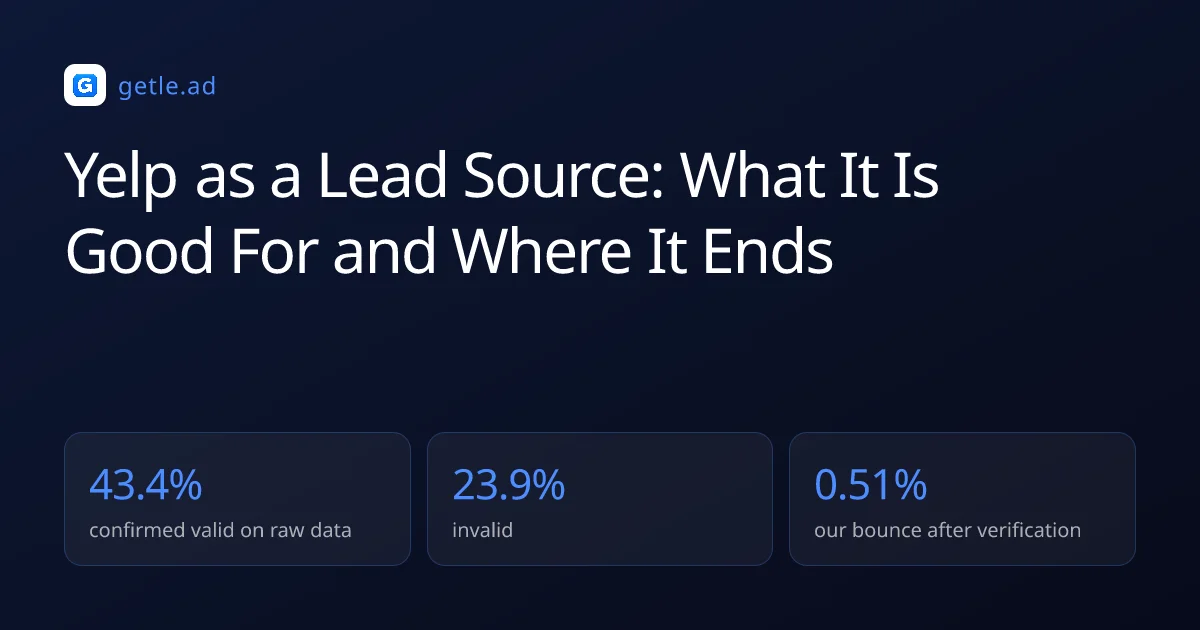
In our verification of 383,368 raw B2B addresses only 43.4% came back confirmed valid, and small local businesses sit at the weaker end of that distribution because their domains and hosting change often.
The legal position on collection
US law treats public and logged out collection very differently from access under accepted terms, and that distinction is the whole practical rule.
The hiQ holding that scraping publicly accessible data does not violate the federal computer access statute is reported as still standing in 2026, while contract, unfair competition and privacy claims remain separate exposures.
Do not create an account and collect against its terms, do not bypass technical barriers, and apply ordinary data rules to any personal information you keep.
Where this source stops being useful
Yelp coverage is uneven by category and geography, and it skews toward consumer facing businesses with a physical presence.
For B2B service providers, manufacturers or anything without walk in customers, the coverage thins fast and a proper business database is the better starting point.
The honest framing is that directory collection saves money on discovery and costs time on contact resolution, and whether that trade is good depends entirely on how much of your target segment appears there at all.
Sources and method
First-party data (Getlead, 2026): the verification split of 43.4% confirmed valid, 23.9% invalid, 16.7% catch-all and 16.0% unknown comes from 383,368 addresses analyzed through live SMTP verification, and the 0.51% bounce rate comes from 34,973 tracked sends, aggregated and anonymized at campaign level. Full method in our cold email benchmark study.
External sources: the standing of the hiQ Labs v LinkedIn holding on publicly accessible data, and the distinction between logged out public scraping and logged in access under accepted terms, come from 2026 web scraping legal analyses; US commercial email obligations come from the FTC CAN-SPAM compliance guide.
Field availability and coverage descriptions reflect public listing structure and vary by category and market. Checked in August 2026.
Frequently asked questions
Can I get email addresses from Yelp?
Rarely. Listings carry name, category, address, phone and often a website, but email is largely absent. The website field is what matters, because it converts a listing into a domain you can run contact discovery against.
What is Yelp actually good for in lead generation?
Discovery and activity filtering. Category and location coverage is strong, and review recency tells you which businesses are still trading, which most static directories cannot answer.
How do I filter out closed businesses?
Use review recency and volume. A review in the last quarter suggests current trading, steady accumulation suggests real volume, and years of silence is a strong exclusion signal regardless of listing status.
Is scraping Yelp legal?
Collecting public listing pages while logged out is the defensible position in the US, where the hiQ holding on publicly accessible data is reported as still standing. Creating an account and collecting against its terms is a different exposure, as are privacy claims.
What is the full pipeline from listing to send?
Collect listings with the website field, filter on review activity, resolve a named owner at the domain, verify by SMTP, then suppress anything already in your CRM or on an opt-out list.
When is a directory the wrong source?
For B2B service providers, manufacturers and anything without walk in customers, where coverage thins quickly. A proper business database is the better starting point when your segment barely appears in consumer directories.