ON THIS PAGE
By Efe Berke Colaker, Founder at GetleadReviewed by the Getlead editorial team for accuracy. Last updated August 2026.
Companies announce their priorities in public every time they post a role, with a date attached and no vendor in between.
That makes hiring one of the few signals a small team can use without buying anything, and it is under used because it takes slightly more work than downloading a list.
What to extract from a posting
Days open is the field most people ignore and the one that carries the most tension. A role advertised for six weeks is a problem the company already knows it has.
For example, a 120 person company with four engineering roles open, two of them for over a month, is a company with a sourcing problem it can measure. That is a far better opening than any category level observation.
Turning postings into a weekly segment
- Define the roles that indicate demand for what you sell.
- Collect postings weekly rather than monthly, since the signal expires.
- Attach each posting to a canonical company domain so it joins your existing data.
- Score by volume and days open rather than treating every posting equally.
- Resolve the owning contact, which is often the named hiring manager.
- Verify the address in the same week, then send.
The weekly cadence is what makes this cheap. The segment is small, so verification costs little, and it rebuilds itself rather than decaying like a static list.
Writing to a hiring signal without being obvious
The temptation is to open with the posting itself, which reads as automated the moment two vendors do it in the same week.
- Reference the situation rather than the URL: what they are building, not that you saw an advert.
- Lead with the consequence you can affect, not with congratulations on growth.
- Do not pitch recruiting services unless that is what you sell.
- Keep the ask answerable in one line, since hiring managers are busy by definition.
For example, saying you noticed they are expanding the ops team and asking who owns tooling decisions during that expansion is specific without being creepy. Quoting the job advert back at them is neither, and the ask should stay small enough to answer in one line.
Keeping the collection defensible
Job boards are public pages, and the safe position is the ordinary one: collect logged out, respect rate limits, store the source URL and date with each record.
Where a posting names an individual, that is personal data, so the same lawful basis and notice duties apply as with any sourced contact.
Sources and method
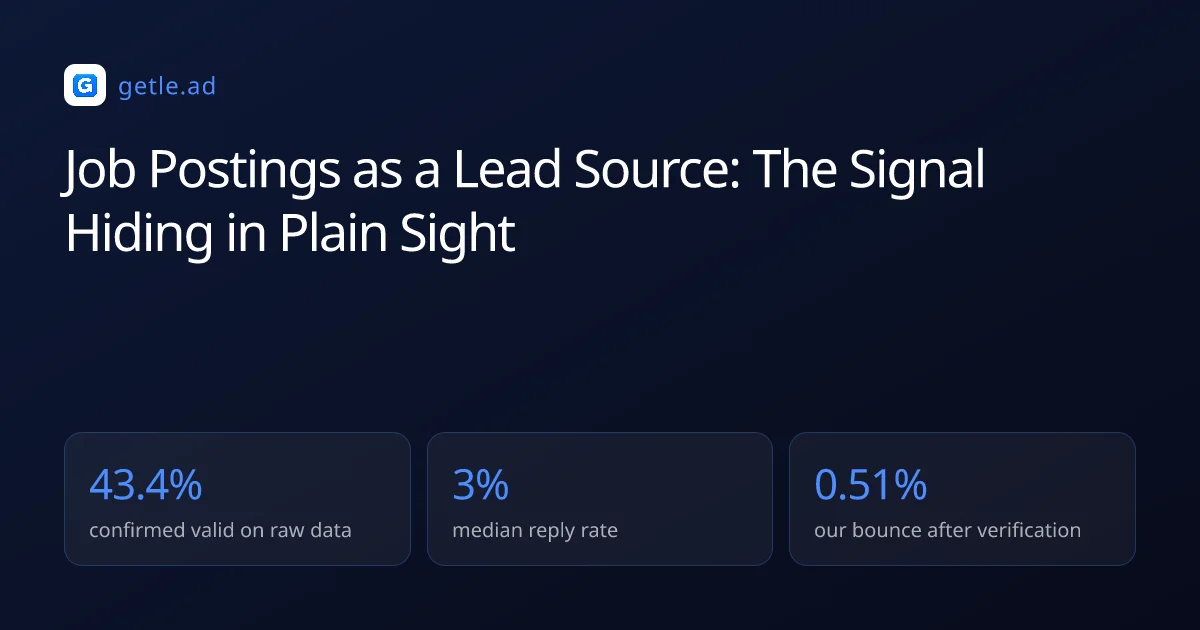
First-party data (Getlead, 2026): the verification split of 43.4% confirmed valid, 23.9% invalid, 16.7% catch-all and 16.0% unknown comes from 383,368 addresses analyzed through live SMTP verification, and the 0.51% bounce rate comes from 34,973 tracked sends, aggregated and anonymized at campaign level. Full method in our cold email benchmark study.
External sources: median B2B reply rates near 3% come from 2026 cold email benchmark compilations; the 0.3% spam complaint ceiling comes from the Google Workspace sender guidelines.
This is operational guidance rather than legal advice, and the law differs by jurisdiction and changes. Checked in August 2026.
Frequently asked questions
Why are job postings a good lead signal?
Because they are public, dated and specific. A posting states which function a company is investing in and when, without a vendor inferring it, which makes it stronger evidence than most purchased account level intent data.
What should I extract from a job posting?
Role and seniority, how many roles that department has open, how long the role has been open, location, and any named hiring contact. Days open and department volume carry the most signal.
How often should I collect postings?
Weekly. The signal expires quickly, and a weekly cadence keeps the segment small enough that verification costs little while the list rebuilds itself instead of decaying.
How do I write to a hiring signal without sounding automated?
Reference the situation rather than the advert. Mentioning that a team is expanding and asking who owns tooling during that expansion is specific, while quoting the job posting back reads as a template the moment two vendors do it.
Is scraping job boards legal?
Collecting publicly visible postings while logged out, respecting rate limits and storing the source and date is the defensible position. Where a posting names an individual, that is personal data and the usual lawful basis and notice duties apply.
Do I still need to verify these contacts?
Yes. A name in a posting is not a verified address, and in our verification of raw B2B data 23.9% of addresses were invalid, so verification in the same week you send protects both the campaign and the domain.