ON THIS PAGE
By Efe Berke Colaker, Founder at GetleadReviewed by the Getlead editorial team for accuracy. Last updated August 2026.
Directories look like lead lists and behave like phone books. They tell you a company exists, roughly what it does and where, which is genuinely useful and not the same as a lead.
Knowing which half they solve keeps the effort proportionate.
What directories actually cover well
A directory listing is an account level record: it identifies an organisation and its category, and rarely identifies a person with buying authority.
For example, a licensing register for a regulated trade is often the most complete list of operating businesses that exists anywhere, and it still gives you a company phone number rather than the owner's address.
Why the contact data is the weakest part
Listings are maintained by whoever created them, which is usually not the business. Details age without anyone noticing, and the address on file is often a shared inbox published years ago.
Expect worse than the 43.4% confirmed valid rate we measure on ordinary raw B2B data, and expect a high role address share, since directories publish info@ style contacts by convention.
Neither problem is fatal. Both mean the listing is an input to research rather than an output you can mail.
Turning a listing into a usable lead
- Import the listing as an account record keyed on the canonical domain, not the company name.
- Discard listings with no working domain, since they cannot support a business email at all.
- Resolve a named contact for the role you sell to, using a database or the company site.
- Verify the address in the week you intend to send.
- Keep the directory and the date as provenance on the record.
For small local businesses, the general contact address is sometimes the owner's real mailbox, which is the exception worth allowing rather than the rule to build on.
Collecting them without trouble
Public directory pages are the ordinary case: collect logged out, respect rate limits, store the source URL and date.
Where a listing names an individual, that is personal data with the usual duties attached, and platform directories behind an account are a terms question rather than a public data one.
Sources and method
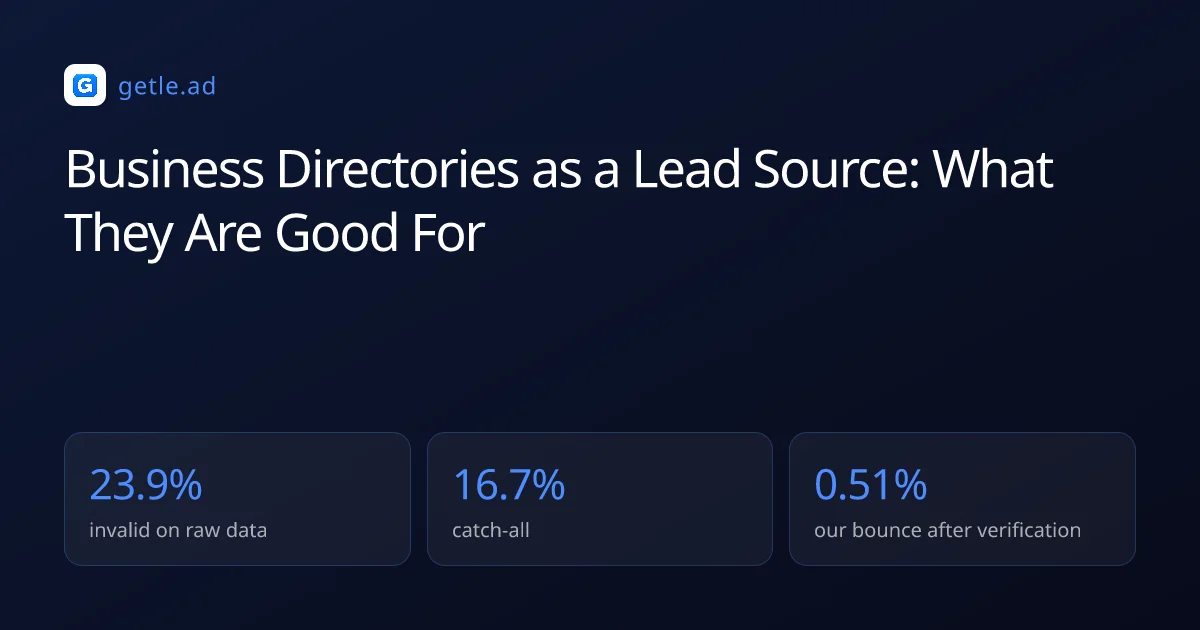
First-party data (Getlead, 2026): the verification split of 43.4% confirmed valid, 23.9% invalid, 16.7% catch-all and 16.0% unknown comes from 383,368 addresses analyzed through live SMTP verification, and the 0.51% bounce rate comes from 34,973 tracked sends, aggregated and anonymized at campaign level. Full method in our cold email benchmark study.
External sources: median B2B reply rates near 3% and the finding that roughly 42% of replies arrive from follow-ups come from 2026 cold email benchmark compilations; the 0.3% spam complaint ceiling comes from the Google Workspace sender guidelines; US commercial email obligations come from the FTC CAN-SPAM compliance guide.
Third party benchmarks vary in methodology and should be read as directional. Checked in August 2026.
Frequently asked questions
Are business directories good for lead generation?
They are good for company discovery and weak for contacts. A listing identifies an organisation and its category, which is an account record rather than a lead, since it rarely names a person with buying authority.
Which directories are most useful?
Trade and licensing registers, because for regulated trades they are often the most complete list of operating businesses in existence. Local listings help with geography, and association lists sometimes name members.
Why is directory contact data poor?
Because listings are maintained by whoever created them rather than by the business. Details age unnoticed and the published address is usually a shared inbox, so expect a lower confirmed valid rate than the 43.4% we see on ordinary raw B2B data.
How do I turn a directory listing into a lead?
Import it as an account keyed on the canonical domain, discard listings with no working domain, resolve a named contact for the role you sell to, verify the address in the week you send, and keep the directory and date as provenance.
Should I email the info@ address from a listing?
Only at very small businesses, where it is often the owner's real mailbox. At anything larger it reaches a queue, and role addresses generate complaints rather than replies while verifying perfectly.
Is collecting directory data allowed?
Public pages collected logged out, at reasonable rates, with the source and date recorded, is the ordinary defensible position. Directories behind a login are a terms of service question, and named individuals are personal data with the usual duties.