ON THIS PAGE
By Efe Berke Colaker, Founder at GetleadReviewed by the Getlead editorial team for accuracy. Last updated August 2026.
HR is one of the easiest functions to find and one of the hardest to keep current. The titles are inconsistent, the people move often, and a list built in spring is noticeably stale by autumn.
This covers the title problem first, because it decides how many people you can even see. Then the sources, then the verification cadence that keeps the list usable.
The title problem, which comes first
An HR manager is whoever owns hiring, onboarding and people operations at a company, and the title attached to that job varies enormously by size and country.
Filtering on the exact string HR Manager will return a fraction of the market. Search the role instead, then normalise what comes back into your own seniority levels.
For example, a 40 person agency usually has no HR title at all. The person who signs an HR tool is the founder or the operations lead, so searching for HR titles at that size returns almost nothing while the buyer sits one filter away.
Where HR contacts actually are
Four sources, in the order that costs least per usable contact.
- A B2B database filtered by role and headcount band, which returns sourced records with a provenance trail.
- Job postings, which name the hiring contact more often than any other public source.
- Company team pages, useful at small companies where the people function is one person.
- Industry associations and event attendee lists, where senior HR people are named.
Job postings deserve more attention than they get. A company hiring for three roles at once has an active people function, a budget, and a reason to care about anything that touches hiring, which makes the posting both a contact source and a timing signal.
If you want the segment prebuilt rather than assembled, our HR manager email list page covers the same audience with verification already applied.
Why an HR list ages faster than most
Two decay rates stack on this role. General B2B contact data decays at roughly 2.1% a month, compounding to about 22.5% a year. On top of that, HR itself is a high turnover function, with reported turnover near 15% a year among HR professionals.
For example, a 5,000 record HR list built in January will have lost a meaningful share of its recipients by summer, and the addresses that remain valid may now belong to someone who moved into the seat rather than the person you researched.
Verification recency is therefore the number that matters on this segment, not whether the list was ever verified. Check the segment in the week you send it, not the quarter you bought it.
Verify, then segment by what they own
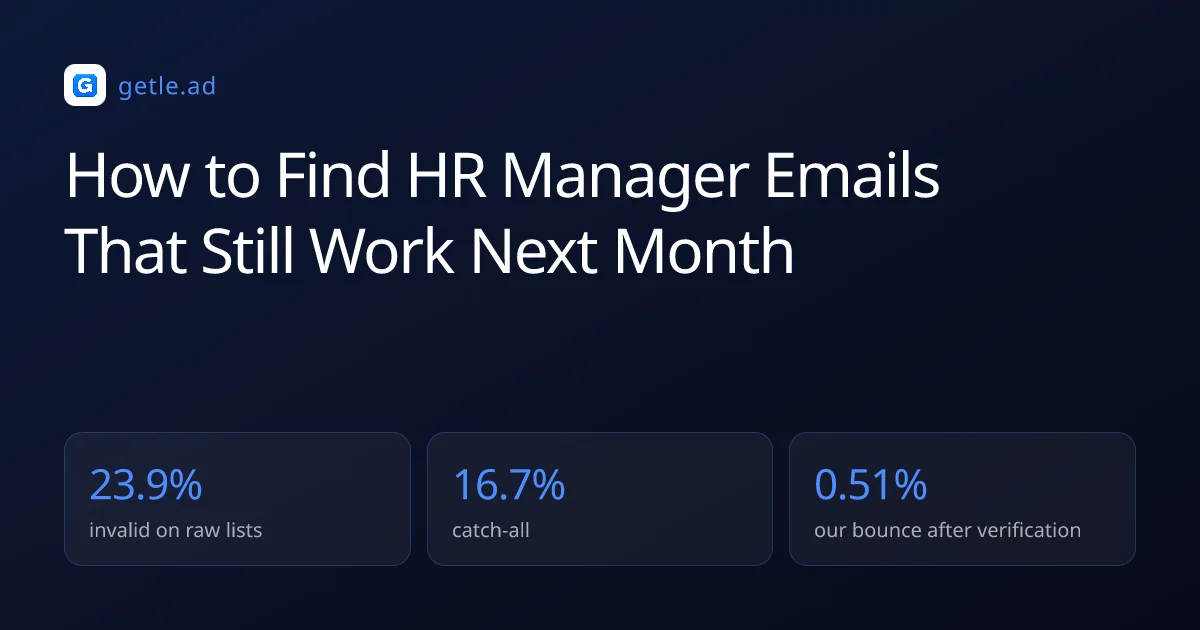
Run the segment through SMTP verification immediately before the send. Across raw B2B records we measure 23.9% invalid and 16.7% catch-all, and an HR list carries the ordinary rate plus its own churn on top.
Then split by what the person actually owns, because HR is several jobs wearing one label. Recruiting, benefits, payroll, learning and compliance rarely sit with the same person above 200 employees.
- Recruiting and talent, the segment that cares about sourcing and hiring speed.
- Benefits and compensation, which buys on cost and compliance.
- Payroll and HR operations, which buys on time saved and error rates.
- Learning and development, usually the smallest budget and the longest cycle.
Using the hiring signal instead of a static list
A static HR list decays. A signal based one refreshes itself, because the trigger is an event rather than a record.
The event worth watching is an open role. It tells you the function is active, the budget exists, and the person who posted it is accountable for filling it. None of that is knowable from a title field.
- Volume of open roles. Three or more at once usually means a hiring push rather than a replacement.
- Role type. Engineering and sales roles indicate growth, back office roles often indicate churn.
- Posting age. A role open for six weeks is a role somebody is struggling to fill.
- Repeat postings. The same title reappearing every few months points at a retention problem the buyer already knows about.
For example, a 120 person company with four engineering roles open for a month has a sourcing problem it can measure. A message that names that situation lands differently from one that offers to improve people operations in general.
Build the segment weekly rather than quarterly. The list is smaller, the verification cost is lower, and the reason for writing is current rather than inferred from a database field.
This is also the cheapest way to keep an HR segment alive without re-buying data. The trigger regenerates the audience, and verification only has to run on the small set you are actually contacting this week.
What HR actually answers
HR inboxes receive more vendor mail than almost any other function, and most of it opens the same way. The messages that get answered name a situation rather than a category.
For example, a company that posted four engineering roles this month has a sourcing problem right now, and a first line that says so reads as research. A first line about streamlining people operations reads as a template, because it is one.
Keep the ask small and the message short. Then honor opt-outs immediately, because a shared people function talks internally and a persistent sender becomes a story rather than a supplier.
Sources and method
First-party data (Getlead, 2026): the verification split of 43.4% confirmed valid, 23.9% invalid, 16.7% catch-all and 16.0% unknown comes from 383,368 addresses analyzed through live SMTP verification, and the 0.51% bounce rate comes from 34,973 tracked sends, aggregated and anonymized at campaign level. Full method in our cold email benchmark study.
External sources: contact decay of about 2.1% a month comes from the HubSpot database decay model built on MarketingSherpa research; HR turnover near 15% a year is reported in 2026 HR benchmark compilations; US commercial email obligations come from the FTC CAN-SPAM compliance guide.
Turnover figures vary by industry and methodology, so treat them as directional. Figures were checked in August 2026.
Frequently asked questions
How do I find HR manager email addresses?
Search a B2B database by role and headcount band rather than by an exact title string, then check job postings, company team pages and industry association listings. Verify every address with SMTP immediately before sending, since HR contacts churn faster than most functions.
What titles should I search for instead of HR Manager?
It depends on size. Under 50 people the owner is usually the founder or operations lead, between 50 and 200 it is an HR Manager or People Lead, above 200 it becomes Head of People or an HR Business Partner, and above 1,000 a CHRO with a specialist team.
Why do HR email lists go stale so quickly?
Two rates stack. General B2B contact data decays around 2.1% a month, compounding to roughly 22.5% a year, and HR itself reports turnover near 15% annually. A list built in January is materially different by summer.
Are job postings a good source of HR contacts?
Yes, and they are also a timing signal. A company advertising several roles at once has an active people function with budget, so the posting identifies both the contact and the moment when hiring related outreach is relevant.
Should I email info@ for HR outreach?
Only at very small companies where the shared inbox is effectively the founder's second mailbox. At larger organisations that address is a triage queue, and messages sent there generate complaints rather than replies.
How should I segment an HR list?
By what the person owns rather than by the HR label. Recruiting, benefits and compensation, payroll and HR operations, and learning and development are separate buyers above 200 employees, and each responds to a different first line.