ON THIS PAGE
By Efe Berke Colaker, Founder at GetleadReviewed by the Getlead editorial team for accuracy. Last updated August 2026.
Recruiters are unusually easy to reach and unusually hard to impress. They spend their day writing outreach, so they recognise every technique in a cold message before they finish the first line.
The sourcing problem is also different from other roles. There are two distinct markets wearing the same job title, and mixing them produces a list where half the recipients cannot buy what you are selling.
Two markets, one job title
An agency recruiter works for a staffing firm and is paid on placements, so tooling that shortens time to fill or widens candidate supply is a revenue argument rather than a cost one.
An in-house talent partner sits inside the hiring company, works to a headcount plan, and buys through HR budget with procurement involved above a certain size. Same title, different economics.
The concentration matters for how you spend effort. Around 27,000 staffing firms operate in the US across roughly 54,000 offices, yet 224 large shops account for about two thirds of industry revenue, so the long tail is where owner led decisions are quick and the head is where cycles are long.
Where recruiter addresses actually are
This is the rare role where public sources beat inference, because a recruiter who cannot be contacted cannot work.
- Job postings, which frequently name the recruiter handling the role and sometimes carry a direct address.
- Agency team pages, where boutique firms list every consultant by name and desk.
- Industry directories and association listings for staffing firms.
- A B2B database filtered by role and firm size, which returns sourced records with provenance.
For example, a 12 person agency usually publishes its whole team with named addresses, so one visit to the site yields the entire buying unit including the owner who signs off on tools.
Job postings carry a second advantage. A recruiter advertising six roles this week has active mandates and a reason to care about supply, which is a timing signal a static database cannot give you.
Verify first, because this segment moves
Recruitment has high internal churn, and agency staff move between firms frequently. Layered on top of the ordinary decay rate, that makes recruiter lists age quickly.
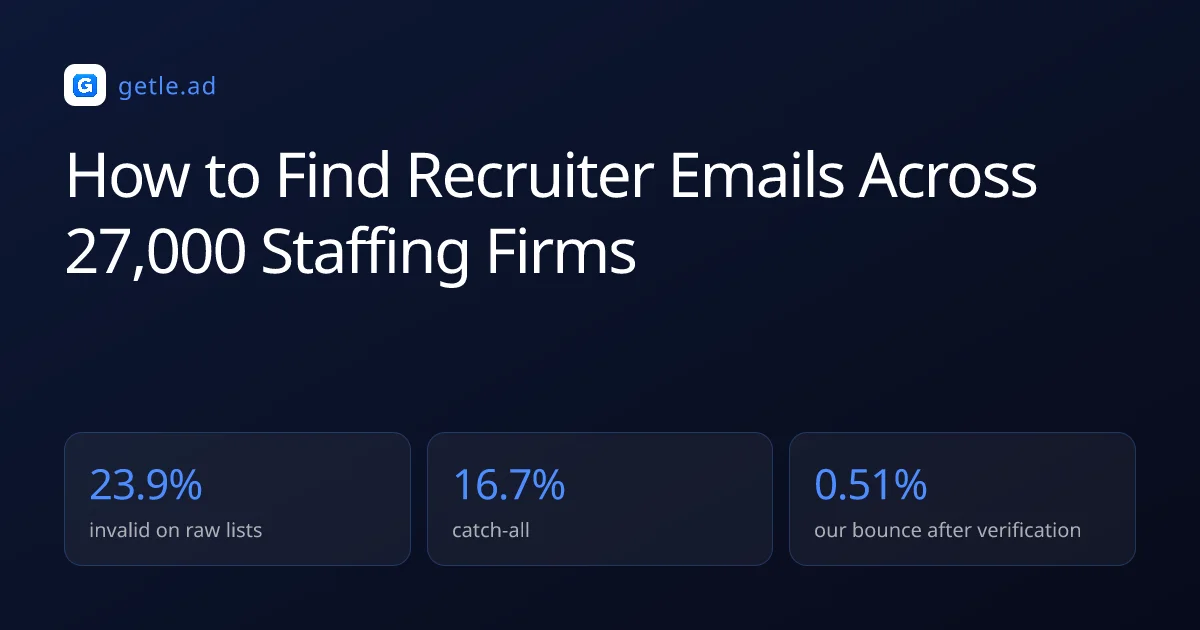
Across 383,368 raw B2B addresses we verified, 23.9% were invalid and 16.7% were catch-all. Send an unverified recruiter list and both numbers land on your sending domain at once, which is why verified sends in our data bounce at 0.51% and unverified ones do not.
Verification recency is the metric to track on this segment. A file checked in the same week you send it behaves completely differently from one checked when it was purchased.
Writing to people who write outreach for a living
Recruiters see every pattern. Merge field personalisation, false familiarity and the break up email are all techniques they use themselves, so using them signals that you are running a sequence rather than writing to a person.
For example, a message that names the three roles a firm currently has open and asks one specific question about how they source for them reads as research. A message about helping recruiters scale their outreach reads as a template, because that is what it is.
- Lead with the mandate, not with your product category.
- Keep the ask to something answerable in one line between calls.
- Skip the fake follow-up sequence language, which this audience recognises instantly.
- Be precise about which segment they are in, since agency and in-house economics differ.
The compliance detail this audience notices
Recruiters handle candidate data all day, so they are more alert than most audiences to how you got their address and whether the exit works.
Include a working one click unsubscribe and honor it immediately. US commercial email also requires accurate headers, a physical postal address and an opt-out honored within 10 business days under the FTC's CAN-SPAM rules.
If any recipients are in the EU or UK, be ready to say where the record came from, since obtaining personal data from a third party triggers a notice obligation under Article 14 of the GDPR.
Sources and method
First-party data (Getlead, 2026): the verification split of 43.4% confirmed valid, 23.9% invalid, 16.7% catch-all and 16.0% unknown comes from 383,368 addresses analyzed through live SMTP verification, and the 0.51% bounce rate comes from 34,973 tracked sends, aggregated and anonymized at campaign level. Full method in our cold email benchmark study.
External sources: US staffing market size, firm and office counts and revenue concentration come from 2026 industry compilations; commercial email obligations come from the FTC CAN-SPAM compliance guide; third party data notice duties come from Article 14 of the GDPR.
Market figures vary by source and definition of the industry, so treat them as directional. Figures were checked in August 2026.
Frequently asked questions
How do I find recruiter email addresses?
Start with job postings, which often name the recruiter handling a role, then agency team pages, industry directories and a B2B database filtered by role and firm size. Recruiters publish contact details more than most roles because being reachable is part of the job.
Should I target agency recruiters or in-house talent teams?
They are separate buyers. Agency recruiters are paid on placements, so speed and candidate supply are revenue arguments. In-house talent teams work to a headcount plan and buy through HR budget, often with procurement above a certain size.
How large is the recruiter market?
Around 27,000 staffing and recruiting firms operate in the US across roughly 54,000 offices, in a market worth about $178.9 billion in 2025. Concentration is high: 224 large shops account for roughly two thirds of industry revenue.
Why do recruiter lists go stale quickly?
Agency staff move between firms frequently, and that churn sits on top of the ordinary contact decay rate. Verify the segment in the week you send it rather than relying on a check made when the list was acquired.
What kind of message works with recruiters?
One that names a live mandate rather than a product category. This audience writes outreach for a living, so merge field personalisation and sequence language read as automation immediately, while a specific question about how they source for an open role reads as research.
What compliance details matter for recruiter outreach?
A working one click unsubscribe honored immediately, accurate headers and a physical postal address under CAN-SPAM, and readiness to say where the record came from if recipients are in the EU or UK, since Article 14 of the GDPR requires notice when data is obtained from a third party.