ON THIS PAGE
By Efe Berke Colaker, Founder at GetleadReviewed by the Getlead editorial team for accuracy. Last updated August 2026.
Founders are the most reachable senior people in B2B. They speak at events, they write, they appear in registries. And at small companies they answer their own mail because there is nobody else to answer it.
That accessibility is also the trap. Everyone else has worked out the same thing, so a founder inbox at any company doing well is a queue of identical messages. And the address you worked to find is worth nothing without something worth saying.
Below: where the addresses actually are, how patterns differ at small companies, and the question to answer before you use what you find.
Where founder addresses actually appear
Founders leave more public trace than any other executive role, because building a company requires being findable. Six sources cover most of it.
Start with the database anyway. A lookup either returns a sourced record in seconds or confirms that the manual work is necessary. And knowing which saves the twenty minutes that the other five rows take.
Open source history is the underrated one for technical founders. Commits carry the address the person configured years ago, which is often the same address they still read. And it is public by the nature of the medium.
Registries vary more than people expect
Company registry filings are a genuine source in some jurisdictions and useless in others. Several European registers publish a named officer and a contact address, while others expose only a registered office and a company number.
Check what your target market actually publishes before building a workflow around it. A method that works beautifully for one country can return nothing at all across the border. And discovering that after building the process is an expensive way to learn it.
Provenance is the record of where a contact detail came from, which decides both data quality and what you can tell the person if they ask.
Why small company patterns are different
Naming conventions exist to resolve collisions. A four person company has no collisions, so it uses the shortest thing that works: the first name.
- Under 20 people. first@ is most likely, then first.last. A founder often also reads hello@ or info@.
- 20 to 200. first.last becomes standard as the company hires people with shared first names.
- Above 200. first.last or flast, and the founder is increasingly filtered by an assistant or a rule.
- Any size. A personal domain address, for founders who kept their own domain from a previous project.
The general contact address is worth a second look at this size. At a company of five, hello@ is not a shared inbox in any meaningful sense, it is the founder's second mailbox. And the usual advice to avoid role addresses does not apply.
The personal domain case is easy to miss and easy to check. Founders who have shipped more than one thing frequently keep a domain of their own. And that address is often the one they actually read.
A naming convention is the rule a company applies when it creates mailboxes. And it is consistent across the whole domain, which is why one confirmed address answers the question for every employee.
For example, a four person company will almost always use first name alone. So confirming anna@example.com tells you the founder is reachable at their own first name rather than at a first.last pattern that would only exist if collisions had forced it.
Verify, particularly at small companies
Small company data decays in a way large company data does not. Companies close, people move on, and a founder can stop being reachable at their own domain within weeks of a decision nobody announced.
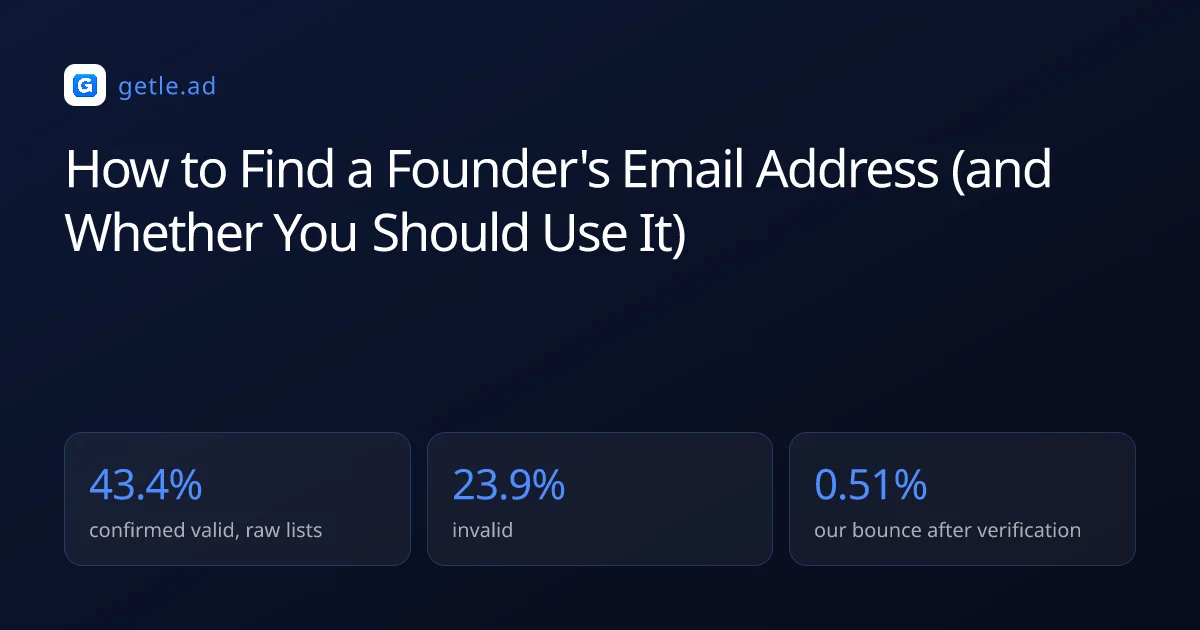
Across 383,368 raw B2B addresses we verified, 23.9% were invalid outright. On founder lists assembled from older public sources the share is often worse, because the sources themselves are static and the companies are not.
Run the check immediately before sending rather than at import. Verified sends in our data bounce at 0.51%, against a roughly 3% level where sender reputation suffers. And that margin is what a founder campaign needs when every address is at a company with no IT department to keep the domain tidy.
Verification recency is how long ago an address was last checked, and it matters more than whether the list was ever verified at all.
The question to answer before you use the address
Founders receive more cold email than any other role. And they read it with a specific filter: does this person know anything about my company, or did they find my email.
That is the whole test. A message that could have been sent to two hundred founders will be read as one of two hundred. And the effort spent finding the address is wasted at the moment the first line lands generically.
- Name the specific situation you are writing about, not the industry.
- Reference something that changed recently: a hire, a launch, a market they entered.
- Make the ask small enough to answer in one line while walking between meetings.
- Say why them rather than anyone else at the company, since founders delegate fast when the answer is obvious.
- Keep it short. A founder skims, and length reads as work rather than as value.
The fourth point saves the most time on both sides. If the right recipient is actually the head of operations, writing to the founder buys a forward at best. And a founder who forwards your email has decided you did not know the company well enough to route it yourself.
Why founders reply to some cold email
The ones that get answered usually share a shape. They are short, they contain one specific observation that could only apply to that company. And they ask for something small enough that saying yes costs nothing.
None of that requires flattery or research theatre. Naming the actual situation, in one sentence, does more than a paragraph explaining how much you admire the company. And it takes a fraction of the time to write.
When the founder is the wrong target
Reachability is not the same as relevance, and the founder is frequently the wrong door even when they are the easiest one to find.
The last item on the right is the common waste. Teams find a founder address, get excited, and mail it while a perfectly good head of department sits in the same database with a role that matches what they sell.
Used well, founder outreach is the highest ceiling segment in B2B. Because one reply can move a decision that would take three months through a committee. Used as a shortcut around targeting, it is the fastest way to burn a list of people who talk to each other.
Sources and method
First-party data (Getlead, 2026): the verification split of 43.4% confirmed valid, 23.9% invalid, 16.7% catch-all and 16.0% unknown comes from 383,368 addresses analyzed through live SMTP verification. And the 0.51% bounce rate comes from 34,973 tracked sends, aggregated and anonymized at campaign level. Full method in our cold email benchmark study.
External sources: contact decay of about 2.1% a month comes from the HubSpot database decay model built on MarketingSherpa research; where records are obtained from third parties rather than the person, Article 14 of the GDPR sets out what you have to tell them.
US commercial email obligations, including accurate headers, a physical postal address and a working opt-out honored within 10 business days, come from the FTC CAN-SPAM compliance guide.
Figures were checked in August 2026.
Frequently asked questions
How do I find a founder's email address?
Look them up in a B2B database first, then check company registry filings, conference and podcast pages, open source commit history, their personal site or newsletter, and investor or accelerator pages. Founders publish more contact detail than any other executive role.
What email format do founders usually use?
At companies under 20 people, first name alone is most common because there are no collisions to resolve. Between 20 and 200 the convention shifts to first.last, and above 200 it is usually first.last or flast with more filtering in between.
Is it worth emailing info@ at a small company?
Yes, at a company of about five people that address is effectively the founder's second mailbox rather than a shared queue. The usual advice to avoid role addresses applies to larger companies where the inbox is triaged by people without buying authority.
Why do founder lists bounce more?
Small company data decays faster. Companies close, people move on, and domains lapse without an IT department to maintain them. Across raw B2B records we verified, 23.9% were invalid, and founder lists built from older public sources are frequently worse.
Should I always target the founder?
No. At companies above roughly 30 people there is usually a named owner for the function you serve. And a founder who forwards your message has concluded you did not know the company well enough to route it yourself. Reachability is not relevance.
What makes founder outreach work?
Specificity. Founders read cold email with one filter: does this person know anything about my company, or did they just find my address. Reference a recent change, make the ask answerable in one line, and explain why them rather than anyone else.