ON THIS PAGE
By Efe Berke Colaker, Founder at GetleadReviewed by the Getlead editorial team for accuracy. Last updated August 2026.
Nobody wants to make it easy to leave. Every opt-out looks like a lost prospect, so the link goes small, grey and to the bottom. And half the time it is a plain sentence asking people to reply if they want out.
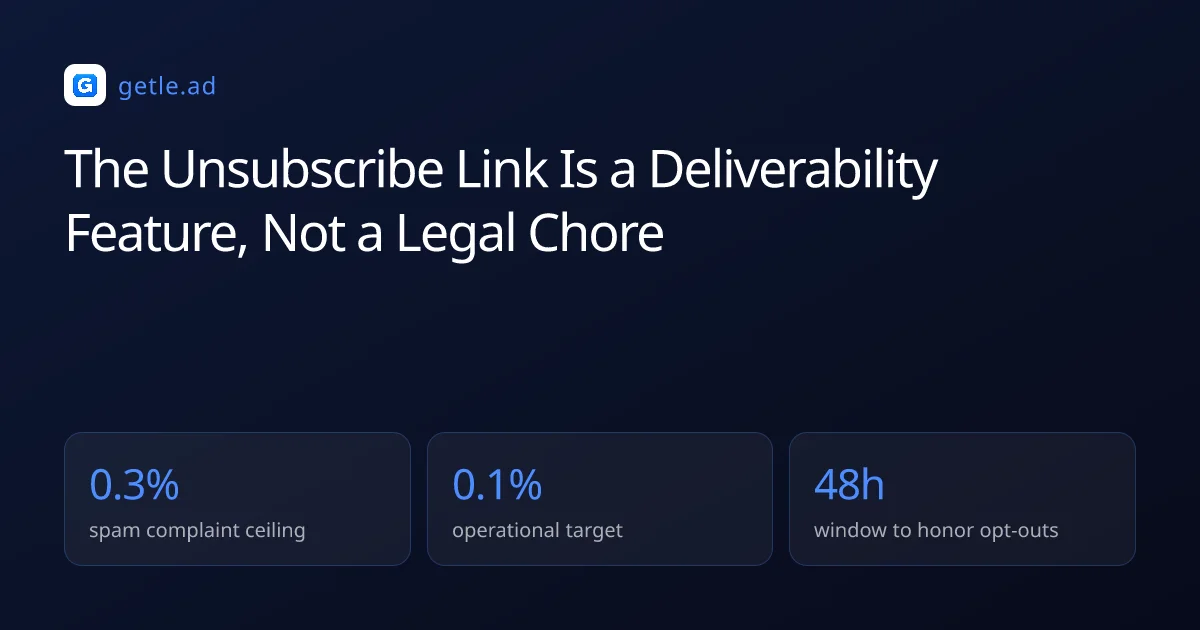
That instinct is expensive, and the arithmetic is not close. An opt-out costs you one contact who was never going to buy. A spam complaint costs delivery to every other recipient at that mailbox provider, and the ceiling is three complaints per thousand delivered messages.
This covers what the rules actually require, the difference between the header and the link. And how to run suppression so an opt-out stays opted out. The complaint ceiling behind all of it is three complaints per thousand delivered messages.
Two mechanisms, and only one of them is checked
There are two ways to offer an unsubscribe and they serve different audiences. The visible link in the message body is for the reader. The List-Unsubscribe header is for the mailbox provider, and it is the one that shows up in compliance checks.
Gmail reads that header and renders a native unsubscribe control at the top of the message, next to the sender name. That placement is deliberate: it puts a one click exit directly beside the spam button. So an irritated recipient has a cheaper option than reporting you.
One click unsubscribe is specified in RFC 8058, which requires the request to complete without further interaction. A header that leads to a preference centre asking the recipient to log in does not satisfy it, and providers can tell the difference.
Publish both. The header satisfies the provider requirement and gives one click removal. And the visible line gives the reader an obvious answer when they scan for it. Neither is a substitute for the other.
One click unsubscribe is a header based mechanism that removes a recipient in a single action, without a login or a preference centre. And it is the part mailbox providers actually check.
For example, on a 2,000 message campaign, fifty opt-outs remove fifty people who were never going to buy. While the six complaints that hiding the link would have produced put the domain at the published ceiling.
What the rules actually require
The two timing rules are not in conflict, they are different floors. CAN-SPAM allows 10 business days as an outer limit, provider guidance expects 48 hours. And the only sane implementation is immediate suppression at the moment the request arrives.
The postal address requirement catches people out because it feels dated. It is still in force, it applies to commercial email including cold outbound, and a registered office or a mailbox address satisfies it.
Under GDPR the emphasis shifts
In the EU and UK, B2B outreach usually relies on legitimate interest rather than consent. And legitimate interest comes with an unconditional right to object. In practice that means the opt-out has to work immediately, and you should also be ready to say where the data came from.
The arithmetic that settles the argument
Teams hide the unsubscribe because opt-outs are visible and complaints are not. Both happen, but only one of them appears in a dashboard, so the invisible one gets ignored until placement collapses.
For example, run the numbers on a 2,000 message campaign. Five or six complaints puts the domain at the published ceiling. Fifty opt-outs, on the other hand, cost you fifty records that were never going to convert and improve every subsequent metric by removing them.
There is a second order effect too. Opt-outs are a free targeting signal: a segment producing a much higher opt-out rate than the others is telling you the audience definition is wrong, well before the complaint rate makes that expensive.
And unlike complaints, opt-outs are visible in your own data immediately. You can act on them this week rather than discovering the problem in Postmaster Tools a month later.
What a healthy opt-out rate looks like
There is no published threshold for opt-outs the way there is for complaints, because providers do not penalise them. Use them internally instead: a segment where opt-outs climb well above your usual level is mistargeted, and the copy is rarely the reason.
Watch the ratio between opt-outs and complaints as well. A high opt-out rate with almost no complaints means the exit is working as designed. Few opt-outs and rising complaints means people cannot find the exit and are using the spam button instead.
Suppression: the part that actually fails
Publishing the header is easy. Making sure the person never hears from you again is where implementations break, usually in one of four ways.
- Campaign scoped suppression. The opt-out is recorded against one campaign, so the next sequence from another rep reaches the same person.
- Import scoped suppression. Suppression is applied when a list is loaded rather than when the message is sent, so anyone who opts out mid campaign still gets the follow-ups.
- Per mailbox suppression. In a rotation setup, the opt-out lands on one sender and the other seven never learn about it.
- Address level only. The person opts out, then appears again from a second address at the same company, and nothing connects them.
The fix for the first three is the same: one global suppression list, applied at send time, shared across every mailbox and campaign. Anything narrower is a rule that works until the day it embarrasses you.
The fourth needs a judgement call. A person who asks to be removed usually means themselves, not their whole company. But a company that has asked twice from two addresses is telling you something about the account. Suppressing at domain level after repeat requests is the polite reading.
Keep customers, open opportunities and current conversations in the same suppression list. The worst outbound failure mode is not a complaint, it is a cold pitch arriving at a customer who already pays you.
Writing the opt-out so it reads like a person wrote it
Cold outbound reads as a one to one message, and a marketing footer breaks that illusion faster than anything else in the body. The line should sound like the rest of the email.
- Keep it to one short sentence at the end, with no separator graphics or legal styling.
- Offer a real choice rather than a threat, for example that a reply saying no will end it.
- Ship the List-Unsubscribe header regardless of how the visible line is worded.
- Include the postal address in a single plain line, not a formatted block.
- Never route the visible link through a tracking domain that has no sending reputation.
That last point is a genuine deliverability trap. A freshly registered link domain in a cold message inherits none of your reputation and plenty of suspicion. And unsubscribe links are exactly where filters look for it.
Handling replies that say stop is part of the same job. Many recipients will answer the email rather than use the header. So a message asking to be removed has to trigger suppression whether it arrives as a click or as a sentence.
Reply based opt-outs need automation too
In cold outbound most removal requests arrive as a reply rather than a click, often one word long. If that path is manual, someone eventually misses one and the sequence keeps running, which converts a polite request into a complaint.
Scan incoming replies for the obvious phrases, suppress on match, and route the message to a human anyway so nothing gets closed silently. The automation is there to guarantee the suppression, not to end the conversation.
Sources and method
First-party data (Getlead, 2026): the verification split of 43.4% confirmed valid, 23.9% invalid, 16.7% catch-all and 16.0% unknown comes from 383,368 addresses analyzed through live SMTP verification. And the 0.51% bounce rate comes from 34,973 tracked sends, aggregated and anonymized at campaign level. Full method in our cold email benchmark study.
External sources: one click unsubscribe is specified in RFC 8058; the requirement to offer it and honor requests within 48 hours, along with the 0.3% spam complaint ceiling, comes from the Google Workspace sender guidelines, 2026; the 10 business day rule, postal address and header accuracy requirements come from the FTC CAN-SPAM compliance guide.
This is not legal advice. Rules vary by jurisdiction and change, and figures were checked in August 2026.
Frequently asked questions
Do cold emails need an unsubscribe link?
Yes. CAN-SPAM requires a working opt-out in every commercial message. And bulk sender requirements from the major providers require one click unsubscribe under RFC 8058 for marketing mail. Beyond compliance it is a deliverability feature, because it gives annoyed recipients an alternative to the spam button.
What is one click unsubscribe?
A List-Unsubscribe header that lets a recipient opt out in a single action, without logging in or completing a form. Gmail renders it as a native control at the top of the message. A footer link alone does not satisfy the requirement, because providers check the header.
How fast do I have to honor an unsubscribe request?
Provider guidance expects requests to be honored within 48 hours, while CAN-SPAM allows up to 10 business days. Treat immediate suppression as the policy, since both rules are outer limits rather than targets and delay produces complaints.
Does an unsubscribe hurt my campaign?
It removes one contact who was not going to convert. A spam complaint instead damages delivery to every other recipient at that provider, with a ceiling of 0.3% of delivered messages. Making the opt-out easy is the cheaper of the two outcomes by a wide margin.
Where should the suppression list live?
One global list, applied at send time, shared across every campaign, mailbox and sending domain. Campaign scoped or import time suppression lets an opt-out reappear in the next sequence. That is the most common way teams break their own compliance.
Do I need a physical address in a cold email?
Yes, under CAN-SPAM every commercial message must include a valid physical postal address. A registered office or a mailbox address satisfies it, and one plain line at the end of the message is enough.