ON THIS PAGE
By Efe Berke Colaker, Founder at GetleadReviewed by the Getlead editorial team for accuracy. Last updated August 2026.
A campaign goes out to a mixed list. The Gmail recipients reply at a normal rate and the Outlook recipients reply at nearly zero. Nothing about the message changed between them, and the tool reports the same successful delivery for both.
That is not a mystery, it is two independent filtering systems reaching different conclusions from the same evidence. They weigh different signals, they publish different tooling, and they fail in different ways.
Knowing which is which turns a vague deliverability problem into a specific one, and specific problems have fixes.
The baseline they agree on
Start with what is identical, because meeting it is not optional at either provider and most problems below the baseline are self inflicted.
- SPF, DKIM and DMARC published and aligned for domains sending at volume.
- One click unsubscribe under RFC 8058 on marketing mail, honored quickly.
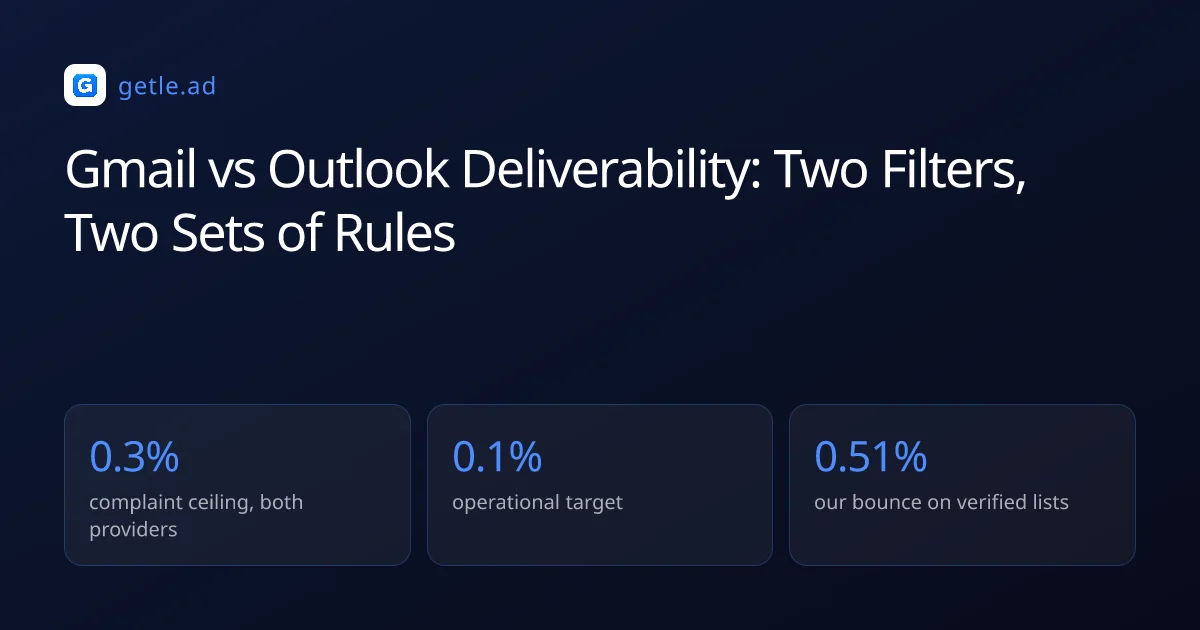
- A spam complaint rate under 0.3%, with 0.1% as the level to operate at.
- Valid reverse DNS and a sending domain that resolves to something real.
- Consistent sending patterns rather than sudden volume spikes.
Microsoft aligned with Google and Yahoo in May 2025, returning a permanent 550 5.7.515 rejection for non compliant bulk senders. Before that there was a soft target for badly configured mail, and now there is not.
Sender reputation is each provider's private running assessment of your domain, computed from complaints, bounces, authentication and engagement.
Where the two filters diverge
The engagement bias at Gmail is the most useful thing to understand. A mailbox whose messages are opened and answered gets room that a silent one does not. That is exactly why warm-up traffic works and why a quiet campaign week can quietly degrade placement.
Microsoft's tooling is more IP oriented, which matters if you send from dedicated infrastructure and matters less on a shared sending platform where the IP belongs to the vendor. In the shared case your domain reputation is the lever you actually control.
Business mailboxes filter differently again
A Google Workspace or Microsoft 365 mailbox sits behind organisational policy as well as the provider's own filtering. Administrators add rules, third party security gateways sit in front. And a message that reaches a personal Gmail account can be quarantined at a company on the same underlying platform. Splitting a fleet across both platforms hedges that, which is why pre-warmed mailboxes are normally sold on Google Workspace and Microsoft 365 rather than on one of them.
Why the engagement bias matters so much
Cold email is structurally bad at producing engagement. Most recipients never open, few reply, and nobody rescues a message from spam on your behalf. That is a weak signal profile at a provider that weighs engagement above almost everything else.
It explains two things at once. It is why warm-up traffic, which is nothing but engagement, has such a disproportionate effect on placement. And it is why tightly targeted segments outperform large ones by more than their reply rate alone would suggest: the engagement they generate feeds back into placement for everything else you send.
Placement is where an accepted message ends up, meaning the primary inbox, a tab, or the spam folder. And it is decided independently by each provider after delivery succeeds.
For example, a 2,000 message campaign returning 18 replies can split into 16 replies from 900 Gmail recipients and 2 from 1,100 Microsoft ones. That turns an apparent copy problem into a Microsoft placement problem.
Diagnosing them separately
Aggregate numbers are the enemy here. Split every metric by recipient provider and the picture usually resolves in minutes.
- Split your list by recipient domain family: Gmail and Workspace, Microsoft and Outlook, everything else.
- Compare reply rate per thousand delivered for each group, not open rate.
- Check Postmaster Tools for the Gmail side and SNDS for the Microsoft side.
- Seed test with real accounts at both, including one business mailbox on each platform.
- Compare bounce rates per group, since a provider specific bounce spike points at data rather than filtering.
Open rate is the metric to avoid in this comparison. Privacy features fetch images automatically at different rates across providers, so an open rate difference between Gmail and Outlook can be entirely an artifact. Our tracked sends average 35.8% opens overall, a number that moves for reasons unrelated to interest.
Replies per thousand delivered is the honest comparison. It is provider agnostic, it cannot be inflated by image fetching, and a gap between two groups is real signal rather than measurement noise.
A worked split
For example, take a 2,000 message campaign that returned 18 replies. Split by provider and you might find 16 of them came from 900 Gmail recipients and 2 from 1,100 Microsoft ones. The aggregate reply rate of 0.9% looks like a copy problem. The split shows a Microsoft placement problem and a perfectly healthy Gmail campaign.
Without the split, the next action is rewriting the message, which changes nothing because the message was never the issue. With it, the next action is checking SNDS and reducing volume to Microsoft recipients while the reputation recovers.
Reply rate per thousand delivered is the provider agnostic measure of whether messages are reaching people, unlike open rate which privacy features inflate.
What to do when one of them is failing
The fixes differ because the causes differ, so treat a Gmail problem and a Microsoft problem as separate projects.
The volume point is worth emphasising because the instinct is so common. When replies fall, sending more is the natural response and the wrong one: it increases exposure at the provider that is already unhappy, and at Microsoft it accelerates throttling into rejection.
The composition angle nobody checks
Before blaming a filter, look at what the list is made of. B2B lists skew toward business mailboxes on both platforms, and the mix determines which filter you are mostly being judged by.
A list that is 70% Microsoft 365 recipients is effectively a Microsoft deliverability problem regardless of what Gmail thinks. And optimising for engagement signals will not move it. Knowing the mix tells you which tooling to register for first.
The mix also changes what a bounce means. In our verification data 23.9% of raw records are invalid. And those invalid records are not evenly distributed: some industries and regions skew heavily toward one platform. So a provider specific bounce spike is often a data sourcing signal.
Track the split as a standing metric rather than checking it during incidents. It changes slowly as your targeting changes, and knowing it in advance means the first question during an incident is already answered.
Sources and method
First-party data (Getlead, 2026): the verification split of 43.4% confirmed valid, 23.9% invalid, 16.7% catch-all and 16.0% unknown comes from 383,368 addresses analyzed through live SMTP verification. And the 0.51% bounce rate and 35.8% open rate come from 34,973 tracked sends, aggregated and anonymized at campaign level. Full method in our cold email benchmark study.
External sources: authentication requirements, the 0.3% spam complaint ceiling and the reputation reporting available to senders come from the Google Workspace sender guidelines and Postmaster Tools, 2026; Microsoft enforcement with error 550 5.7.515 dates from May 2025; one click unsubscribe is specified in RFC 8058.
US commercial email obligations, including accurate headers, a physical postal address and a working opt-out honored within 10 business days, come from the FTC CAN-SPAM compliance guide.
Provider behaviour changes without notice. Figures were checked in August 2026.
Frequently asked questions
Why does my email land in Gmail but not Outlook?
Because the two providers score reputation independently and weigh different signals. Gmail leans heavily on engagement such as opens, replies and messages rescued from spam. While Microsoft leans more on complaints and infrastructure signals including IP reputation.
Do Gmail and Outlook have the same sender requirements?
The baseline is the same: SPF, DKIM and DMARC at volume, one click unsubscribe, and a spam complaint rate under 0.3%. Microsoft aligned with Google and Yahoo in May 2025 and rejects non compliant bulk mail with error 550 5.7.515.
How do I check my reputation at each provider?
Google Postmaster Tools covers Gmail traffic and Microsoft SNDS covers Outlook traffic. Both are free, and they are the only place complaint rate is visible, since that signal never reaches your sending tool.
Should I compare open rates between Gmail and Outlook?
No. Privacy features fetch images automatically at different rates across providers, so open rate differences between them are often measurement artifacts. Compare replies per thousand delivered, which cannot be inflated the same way.
Does business email filter differently from personal?
Yes. A Google Workspace or Microsoft 365 mailbox sits behind organisational policy and often a third party security gateway as well. So a message that reaches a personal account at the same provider can still be quarantined at a company.
What should I do when Microsoft placement drops?
Reduce volume and pace first, then check SNDS status, reverse DNS and whether the sending IP is listed. Microsoft failures tend to progress from throttling to hard rejection, so sending more during a decline accelerates the problem.