ON THIS PAGE
By Efe Berke Colaker, Founder at GetleadReviewed by the Getlead editorial team for accuracy. Last updated August 2026.
Ask three people what a lead is and you get three answers: a form fill, a name on a list, a company that looks like a customer. All three are counted in reports and only one produces revenue.
A definition is worth agreeing because it changes what you buy and what you measure.
The three conditions
A sales lead is a named individual at an account that fits your profile, reachable through a verified contact route, with a plausible reason to have the conversation.
For example, a 60 person agency with an unnamed contact at hello@ fails the first test even if the company is a perfect fit. The record describes an account, not a lead.
Where counted leads actually fail
Contactability is the quiet one, because a record looks complete until a mail server disagrees.
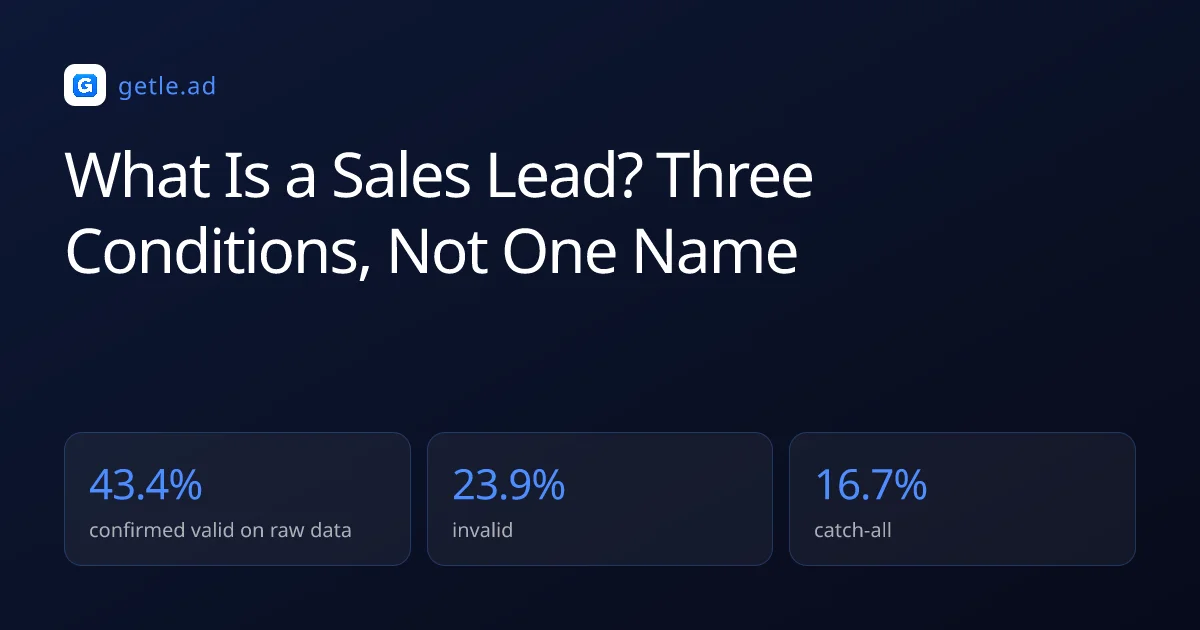
Across 383,368 raw B2B addresses we verified, 23.9% were invalid and 16.7% were catch-all, so 40.7% of a raw list cannot be confirmed as reachable before anything is sent.
That is why lead counts and pipeline rarely move together. A team reporting 4,000 leads may hold 2,400 reachable ones, and the gap shows up two steps later as a bounce rate nobody predicted.
The types worth distinguishing
- Inbound lead. Took an action on your properties, so intent is present and fit still needs checking.
- Outbound lead. You selected them, so fit is high by construction and intent is unknown.
- Referral. Trust arrives with the introduction, which shortens everything.
- Reactivated. A prior contact worth re-checking, since data decays about 2% a month.
Keeping the source on the record matters more than the label. A single conversion rate across all four hides which motion is working.
Sources and method
First-party data (Getlead, 2026): the verification split of 43.4% confirmed valid, 23.9% invalid, 16.7% catch-all and 16.0% unknown comes from 383,368 addresses analyzed through live SMTP verification, and the 0.51% bounce rate comes from 34,973 tracked sends, aggregated and anonymized at campaign level. Full method in our cold email benchmark study.
External sources: contact decay of about 2.1% a month compounding to 22.5% a year comes from the HubSpot database decay model built on MarketingSherpa research; US commercial email obligations come from the FTC CAN-SPAM compliance guide.
Figures were checked in August 2026 and third party benchmarks vary in methodology.
Frequently asked questions
What is a sales lead?
A named individual at an account that fits your profile, reachable through a verified contact route, with a plausible reason to have the conversation. Missing any of the three means the record cannot produce a conversation regardless of how it is counted.
Is a company name a lead?
No, that is an account. A lead requires a named person, because a company cannot reply to an email and a shared inbox reaches a queue rather than someone with authority.
Why do lead counts not match pipeline?
Usually contactability. In our verification of 383,368 raw B2B addresses, 23.9% were invalid and 16.7% catch-all, so about 40.7% of a raw list is unreachable or unconfirmable before a single message is sent.
What is the difference between a lead and a prospect?
Usage varies, but the useful distinction is qualification. A lead meets the three basic conditions, while a prospect has been assessed against need, timing and authority in an actual conversation.
Do leads expire?
Yes. Contact data decays around 2.1% a month, compounding to roughly 22.5% a year, and interest signals expire much faster than that. Both make lead generation a flow to maintain rather than a stock to accumulate.
Should inbound and outbound leads be counted together?
Only at the opportunity stage. Before that they differ in what is known: inbound arrives with intent and unverified fit, outbound with verified fit and unknown intent, so a shared conversion rate hides which motion is working.