ON THIS PAGE
By Efe Berke Colaker, Founder at GetleadReviewed by the Getlead editorial team for accuracy. Last updated August 2026.
Outbound sales is often described as a channel. It is closer to a business model choice, because it changes what you have to be good at.
Inbound rewards being findable. Outbound rewards being precise about who you contact and disciplined about how you reach them.
The definition and what it commits you to
Outbound sales is any go to market motion in which the seller initiates the first contact with a prospect who has taken no prior action.
That single property has consequences. You choose the accounts, so targeting quality is entirely yours. You interrupt, so relevance is the price of attention. And you send, so deliverability becomes an operational discipline rather than a vendor's problem.
For example, a company entering a new market can have outbound conversations within three weeks of deciding to, once domains are warm. The inbound equivalent takes quarters, which is why the two are complements rather than alternatives.
The arithmetic that decides feasibility
Work backwards from meetings and the model either closes or does not.
- Decide the meetings needed per month.
- Divide by the share of positive replies that become calls, roughly a third.
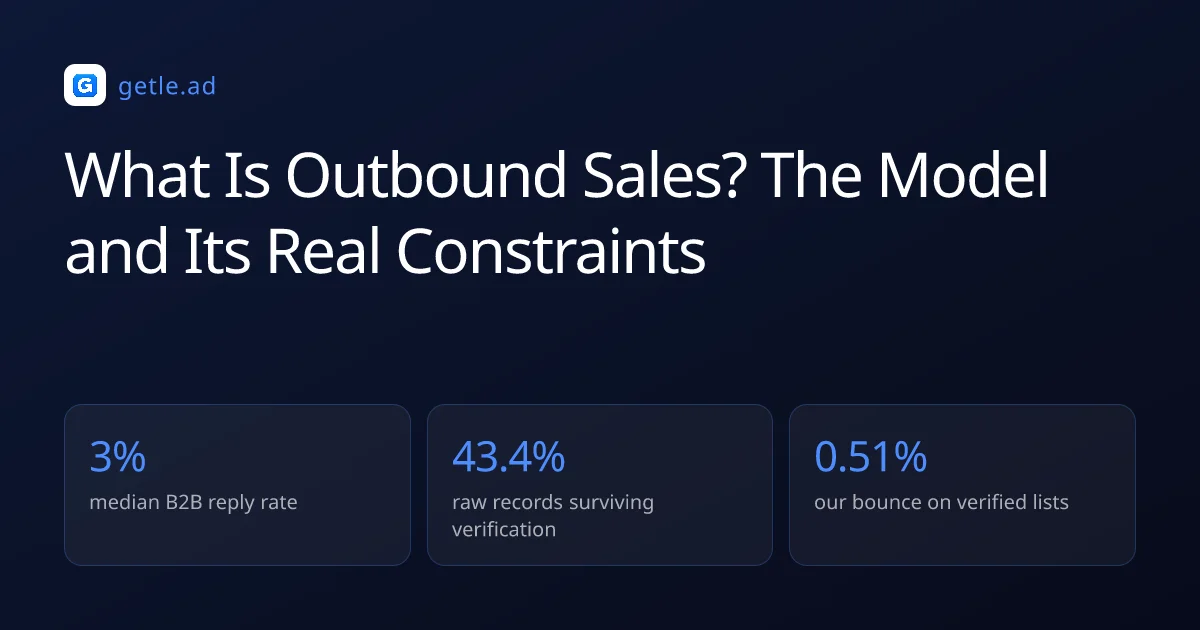
- Divide by the reply rate, near 3% at median.
- Divide by your confirmed valid rate to get raw records to source.
For example, eight meetings a month needs about 24 replies, therefore about 800 contacts reached, therefore about 1,900 raw records at the 43.4% confirmed valid rate we measure. If your market has fewer accounts than that, outbound alone will not carry the number.
How outbound fails, in order
- Unverified data. 40.7% of raw records are dead or unconfirmable in our verification, and sending to them burns the domain.
- Missing infrastructure. No authentication, no separate sending domain, no warm-up.
- Broad targeting. Complaints track relevance, and the ceiling is 0.3% of delivered messages.
- Copy. Real but last, and rarely the binding constraint.
The ordering matters because effort flows the other way by default. Teams rewrite subject lines while the list quietly damages placement for everything they send.
If the arithmetic works but the headcount does not, the other route is to have someone else run the motion, and then the contract matters more than the tactics, because a cold email lead generation agency that keeps the domains and mailboxes in its own account leaves you with nothing to keep when the engagement ends.
Sources and method
First-party data (Getlead, 2026): the verification split of 43.4% confirmed valid, 23.9% invalid, 16.7% catch-all and 16.0% unknown comes from 383,368 addresses analyzed through live SMTP verification, and the 0.51% bounce rate comes from 34,973 tracked sends, aggregated and anonymized at campaign level. Full method in our cold email benchmark study.
External sources: US commercial email obligations come from the FTC CAN-SPAM compliance guide; the 0.3% spam complaint ceiling and authentication requirements come from the Google Workspace sender guidelines.
Figures were checked in August 2026 and third party benchmarks vary in methodology.
Frequently asked questions
What is outbound sales?
Any go to market motion where the seller initiates the first contact with a prospect who has taken no prior action. That property makes targeting quality entirely yours and turns deliverability into an operational discipline.
How is outbound different from inbound?
Who starts. Outbound gives control over timing and targeting at the cost of data spend and deliverability risk. Inbound depends on being findable and takes quarters to ramp, but arrives with intent already present.
How much volume does outbound need?
Less than most plans assume. At a median 3% reply rate and roughly a third of positive replies becoming calls, eight meetings a month needs about 800 contacts reached, which is roughly 1,900 raw records at typical verification rates.
Why does outbound fail most often?
In order: unverified data, missing sending infrastructure, targeting that is too broad, and only then copy. In our verification 40.7% of raw records were invalid or unconfirmable, which produces the bounce and complaint pattern that damages delivery.
Is outbound sales still effective in 2026?
Yes, with tighter constraints than before. Gmail, Yahoo and Microsoft enforce authentication and a 0.3% complaint ceiling, so the model rewards verified data and narrow targeting rather than volume.
Can outbound replace inbound?
Not usually. Outbound controls timing and can start within weeks, while inbound compounds and arrives with intent. Most teams that do well run both, using outbound to create demand and inbound to capture it.