ON THIS PAGE
By Efe Berke Colaker, Founder at GetleadReviewed by the Getlead editorial team for accuracy. Last updated August 2026.
Most ICP documents describe a mood. Ambitious mid market companies that value efficiency and want to scale is a sentence nobody can act on, because no database has a field for ambition.
The version that works reads like a query. It names ranges, roles and one signal, and it produces a list you can verify and send to without further interpretation.
What an ICP is, in operational terms
An ideal customer profile is the set of company level attributes that predict whether an account will buy, succeed and stay, expressed precisely enough to be used as filters.
Note the level. An ICP describes companies, while a persona describes the people inside them. Confusing the two produces a document that is neither filterable nor useful for writing.
For example, agencies between 20 and 200 people in the US and UK, where an operations lead exists and the company is currently hiring, is a query. It returns a finite list, and every element of it can be checked.
Derive it from closed deals, not from a workshop
The strongest evidence you have is the customers who already bought and stayed. Start there rather than in a room with a whiteboard.
- List every closed won account from the last 12 months.
- Remove the ones that churned or never onboarded, since they are counter evidence.
- Record headcount, industry, country and the title of the person who signed for each.
- Look for the bands where several accounts cluster rather than for averages.
- Do the same for closed lost, then look at what separates the two sets.
Clusters beat averages here. If you closed companies at 30 people and at 900, the average of 465 describes nobody, and a filter built on it will return the segment where you have no evidence at all.
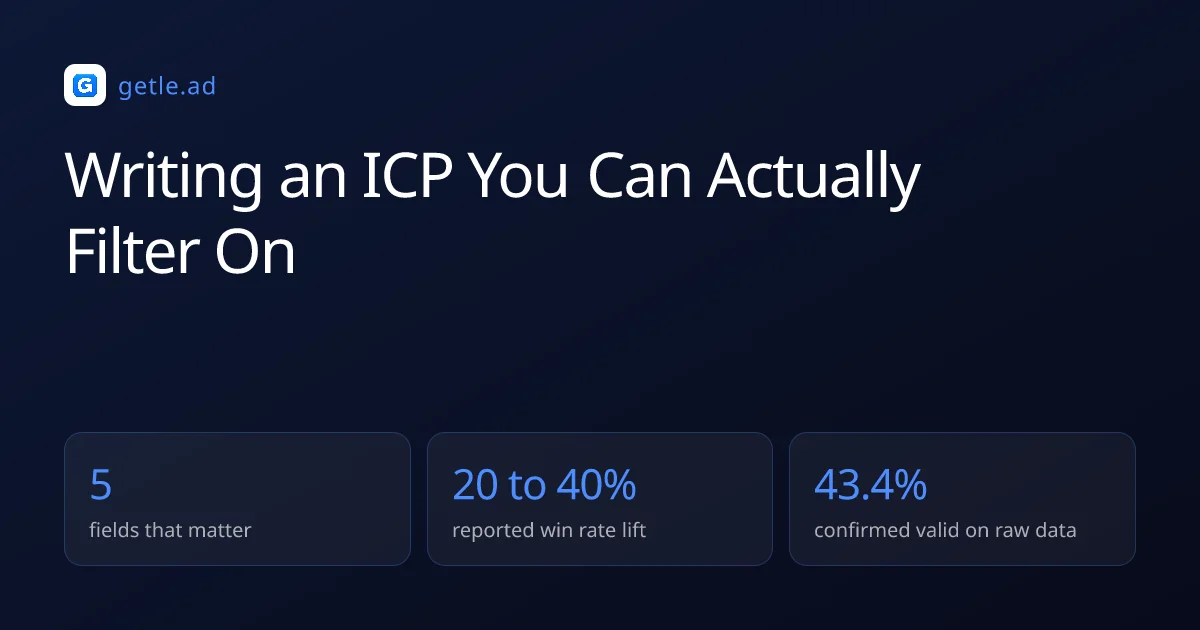
Teams that document and score the profile report meaningfully better outcomes, with published figures citing 20 to 40% higher win rates and shorter sales cycles, while a large share of B2B companies still have no defined ICP at all.
From profile to score
A binary fits or does not fit throws away information. A small rubric lets you rank a list rather than merely filter it.
- Headcount in band: 3 points. Adjacent band: 1 point.
- Industry in target set: 2 points.
- Owning role present and identifiable: 3 points.
- Situational signal active: 3 points, and this is what decides sequencing.
- Disqualifiers: competitor, existing customer, prior opt-out. Score zero regardless of the rest.
For example, a 60 person agency in the UK with a named head of operations and three open roles scores 11 out of 11 and belongs in this week's send. A 400 person firm in an adjacent industry with no identifiable owner scores 3 and belongs in a nurture list, not in the campaign.
The signal layer, which decides timing
Firmographics tell you who could buy. A signal tells you who might buy now, and it is the difference between a list and a queue.
Useful signals share one property: they are observable from outside and they expire. Hiring for a role you serve, launching a product, entering a market, adopting a competing tool and recent funding all qualify.
A situational signal is an observable, time bound event that makes your offer relevant this month rather than in principle, and it is the field most ICP documents omit entirely.
Because signals expire, the segment rebuilds itself. That is also why signal driven lists stay cheaper to maintain: you verify a small current set each week instead of re-verifying a large static file every quarter.
Testing the profile before you scale it
An ICP is a hypothesis. Run it small before committing a quarter of outbound to it.
- Build one segment of 100 to 300 accounts that score at the top of the rubric.
- Verify the addresses in the same week you send, since data decays about 2% a month.
- Send one sequence with one message written for that exact situation.
- Judge on positive replies and meetings per thousand delivered, not on opens.
- Compare against a second segment that differs in exactly one field.
Changing one field at a time is what makes the test readable. If the industry and the headcount band and the message all change together, a better result tells you nothing about which decision caused it. Judge each variant on positive replies and meetings per thousand delivered.
Expect the profile to narrow rather than widen as evidence arrives. Almost every team that runs this exercise honestly ends up with a smaller target market and a better conversion rate than they started with.
Sources and method
First-party data (Getlead, 2026): the verification split of 43.4% confirmed valid, 23.9% invalid, 16.7% catch-all and 16.0% unknown comes from 383,368 addresses analyzed through live SMTP verification, and the 0.51% bounce rate comes from 34,973 tracked sends, aggregated and anonymized at campaign level. Full method in our cold email benchmark study.
External sources: reported win rate and cycle length effects for documented ICPs come from 2026 B2B marketing compilations; contact decay of about 2.1% a month comes from the HubSpot database decay model built on MarketingSherpa research; US commercial email obligations come from the FTC CAN-SPAM compliance guide.
Vendor published win rate figures vary widely in methodology and should be read as directional. Figures were checked in August 2026.
Frequently asked questions
What is an ideal customer profile?
It is the set of company level attributes that predict whether an account will buy, succeed and stay, written precisely enough to be used as database filters. An ICP describes companies, while a persona describes the people inside them.
What fields belong in an ICP?
Five carry almost all of the value: headcount band, industry, geography, the role that owns the problem, and one situational signal such as hiring for that role. Anything you cannot filter on belongs in positioning rather than in the profile.
How do I build an ICP without much data?
Start from closed won accounts in the last 12 months, remove the ones that churned, and record headcount, industry, country and signing title for each. Look for clusters rather than averages, since an average of two distinct clusters describes nobody.
Does a documented ICP actually improve results?
Published 2026 compilations report 20 to 40% higher win rates and shorter sales cycles for teams with a documented and scored profile. Treat the exact figures as directional, since methodology varies, but the direction is consistent across sources.
What is a situational signal?
An observable, time bound event that makes your offer relevant now rather than in principle: hiring for a role you serve, entering a new market, adopting a competing tool or announcing funding. Because signals expire, the segment rebuilds itself each week.
How do I test an ICP?
Build one segment of 100 to 300 top scoring accounts, verify the addresses in the same week you send, run one sequence written for that exact situation, and compare against a second segment that differs in exactly one field. Judge on positive replies rather than opens.