ON THIS PAGE
By Efe Berke Colaker, Founder at GetleadReviewed by the Getlead editorial team for accuracy. Last updated August 2026.
Vendors sell record counts because they are easy to compare. A 700 million record database with thin coverage of your market is a small database for you.
The properties that matter are structural, and they explain why two databases with identical row counts behave completely differently.
The definition
A lead database is a structured, deduplicated and continuously refreshed store of company and contact records, where every record carries its source, its acquisition date and its verification state.
For example, two files of 50,000 rows can differ by a factor of two in usable contacts, because one was verified last week and the other was assembled a year ago and never checked.
What it should contain
Nine fields carry nearly all the segmentation value, and the domain rather than the company name is the key.
- Verified email with its verification state and date.
- First name, for personalisation that is not a merge field.
- Job title plus a normalised seniority level you derive.
- Company name and canonical domain, the real primary key.
- Employee count band, the best single predictor of buying process.
- Normalised industry and country.
- Relevant technology or platform signals.
- Source and acquisition date on every record.
Deduplicating on the canonical domain rather than the company name removes a large share of data quality problems before any enrichment spend, because Acme Inc and ACME are one account.
The running cost nobody budgets
A database is not a purchase, it is a subscription to a decay problem.
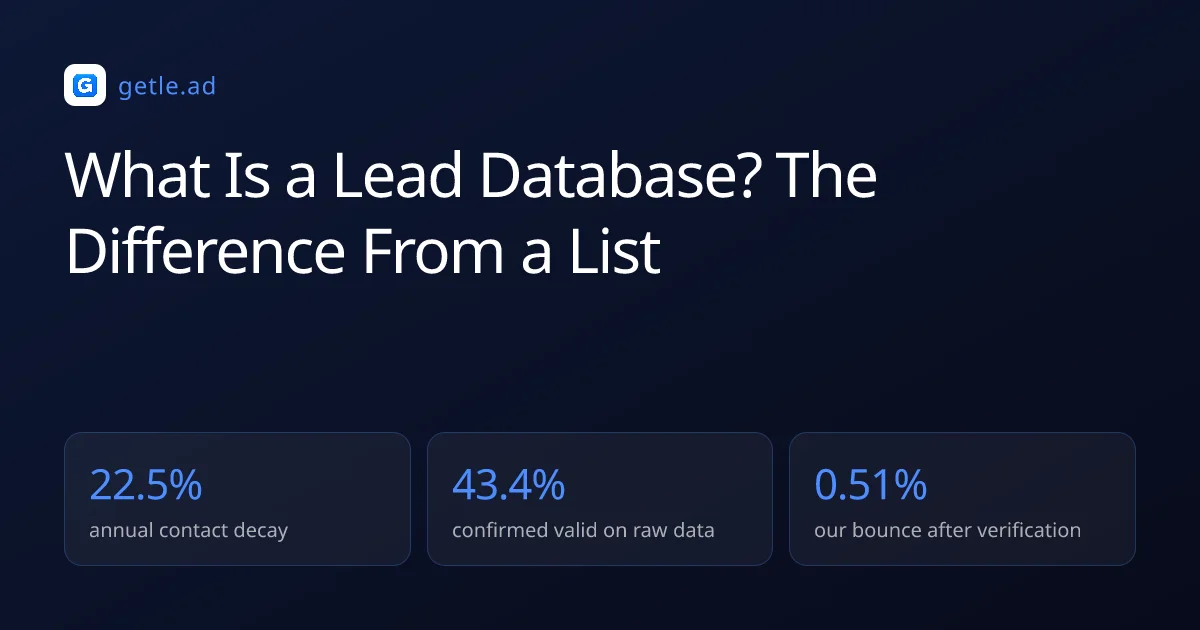
Contact data decays at roughly 2.1% a month, so a 100,000 record database loses tens of thousands of usable records a year without anybody touching it.
Quarterly re-verification is the smallest maintenance that keeps the verified share above 90%, and it is what holds bounce rates near the 0.51% we measure on verified sends rather than the double digits an unmaintained file produces.
Sources and method
First-party data (Getlead, 2026): the verification split of 43.4% confirmed valid, 23.9% invalid, 16.7% catch-all and 16.0% unknown comes from 383,368 addresses analyzed through live SMTP verification, and the 0.51% bounce rate comes from 34,973 tracked sends, aggregated and anonymized at campaign level. Full method in our cold email benchmark study.
External sources: notice duties when personal data is obtained from a third party are set out in Article 14 of the GDPR; US commercial email obligations come from the FTC CAN-SPAM compliance guide; contact decay of about 2.1% a month comes from the HubSpot database decay model.
Figures were checked in August 2026 and third party benchmarks vary in methodology.
Frequently asked questions
What is a lead database?
A structured, deduplicated and continuously refreshed store of company and contact records where each record carries its source, acquisition date and verification state. The maintenance is what separates it from an exported list.
How is a lead database different from a lead list?
A list is a snapshot frozen at export time with no schema, provenance or refresh. A database has all three, which is why two files with identical row counts can differ by a factor of two in usable contacts.
What fields should a lead database have?
Verified email with state and date, first name, job title with a normalised seniority level, company name and canonical domain, employee count band, normalised industry and country, technology signals, and source with acquisition date.
Should I deduplicate on company name or domain?
Canonical domain. Company name strings vary by punctuation and capitalisation, so Acme Inc, Acme, Inc. and ACME become three rows on name matching and one account on domain matching.
What does it cost to maintain a lead database?
Mostly re-verification. Contact data decays around 2.1% a month, so quarterly re-verification of the active database is the minimum that keeps the verified share above 90% and bounce rates near the 0.51% we see on verified sends.
How should I judge a vendor's database?
On coverage of your specific ICP and verification recency rather than total record count. Ask for per record last verified timestamps and run a paid sample through your own verification before committing.