ON THIS PAGE
By Efe Berke Colaker, Founder at GetleadReviewed by the Getlead editorial team for accuracy. Last updated August 2026.
Most lead scoring advice assumes the lead did something first: downloaded a paper, visited pricing, opened three emails. Outbound starts before any of that exists.
So the model has to be built from what you can observe from outside: how well the account fits, and whether something happened recently that makes the timing defensible.
What changes when there is no engagement
Lead scoring is ranking prospects by likelihood to convert so that limited attention goes to the right accounts first, and the inputs available differ completely between inbound and outbound.
For example, an inbound model might give 30 points for a pricing page visit. In outbound that row is empty on every record, so a model copied from inbound produces a list where everyone scores the same and the ranking is meaningless.
A model you can build this afternoon
Three components, small enough that a rep can hold it in their head and argue with it, which is the property that decides whether it gets used.
- Fit, 0 to 8. Headcount band in range, industry in target set, geography served, and the owning role identifiable at the account.
- Timing, 0 to 6. A dated public event: hiring for the owning function, funding, a launch, a market entry or a visible tool change.
- Contactability, 0 to 3. A named contact exists, the address verified recently, and the domain is not catch-all.
- Negatives, unlimited downside. Competitor, existing customer, open opportunity, prior opt-out, or previously bounced twice.
Negatives are not a rounding adjustment. A single disqualifier should zero the record regardless of how well it scores elsewhere, because contacting a customer or a prior opt-out costs more than any marginal prospect is worth.
Published cases support the emphasis. One reported implementation of negative scoring cut total lead volume by 40% and lifted win rates by 22%, which is the shape you should expect: fewer records, better outcomes.
Score first, verify second
Verification costs money per address and scoring costs nothing, so run them in the order that spends least.
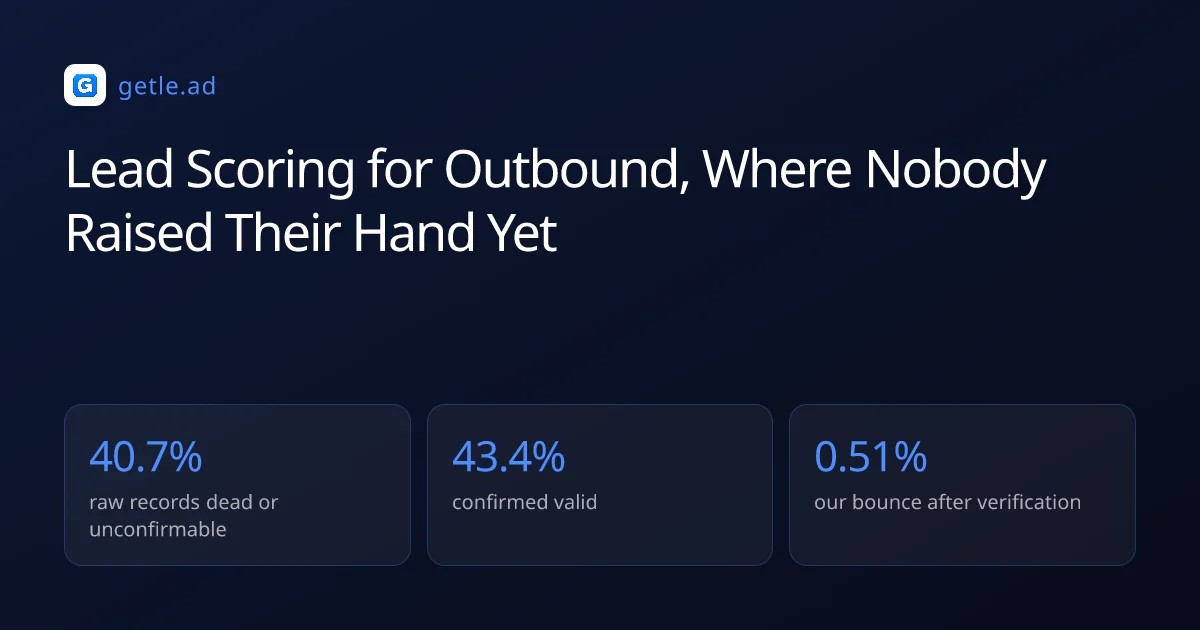
Across 383,368 raw B2B addresses we verified, 40.7% were invalid or unconfirmable. Verifying an entire list before scoring means paying to check records that the score would have discarded anyway.
For example, on a 20,000 record list where scoring keeps the top 3,000, verifying after the score costs roughly a seventh of verifying before it, and the campaign is identical either way.
The exception is contactability, which is part of the score. Use the cheap checks there, syntax and MX, and leave the paid mailbox probe for the band you actually intend to send to.
Keep it explainable or nobody uses it
A model that produces a number without a reason gets quietly ignored. Reps work the accounts they believe in, and belief comes from being able to see the inputs.
- Show the component scores, not just the total, on every record.
- Name the timing signal in words: hiring three ops roles since 2 August beats a score of 6.
- Cap the number of rules. Twelve is memorable, forty is a black box with extra steps.
- Review the weights quarterly against closed won, and change them deliberately rather than continuously.
Machine learning has a place once you have enough closed deals to train on, and it carries a specific weakness: it learns what predicted wins in the past, so when the product or the market shifts, the historical correlations quietly stop applying.
For a small outbound program, a transparent rules model that reps trust will outperform a better model they route around.
Proving the score works
A score is a hypothesis about ranking. Test it the way you would test any ranking: by comparing bands.
- Split the scored list into three bands rather than a top slice and a remainder.
- Send the same sequence to a sample from each band in the same week.
- Compare positive replies and meetings per thousand delivered, not opens.
- If the middle band matches the top band, your weights are not separating anything.
- Re-check quarterly, because a score built on last year's closed deals ages with the market.
The failure this exposes most often is a fit model that is really a size model. If every high scoring account is simply a large one, the score is ranking by headcount and calling it fit.
Judge on positive replies rather than replies. A band can produce plenty of responses and no interest, which looks like success in a dashboard and produces nothing downstream.
Sources and method
First-party data (Getlead, 2026): the verification split of 43.4% confirmed valid, 23.9% invalid, 16.7% catch-all and 16.0% unknown comes from 383,368 addresses analyzed through live SMTP verification, and the 0.51% bounce rate comes from 34,973 tracked sends, aggregated and anonymized at campaign level. Full method in our cold email benchmark study.
External sources: reported effects of negative scoring on lead volume and win rate come from 2026 lead scoring compilations; US commercial email obligations come from the FTC CAN-SPAM compliance guide.
Vendor and case study figures vary widely in methodology and should be read as directional. Checked in August 2026.
Frequently asked questions
How is lead scoring different for outbound?
Inbound models are built on engagement such as page visits and email opens, and none of that exists before first contact in outbound. Fit and a dated timing signal carry the score instead, with negative signals doing more work than in inbound models.
What should an outbound scoring model contain?
Fit from 0 to 8 covering headcount band, industry, geography and an identifiable owning role. Timing from 0 to 6 based on a dated public event. Contactability from 0 to 3. Then negatives that zero the record entirely, such as competitor, customer, open opportunity or prior opt-out.
Why is negative scoring so important?
Because the cost of contacting the wrong account is asymmetric. Mailing a customer or someone who previously opted out damages more than a marginal prospect gains, and one reported implementation cut lead volume by 40% while lifting win rates by 22%.
Should I verify before or after scoring?
After, for the paid mailbox probe. Verification costs money per address and scoring costs nothing, so score first and verify the top band. Use the free syntax and MX checks during scoring, since contactability is part of the model.
Is machine learning worth it for outbound scoring?
Only once you have enough closed deals to train on, and with a known weakness: it learns what predicted wins historically, so when the product or market shifts those correlations stop applying. A transparent rules model reps trust usually beats a better model they route around.
How do I know if my score is working?
Split the list into three bands, send the same sequence to a sample from each in the same week, and compare positive replies and meetings per thousand delivered. If the middle band matches the top band, the weights are not separating anything.