ON THIS PAGE
By Efe Berke Colaker, Founder at GetleadReviewed by the Getlead editorial team for accuracy. Last updated August 2026.
Before any paid verification runs, two checks can be done locally in milliseconds. They are the cheapest quality gate available and the one most teams either skip or implement too aggressively.
This covers what each check actually establishes, the rules that reject valid addresses, and where the two of them stop being useful.
Syntax: the shape of the address
A syntax check tests whether an address is formed the way the specification allows, which is a question about structure rather than about existence.
It catches the obvious failures instantly: missing at signs, double dots, trailing spaces, unencoded characters and addresses that were truncated in a spreadsheet export.
For example, a CSV column that was widened after export commonly produces trailing whitespace on every value. A syntax check strips or flags those in one pass, which is often the single largest cause of avoidable failures in an imported file.
Where over strict rules cause damage
- Plus addressing. jane+crm@example.com is valid and widely used.
- Apostrophes and hyphens. o'brien@example.com and mary-jane@example.com are both legal.
- Long TLDs. .marketing, .technology and .international are real and frequently rejected by outdated rules.
- Numeric local parts. 12345@example.com is unusual and perfectly valid.
Rejecting these silently removes real prospects, and the loss never appears in any report because the records disappear before anything measures them.
MX: does the domain receive mail at all
An MX record is the DNS entry that names the servers responsible for receiving mail at a domain, and its absence means the domain cannot accept mail from anyone.
For example, a company that shut down last year often keeps the domain registered while the mail service lapses. The website may still load from a parked page, and only the MX lookup reveals that nothing can reach anyone there.
The MX record also tells you which provider handles the mail, which is useful for planning. A list dominated by one provider means your placement is largely decided by that provider's filtering.
What neither check proves
Both are eliminations, and treating a pass as a positive result is the most common misuse.
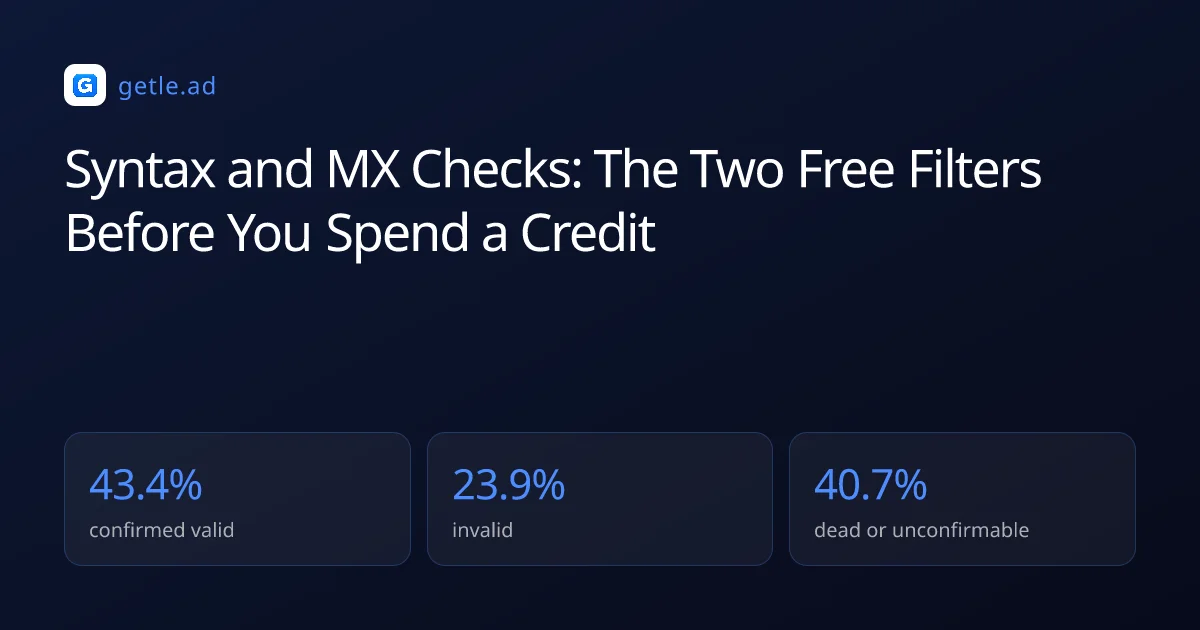
Across 383,368 raw B2B addresses we verified, 40.7% were either invalid or unconfirmable, and nearly all of those had clean syntax at domains with working MX records. The address looked right and the mailbox was not there.
That gap is the whole argument for the mailbox probe. Syntax and MX narrow the field cheaply, and only the probe returns evidence about the specific recipient.
The order that saves the most money
Run the cheap filters first, in this order, so the expensive step only sees records that could plausibly succeed.
- Normalise: lowercase, trim whitespace, strip invisible characters.
- Syntax check, using permissive rules that accept plus signs, apostrophes and long TLDs.
- Deduplicate on the address, then on the canonical company domain.
- Remove role based prefixes into a separate segment rather than deleting them.
- MX lookup per domain, cached, since one lookup covers every address at that company.
- Mailbox probe on whatever survives, which is the only step that costs real money.
Caching the MX lookup per domain rather than per address is the step that matters at scale. A 50,000 record list often contains only a few thousand distinct domains, so the DNS work collapses by an order of magnitude.
Sources and method
First-party data (Getlead, 2026): the verification split of 43.4% confirmed valid, 23.9% invalid, 16.7% catch-all and 16.0% unknown comes from 383,368 addresses analyzed through live SMTP verification, and the 0.51% bounce rate comes from 34,973 tracked sends, aggregated and anonymized at campaign level. Full method in our cold email benchmark study.
External sources: address syntax and the SMTP exchange are defined in RFC 5321, and mail routing through MX records is specified in RFC 5321 section 5; US commercial email obligations come from the FTC CAN-SPAM compliance guide.
Figures were checked in August 2026.
Frequently asked questions
What is an email syntax check?
A test of whether an address is formed the way the specification allows, catching missing at signs, double dots, trailing whitespace and truncated values. It answers a question about structure, so passing proves the address is plausible rather than that it exists.
What is an MX record check?
A DNS lookup for the servers responsible for receiving mail at a domain. No MX record and no A record means the domain cannot accept mail from anyone, which is a definitive reason to suppress every address at it.
Do syntax and MX checks replace verification?
No. In our verification of 383,368 raw addresses, 40.7% were invalid or unconfirmable, and nearly all of those had clean syntax and working MX records. Only the mailbox probe returns evidence about the specific recipient.
Which valid addresses do strict syntax rules reject?
Plus addressing such as jane+crm@example.com, apostrophes and hyphens in names, long modern TLDs like .marketing or .technology, and purely numeric local parts. All are legal, and rejecting them removes real prospects invisibly.
In what order should these checks run?
Normalise, syntax check with permissive rules, deduplicate on address and canonical domain, split out role based prefixes, MX lookup cached per domain, then the mailbox probe on whatever survives. Only the last step costs meaningful money.
Why cache MX lookups per domain?
Because one lookup covers every address at that company. A 50,000 record list usually contains only a few thousand distinct domains, so caching collapses the DNS work by an order of magnitude without changing the result.