ON THIS PAGE
By Efe Berke Colaker, Founder at GetleadReviewed by the Getlead editorial team for accuracy. Last updated August 2026.
Free email checkers are useful and widely misread. They answer a narrow question well, and people take the answer to mean something broader.
This walks through the four layers a checker actually tests, what each one proves, and the exact point where checking one address at a time stops being enough.
The four layers, and what each one settles
An email checker is a tool that tests an address against progressively stronger evidence, stopping at the first failure.
The first three are eliminations. They can tell you an address cannot work, and they can never tell you it does. Only the fourth returns evidence about the specific mailbox.
For example, an address with clean syntax at a domain with valid MX records still fails the probe if the person left and the mailbox was deleted, which is the single most common case on any list older than a few months.
Reading the answer honestly
Most free tools compress the result into valid or invalid. The underlying protocol returns more than that, and the compression is where people get misled.
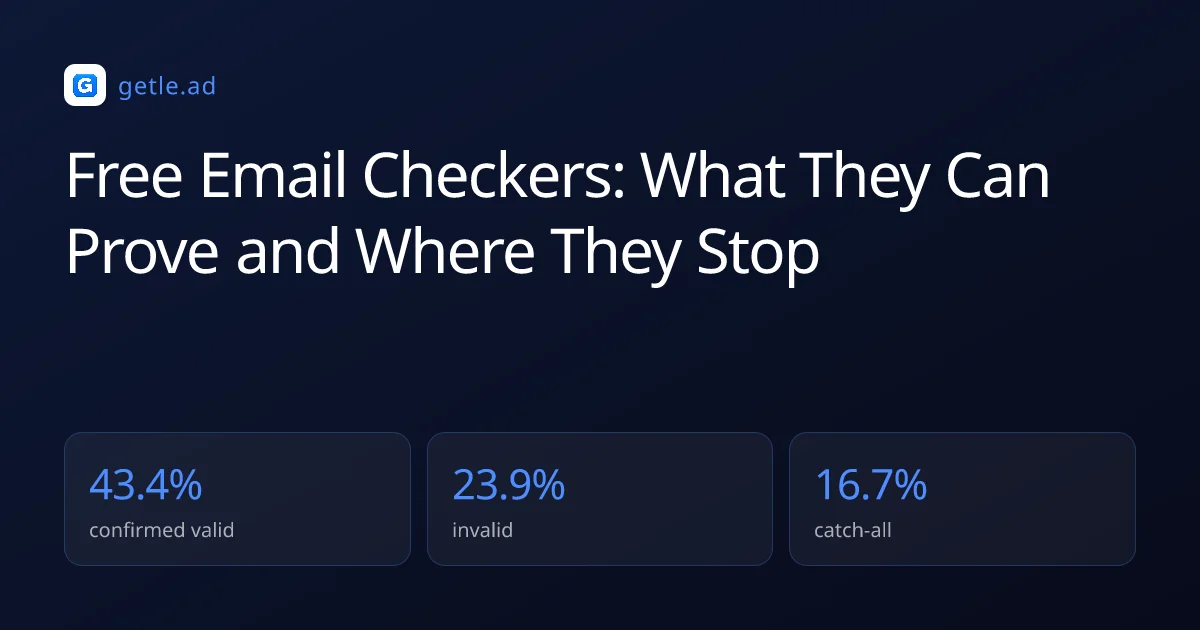
In our verification of 383,368 raw B2B addresses, 43.4% were confirmed valid, 23.9% invalid, 16.7% catch-all and 16.0% unknown. A binary display forces those middle two states into one bucket or the other, and both choices are wrong.
A catch-all domain accepts mail for every possible address, so the probe returns a positive answer whether the mailbox exists or not. Tools that report those as valid are reporting the server's configuration, not the person.
Unknown is the other misread. It usually means greylisting or a probe that was rate limited, not a bad address, so deleting those records throws away contacts you already paid to source.
Where single address checking stops working
A free checker is the right tool for a handful of addresses. Three things break as volume rises.
- Rate limits. Receiving servers throttle repeated probes from one source, which turns confirmed results into unknowns.
- Probe reputation. Checks from infrastructure with no sending history get worse answers than checks that look like ordinary mail traffic.
- Process. Verifying a list by hand before every campaign does not survive a busy week, so it stops happening.
For example, checking 40 addresses before a small send is realistic. Checking 4,000 by pasting them into a form is not, and the version of the process that gets skipped is the one that protects the sending domain.
At that point the question becomes bulk verification, where per address cost runs between $0.003 and $0.01 depending on volume.
Why probe reputation matters
A verification probe is a connection from some IP address to a receiving mail server. Servers judge that connection the same way they judge mail: by what they know about the source.
Probes from infrastructure with a long, well behaved history get clean answers. Probes from a residential connection running hundreds of checks in an afternoon get throttled, and throttling shows up as unknown results rather than as an error message.
That is why the same address can verify differently from two tools on the same day. The address did not change, the questioner did.
What no checker can tell you
Four things sit outside what any verification tool, free or paid, can observe.
- Whether a person reads it. Shared inboxes verify perfectly and reach a queue rather than a decision maker.
- Whether the person still holds the role. The mailbox can outlive the employee by months.
- Whether it is a spam trap. Traps accept mail by design, which is what makes them effective.
- Whether your message will reach the inbox. Existence and placement are separate questions.
The last one causes the most confusion. Our verified sends bounce at 0.51%, comfortably under the roughly 3% level where reputation suffers, and that clean bounce rate says nothing about whether the delivered mail landed in an inbox or a spam folder.
So treat a checker as one gate among several. It removes the addresses that would bounce, and everything after that is targeting, infrastructure and message.
The role address blind spot
For example, info@company.com verifies as confirmed valid at almost every company that publishes it. It is a real mailbox, it accepts mail, and nothing about the check is wrong.
What the check cannot say is that the mailbox is read by three people in rotation, none of whom owns a purchasing decision. Filtering those addresses is a separate step that has to happen before the send.
Practical uses that are worth the two minutes
Free checks earn their place in a few specific moments, all of them low volume and high stakes.
- Before mailing a single named prospect you researched by hand.
- When a form submission looks suspicious and you want to know whether the domain accepts mail at all.
- While testing whether a company uses first.last or flast, since one confirmation resolves the whole domain.
- As a spot check on a supplier sample before committing to a larger purchase.
The fourth is the highest value use of a free tool. Verifying fifty records from a vendor sample tells you whether their data beats the 43.4% confirmed valid baseline we see on raw data, and that answer is worth more than any accuracy claim on their pricing page.
Getlead publishes a free verifier for exactly these cases, and it reports the four states rather than compressing them into a single label.
Sources and method
First-party data (Getlead, 2026): the verification split of 43.4% confirmed valid, 23.9% invalid, 16.7% catch-all and 16.0% unknown comes from 383,368 addresses analyzed through live SMTP verification, and the 0.51% bounce rate comes from 34,973 tracked sends, aggregated and anonymized at campaign level. Full method in our cold email benchmark study.
External sources: the command sequence and reply codes used by the mailbox probe are defined in RFC 5321; US commercial email obligations including a working opt-out come from the FTC CAN-SPAM compliance guide.
Figures were checked in August 2026.
Frequently asked questions
What does a free email checker actually test?
Four layers: whether the address is correctly formed, whether the domain resolves, whether it has MX records and therefore accepts mail, and whether the receiving server accepts that specific recipient. The first three rule addresses out, and only the fourth confirms anything.
Is a free email checker accurate?
For a single address it is as accurate as a paid one, because both run the same protocol level checks. The difference is volume, rate limiting and how honestly the result is displayed, since the underlying protocol returns four states rather than valid or invalid.
Why does a checker say valid when the email bounces?
Usually because the domain is catch-all and accepts mail for every address, so the probe returns a positive answer regardless of whether the mailbox exists. In our data 16.7% of raw records sit in that unconfirmable state.
When should I stop using a free checker?
When the volume passes what you can check by hand before each campaign, typically a few dozen addresses. Beyond that, rate limits degrade results and the manual step gets skipped, which is worse than paying for bulk verification at $0.003 to $0.01 per address.
Can a checker tell me if an address is a spam trap?
No. Traps accept mail by design, which is exactly what makes them work. The only defence is fresh, verified data and retiring records that have been unreachable or unresponsive for a long time.
Does a valid result mean my email will be read?
No. Verification confirms the mailbox accepts mail. It says nothing about whether a person reads that mailbox, whether they still hold the role, or whether your message lands in the inbox rather than the spam folder.