ON THIS PAGE
By Efe Berke Colaker, Founder at GetleadReviewed by the Getlead editorial team for accuracy. Last updated August 2026.
Every CRM starts clean and ends up as an argument. Two records for one account, a title from a job the person left, and a pipeline number nobody quite believes.
The fix is not a big cleanup. It is a small set of checks attached to moments that already exist, plus a schema short enough that people actually fill it in.
What hygiene actually means here
CRM data hygiene is the practice of keeping records accurate, deduplicated and current enough that decisions made from them are sound.
Three properties matter, and they fail independently. Accuracy is whether a field is right. Completeness is whether it is filled. Currency is whether it was right recently, which is the one teams forget.
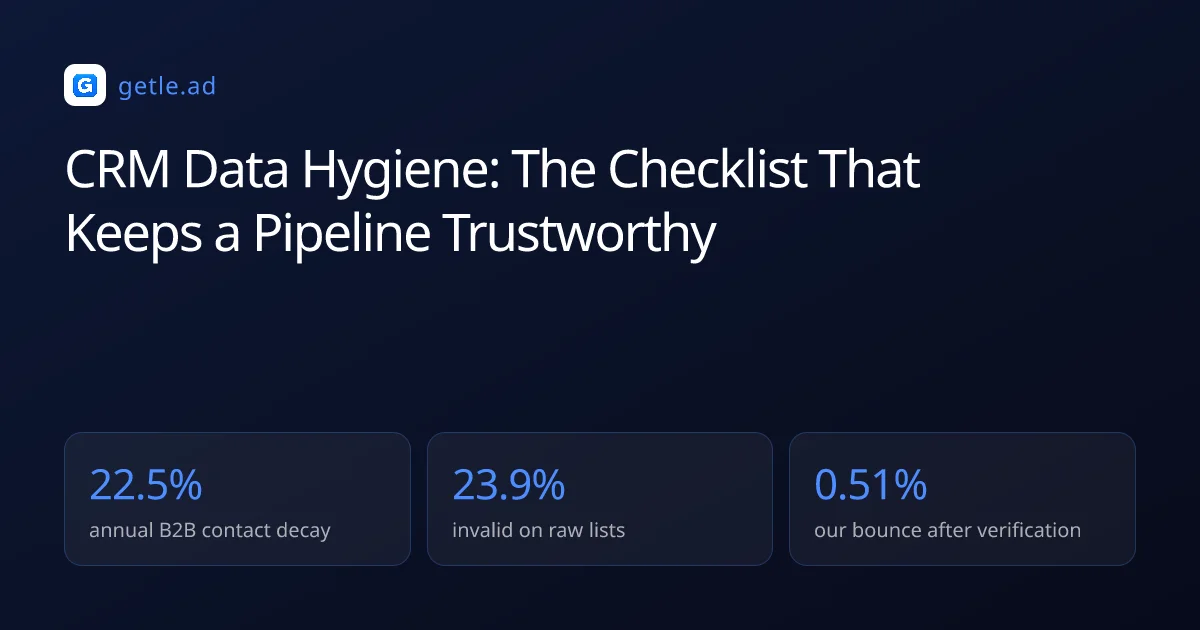
Published research puts B2B contact decay near 22.5% a year, driven by roughly 2.1% a month of job changes, acquisitions and domain retirements. Nothing in your CRM is exempt from that rate.
Enforce six fields, let the rest drift
A required field that reps route around is worse than an optional one, because it produces confident garbage. Pick the smallest set that supports segmentation and enforce only those.
For example, storing the raw job title alone makes a segment of operations leaders impossible, because the same job appears as Head of Ops, Operations Manager and Director of Business Operations. A derived level field solves it once for everyone.
Note who owns each row. Five of the six should be written by the system on import or enrichment, because fields that depend on human discipline decay at the speed of the busiest week.
The cadence, attached to things that already happen
Hygiene fails when it becomes its own calendar entry. Attach it to imports, sends and reporting instead.
- At import: normalise, deduplicate on address then canonical domain, record source and date.
- Before every send: verify the specific segment, apply suppression, exclude open opportunities.
- Monthly: fuzzy deduplication across the active database and a read of the merge report.
- Quarterly: re-verify the full active database and refresh headcount bands.
- Twice a year: retire records unreachable and unengaged for twelve months.
- Continuously: alert when an import path writes records without a source field.
The last item catches the most common regression. A new integration goes live, writes records without provenance, and six months later nobody can explain where a third of the database came from.
Pricing the cleanup against doing nothing
Cleanup competes for time with revenue work, so the argument has to be numeric rather than aesthetic.
Gartner's widely cited estimate puts the average cost of poor data quality at $12.9 million a year per organization, and industry compilations attribute a substantial share of rep time to chasing inaccurate records.
For example, a 20,000 record database decaying at 22.5% loses roughly 4,500 usable records a year. Verification costs a fraction of a cent per address, so re-verifying the entire database quarterly is a small budget line against the campaigns and forecasts those dead records distort.
The deliverability side is easier to price. Our sends to verified lists bounce at 0.51%, comfortably under the roughly 3% level where sender reputation suffers, and a stale database is the fastest way to cross it.
Four metrics that make hygiene visible
Track these quarterly and the conversation stops being about opinions.
- Verified share of active records. Above 90% after a re-verification pass, below 80% means the cadence slipped.
- Duplicate rate on canonical domain. Under 5%, and a rising number points at an import path bypassing checks.
- Provenance coverage. The share of records with a source and acquisition date. Aim for 100% on anything written after today.
- Bounce rate on sends. Under 1%, measured per segment rather than per campaign.
The provenance number is the one that predicts future pain. A database where a third of records have no source cannot be audited, cannot be prioritised by quality, and cannot answer the question a regulator or a customer may eventually ask.
Sources and method
First-party data (Getlead, 2026): the verification split of 43.4% confirmed valid, 23.9% invalid, 16.7% catch-all and 16.0% unknown comes from 383,368 addresses analyzed through live SMTP verification, and the 0.51% bounce rate comes from 34,973 tracked sends, aggregated and anonymized at campaign level. Full method in our cold email benchmark study.
External sources: contact decay of about 2.1% a month compounding to 22.5% a year comes from the HubSpot database decay model built on MarketingSherpa research; the average annual cost of poor data quality is Gartner's estimate; notice duties for third party sourced records are set out in Article 14 of the GDPR; US commercial email obligations come from the FTC CAN-SPAM compliance guide.
Cost estimates vary widely by organisation size and methodology, so treat them as directional. Figures were checked in August 2026.
Frequently asked questions
What is CRM data hygiene?
The practice of keeping records accurate, deduplicated and current enough that decisions made from them are sound. Accuracy, completeness and currency fail independently, and currency is the one teams most often forget to measure.
Which CRM fields are worth enforcing?
Six: canonical domain, verified email with its verification date, a normalised role level, headcount band, source and acquisition date, and lifecycle state. Five of those should be written by the system rather than by a rep, since human maintained fields decay fastest.
How often should a CRM be cleaned?
Attach checks to existing moments rather than to a calendar: normalise and deduplicate at import, verify the segment before every send, run fuzzy deduplication monthly, re-verify the full active database quarterly, and retire unreachable records twice a year.
What does bad CRM data actually cost?
Gartner's widely cited estimate puts poor data quality at an average of $12.9 million a year per organization. More concretely, a 20,000 record database decaying at 22.5% loses about 4,500 usable records annually, and stale data pushes bounce rates toward the level that damages sender reputation.
Why store a verification date rather than a verified flag?
Because verification is a snapshot of a moving target. Contact data decays around 2.1% a month, so a flag set eight months ago tells you almost nothing, while a date lets you decide whether a segment needs re-checking before it is used.
What metrics show whether hygiene is working?
Verified share of active records above 90%, duplicate rate on canonical domain under 5%, provenance coverage at 100% for newly written records, and bounce rate under 1% measured per segment rather than per campaign.