ON THIS PAGE
By Efe Berke Colaker, Founder at GetleadReviewed by the Getlead editorial team for accuracy. Last updated August 2026.
Sales automation is sold as time saved and usually bought as software added. The difference shows up in whether anyone's day actually changed.
The useful way to think about it is a line between mechanics and judgement, then automating only one side.
The definition and the dividing line
Sales automation is the practice of delegating repeatable, rule based steps in the sales process to software, so that people spend their time on decisions that require judgement.
For example, automating suppression removes an entire class of embarrassing mistakes, while automating the reply to a prospect who asked a real question removes the only advantage a small team has.
The order that pays back fastest
- Verification at the point of export, since it protects everything downstream.
- Global suppression applied at send time rather than at import.
- Sequence scheduling with per mailbox volume caps.
- Automatic logging of sends, replies and outcomes to the account record.
- Deduplication on import, before records enter the database.
The first item is first for a measurable reason. In our verification of 383,368 raw B2B addresses, 40.7% were invalid or unconfirmable, and automating sends against that file simply reaches the failure faster.
What breaks when you automate too far
- Personalisation collapses into merge fields, which recipients recognise instantly.
- Rotation without per prospect mapping sends a sequence from three different senders.
- Auto replies to real questions end conversations that a human would have won.
- Volume scaling compensates for a targeting problem and multiplies complaint exposure.
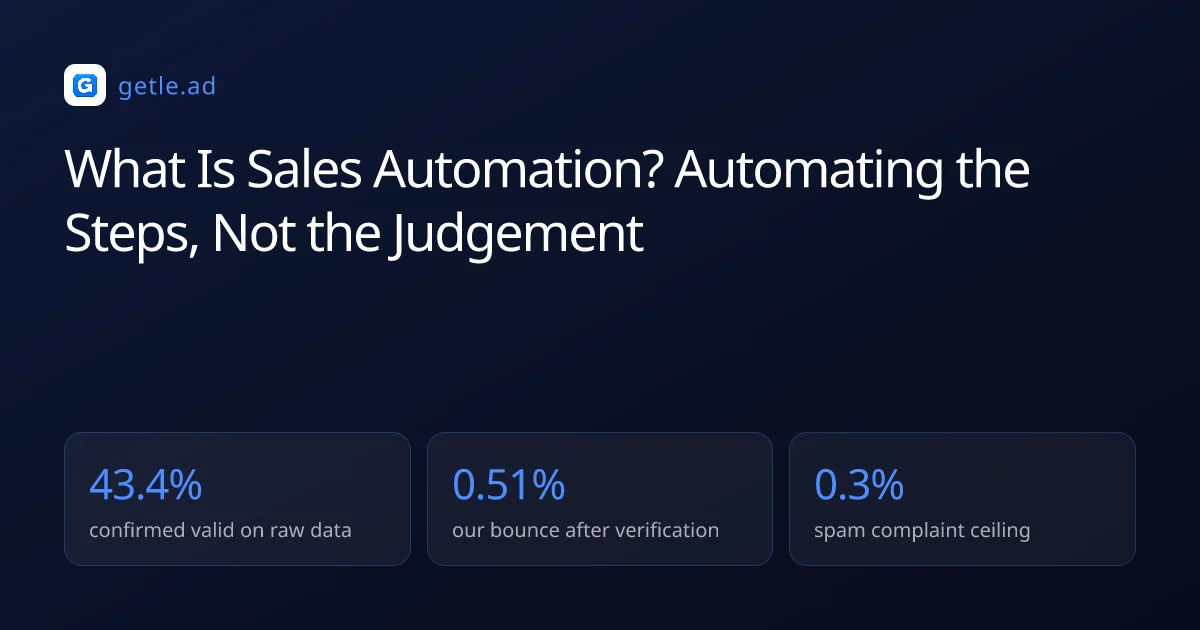
The complaint ceiling is 0.3% of delivered messages, so automation that increases volume without improving relevance moves you toward the limit at speed.
Sources and method
First-party data (Getlead, 2026): the verification split of 43.4% confirmed valid, 23.9% invalid, 16.7% catch-all and 16.0% unknown comes from 383,368 addresses analyzed through live SMTP verification, and the 0.51% bounce rate and 35.8% open rate come from 34,973 tracked sends, aggregated and anonymized at campaign level. Full method in our cold email benchmark study.
External sources: US commercial email obligations come from the FTC CAN-SPAM compliance guide; the 0.3% spam complaint ceiling and authentication requirements come from the Google Workspace sender guidelines.
Third party benchmarks vary in methodology and should be read as directional. Checked in August 2026.
Frequently asked questions
What is sales automation?
Delegating repeatable, rule based steps in the sales process to software so people spend their time on judgement calls. The dividing line is mechanics versus decisions, and only the mechanics should be automated.
What should not be automated in sales?
Choosing the target segment and replying to a human who asked a real question. Both are judgement, and automating the reply removes the main advantage a small team has over a large one.
What is the highest return automation?
Verification at the point of export and global suppression applied at send time. Both remove entire categories of error rather than saving minutes, and verification protects every step that follows it.
Does automation improve results on a bad list?
No, it reaches the failure faster. In our verification of raw B2B data, 40.7% of addresses were invalid or unconfirmable, and automating sends against that file simply generates the bounces and complaints sooner.
How does automation damage personalisation?
By reducing it to merge fields. A first line built from a name and a company reads as automation because it is, while a line naming a specific situation requires a decision that software cannot make for you.
Is more volume the point of sales automation?
No. Volume without relevance moves you toward the 0.3% complaint ceiling faster. The point is removing repeated mechanics so the same team can maintain quality across more accounts.