ON THIS PAGE
By Efe Berke Colaker, Founder at GetleadReviewed by the Getlead editorial team for accuracy. Last updated August 2026.
The outbound versus inbound argument is usually a preference dressed as a strategy. Both work, and the choice is a constraint problem rather than a taste one.
Three constraints settle it: how large the market is, how fast you need results, and how much you can spend before revenue arrives.
The difference that generates the others
Inbound is any motion where the buyer initiates contact. Outbound is any motion where you do. Every other difference follows from that one property.
For example, a company that needs pipeline this quarter cannot solve it with content, and a company selling to a market of 300 accounts cannot rank its way to them either. Both statements are about constraints rather than about which channel is better.
A decision you can make in ten minutes
- Count the addressable accounts. Under a few thousand, outbound reaches all of them and search volume is thin.
- Check deal size. Small deals rarely support per contact outbound cost, so inbound and product led motions fit better.
- Check urgency. Needing pipeline within a quarter points at outbound, since inbound compounds too slowly.
- Check whether buyers search. If nobody queries the category, there is nothing to capture.
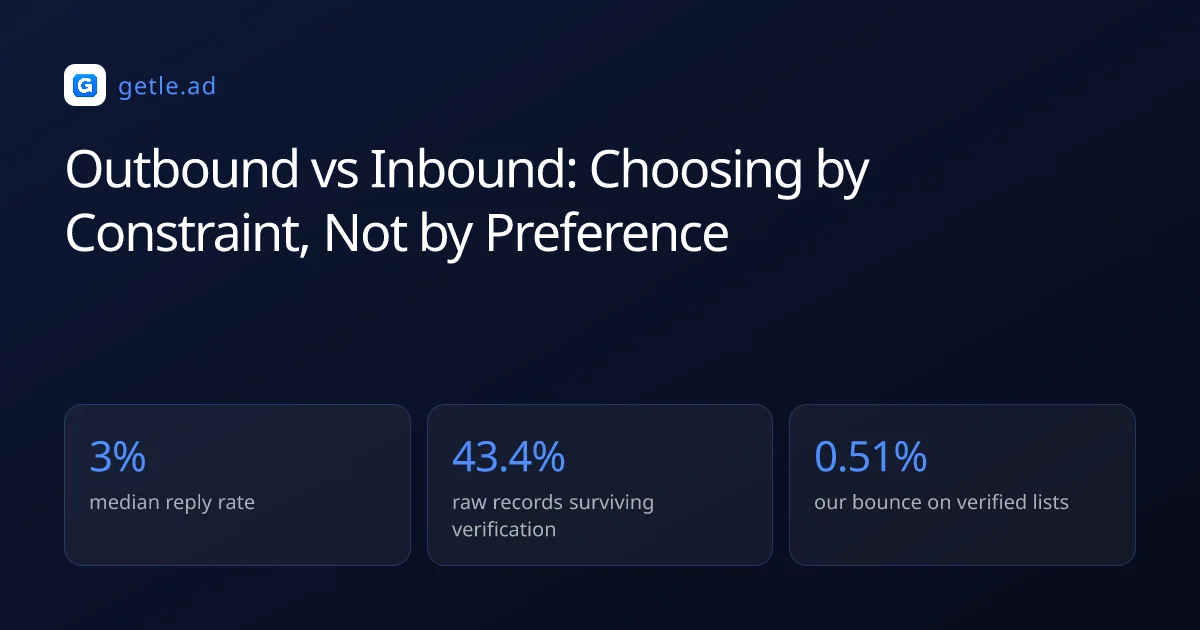
- Check data availability. Outbound needs verified contacts, and only 43.4% of raw records survive verification in our data.
The fourth check is the one teams skip. A category nobody searches for cannot be captured, however good the content is, and that alone decides the sequencing for a lot of new products.
Running both without splitting attention
The usual failure is running both badly. Sequencing avoids it.
- Start outbound to learn who buys and what they respond to, which is market research with pipeline attached.
- Feed inbound with what outbound learned, since the questions prospects ask are the pages worth writing.
- Let inbound take the volume as it compounds, and point outbound at the accounts search will never reach.
- Keep one suppression list across both, or an inbound lead receives a cold sequence.
That last point is operational and unglamorous, and it is the one that embarrasses teams in front of customers. Keeping one global suppression list across both motions prevents it.
Sources and method
First-party data (Getlead, 2026): the verification split of 43.4% confirmed valid, 23.9% invalid, 16.7% catch-all and 16.0% unknown comes from 383,368 addresses analyzed through live SMTP verification, and the 0.51% bounce rate and 35.8% open rate come from 34,973 tracked sends, aggregated and anonymized at campaign level. Full method in our cold email benchmark study.
External sources: median B2B reply rates near 3% and the finding that roughly 42% of replies arrive from follow-ups come from 2026 cold email benchmark compilations; US commercial email obligations come from the FTC CAN-SPAM compliance guide.
Third party benchmarks vary in methodology and should be read as directional. Checked in August 2026.
Frequently asked questions
What is the difference between outbound and inbound?
Who initiates contact. Inbound means the buyer comes to you through search, content or referral. Outbound means you select accounts and contact them first, which gives complete targeting control and requires verified contact data.
Which should a new company start with?
Usually outbound, because it produces results in weeks and teaches you who actually buys. Inbound compounds over quarters, so it is an investment made from a position of some stability rather than a first move.
When is outbound the wrong choice?
When the market is very large and deals are small, since per contact cost does not pay back, or when you cannot source verified contacts. Only 43.4% of raw B2B records survive verification in our data, so sourcing is a real constraint.
When is inbound the wrong choice?
When nobody searches for the category, when the addressable market is a few hundred named accounts, or when pipeline is needed within a quarter. Content cannot capture demand that does not exist yet.
Can a small team run both?
Yes, sequenced rather than simultaneously. Start outbound to learn the market, use what prospects ask to decide which inbound pages to write, then let inbound absorb volume while outbound handles accounts search will never reach.
What breaks when both run at once?
Suppression, most visibly. Without one shared suppression list an inbound lead or an existing customer receives a cold sequence, which costs more trust than either motion generates that week.