ON THIS PAGE
By Efe Berke Colaker, Founder at GetleadReviewed by the Getlead editorial team for accuracy. Last updated August 2026.
MQL and SQL are argued about because the terms are usually defined by feeling. Marketing counts anything that engaged, sales counts anything they liked, and the numbers never reconcile.
The fix is to treat both as contracts with checkable conditions, then measure the conversion between them.
The two definitions
A marketing qualified lead is a contact that meets an agreed fit threshold and has shown an agreed level of interest, whether or not sales has looked at it.
A sales qualified lead is a contact that sales has reviewed and accepted as worth active work, which is the only definition that carries a commitment.
For example, a head of operations at a 60 person agency who downloaded a guide is an MQL if the fit criteria and that signal were agreed in advance. Whether it becomes an SQL depends on sales accepting it, not on marketing insisting.
Writing criteria that survive a quarter
Every criterion should be answerable with a database query or a yes or no from a rep.
- Fit: headcount band, industry, geography, and an identifiable owning role.
- Interest: named actions with weights, such as a pricing page visit or a reply to a sequence.
- Disqualifiers: competitor, existing customer, prior opt-out, unreachable after verification.
- Freshness: the signal must be recent, since interest expires faster than data.
- Rejection path: what happens when sales declines, and who owns the record afterwards.
The fifth item is the one teams omit and then argue about. Without a defined rejection path, declined leads accumulate in nobody's list and the conversion rate becomes unmeasurable.
Why outbound barely has an MQL stage
In outbound, fit is assessed before contact rather than inferred from behaviour afterwards. There is no download to score, so the funnel starts closer to the SQL definition.
That changes what to measure. Positive replies per thousand delivered replaces MQL volume, and the qualifying conversation replaces the interest score.
It also changes where the data spend goes. Since fit is decided upfront, verification and targeting quality carry the weight that lead nurturing carries inbound.
Sources and method
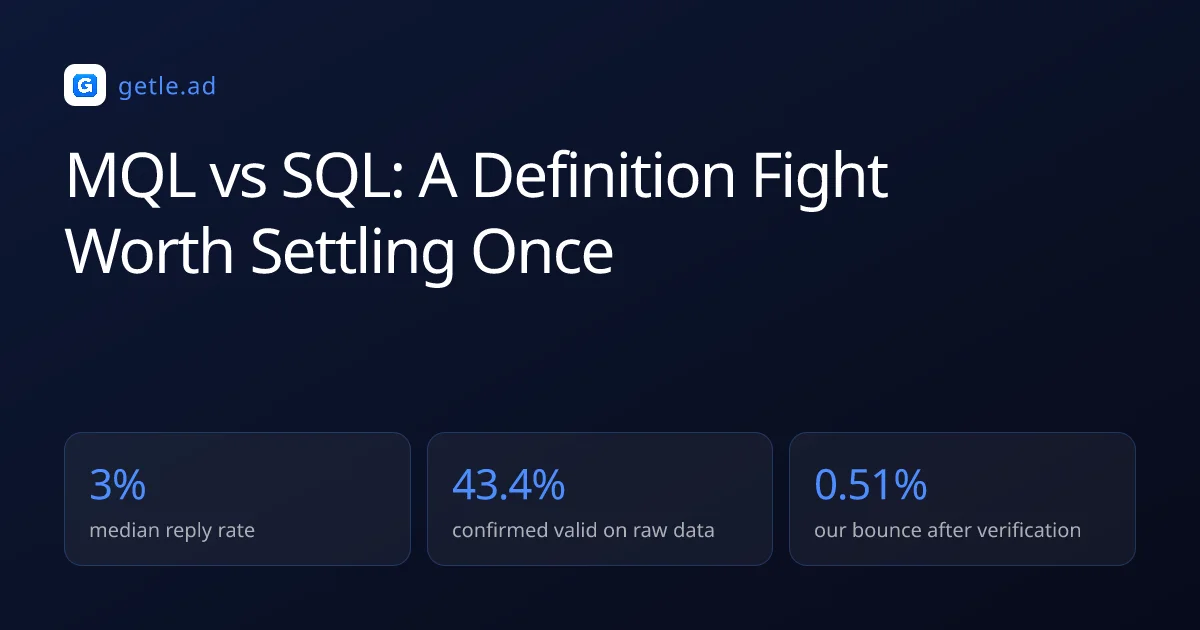
First-party data (Getlead, 2026): the verification split of 43.4% confirmed valid, 23.9% invalid, 16.7% catch-all and 16.0% unknown comes from 383,368 addresses analyzed through live SMTP verification, and the 0.51% bounce rate comes from 34,973 tracked sends, aggregated and anonymized at campaign level. Full method in our cold email benchmark study.
External sources: contact decay of about 2.1% a month compounding to 22.5% a year comes from the HubSpot database decay model built on MarketingSherpa research; US commercial email obligations come from the FTC CAN-SPAM compliance guide.
Figures were checked in August 2026 and third party benchmarks vary in methodology.
Frequently asked questions
What is the difference between an MQL and an SQL?
An MQL meets a fit and interest threshold set by marketing. An SQL has been reviewed and accepted by sales as worth active work. The first is a claim, the second is a commitment, which is why only the second carries accountability.
Who decides when a lead becomes an SQL?
Sales, by accepting it. If marketing can promote records to SQL unilaterally, the stage stops meaning anything and the conversion rate between MQL and SQL becomes unmeasurable.
How should MQL criteria be written?
As checkable conditions: headcount band, industry, geography, identifiable owning role, named interest actions with weights, explicit disqualifiers, a freshness window, and a defined rejection path when sales declines.
Does the MQL stage apply to outbound?
Barely. In outbound, fit is assessed before contact rather than inferred from behaviour, so there is no download to score. Positive replies per thousand delivered replaces MQL volume as the leading measure.
What is a good MQL to SQL conversion rate?
It depends entirely on how strict the MQL definition is, which is why the rate is only useful against your own history. A low rate usually means the MQL bar is too loose rather than that sales is being difficult.
Why do MQL and SQL definitions cause arguments?
Because they are usually written subjectively. Anything that cannot be answered by a database query or a clear yes or no from a rep becomes a monthly negotiation instead of a measurement.