ON THIS PAGE
By Efe Berke Colaker, Founder at GetleadReviewed by the Getlead editorial team for accuracy. Last updated August 2026.
Buyer intent is the most oversold term in B2B data, mostly because one word covers evidence and inference at the same time.
Splitting the two makes the category usable, and it changes what you are willing to pay for.
The definition and the two families
Buyer intent is any signal suggesting an account is actively researching a problem you solve, ranging from behaviour you observed directly to activity inferred from data you never see.
For example, a company posting four roles for the function you serve has published a dated fact. A dashboard reporting elevated topic interest at the same company has published a guess about it, and the two are priced as though they were equivalent.
Where intent misleads
Two failure modes account for most disappointed intent programs.
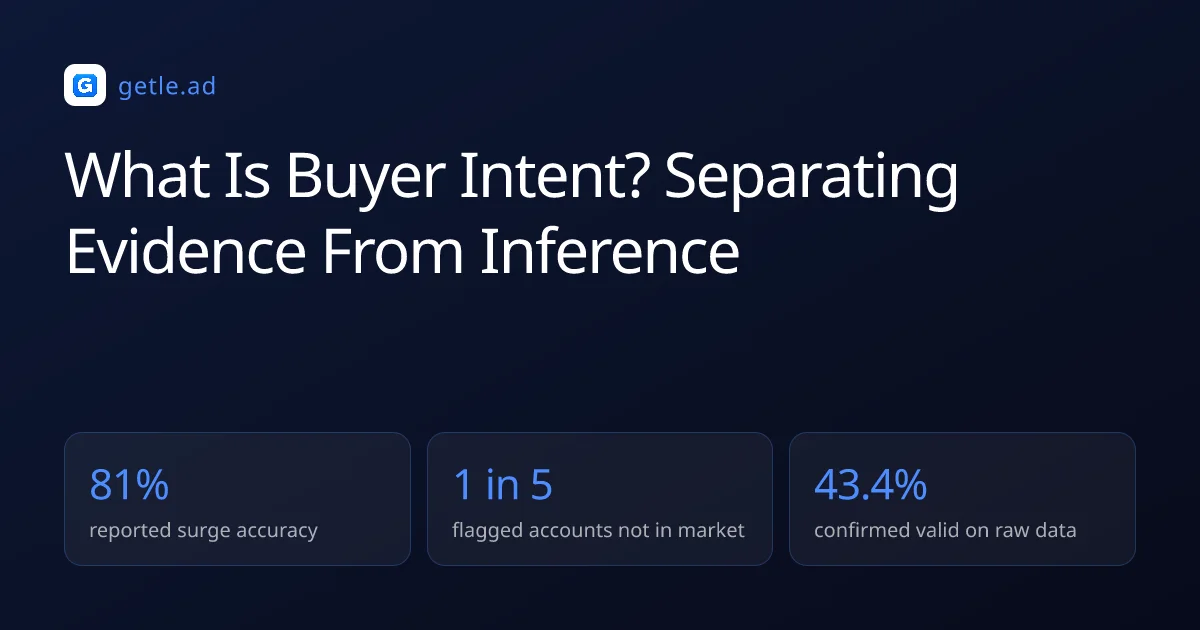
The first is treating a probability as a fact. Independent benchmarking has reported roughly 81% accuracy on surge signals, which is useful and is not certainty.
The second is granularity. Most purchased intent is account level, so it names a company without naming the person, and resolving the right contact remains your problem.
Using it without overpaying
- Define fit first, so intent reorders a list that was already worth contacting.
- Prefer observed signals, including free public ones, over modelled scores.
- Resolve and verify the contact, since a signal expires faster than an address decays.
- Write to the signal specifically, or the advantage disappears into a generic message.
- Run a holdout before renewing any paid intent source.
The holdout is the only honest test. Comparing flagged accounts against a matched unflagged set is what separates a signal that works from one that merely correlates with company size.
Sources and method
First-party data (Getlead, 2026): the verification split of 43.4% confirmed valid, 23.9% invalid, 16.7% catch-all and 16.0% unknown comes from 383,368 addresses analyzed through live SMTP verification, and the 0.51% bounce rate comes from 34,973 tracked sends, aggregated and anonymized at campaign level. Full method in our cold email benchmark study.
External sources: US commercial email obligations come from the FTC CAN-SPAM compliance guide; the 0.3% spam complaint ceiling and authentication requirements come from the Google Workspace sender guidelines.
Figures were checked in August 2026 and third party benchmarks vary in methodology.
Frequently asked questions
What is buyer intent?
Any signal suggesting an account is actively researching a problem you solve. The term covers behaviour you observed directly, public events such as hiring, consented co-op network activity, and inference from bidstream traffic, which differ enormously in reliability.
How accurate is intent data?
Independent benchmarking has reported roughly 81% accuracy on surge signals, meaning about one in five flagged accounts is not genuinely in market. That is usable as a probability and misleading when treated as a fact.
What is the strongest intent signal?
Behaviour you observed on your own properties, because the account, the person and the timestamp all arrive together. Public events such as hiring or funding come second, since they are dated facts rather than models.
Does intent data replace targeting?
No. Fit decides which accounts are worth contacting at all, and intent decides which of them to contact this week. A strong signal at an out of profile account is noise you paid for.
Why is account level intent a problem?
Because it names a company without naming a person. Buying account level signals without a way to resolve and verify the right contact leaves you with company names and the same sourcing work you started with.
How do I test whether intent data works?
Run a holdout: work half the flagged accounts and half of a matched set that was not flagged, then compare meetings booked. Vendor case studies compare flagged accounts against nothing, which guarantees a favourable result.