ON THIS PAGE
By Efe Berke Colaker, Founder at GetleadReviewed by the Getlead editorial team for accuracy. Last updated August 2026.
Intent data is sold as a single product and behaves like three. The differences are not marketing nuance, they decide whether a signal is evidence or an inference someone charged you for.
This separates the sources, states what each can support, and puts intent in its actual place in the workflow, which is later than most vendors suggest.
Three sources, ranked by how much they can prove
Intent data is any signal suggesting an account is actively researching a problem you solve, and its value depends entirely on how directly that signal was observed.
The fourth row is the one teams underuse. A job posting is not modelled or purchased, it is a public statement with a date on it, and it beats a surge score you cannot inspect.
For example, a company advertising four roles for the function you sell into has told you more, in public, than a vendor dashboard reporting elevated topic interest at the same account.
Where the accuracy claims come apart
Vendor accuracy figures are usually unfalsifiable, because the claim is about intention rather than about a fact you can check.
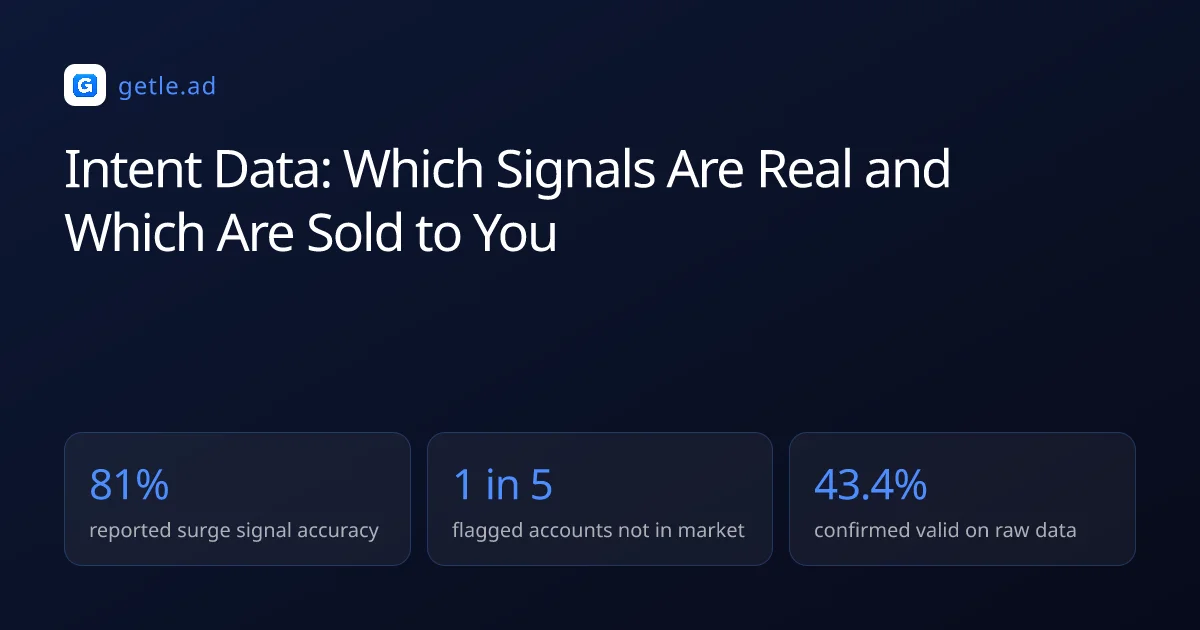
Independent benchmarking reported roughly 81% accuracy on surge signals, which means about one in five flagged accounts is not actually in market. That is workable if you price the false positives in and dangerous if you treat the flag as a fact.
The second problem is granularity. Third party intent is nearly always account level, so it tells you a company is researching a category and not which of its 400 employees to write to.
That gap is where budgets disappear. Buying account level intent without a way to resolve the right contact leaves you with a list of company names and the same sourcing problem you started with.
What intent actually changes in the workflow
Intent is a sequencing input, not a targeting one. It reorders a list your ICP already produced, and it cannot rescue a list built on the wrong profile.
- Define the ICP as filters, which gives you the universe of accounts worth contacting at all.
- Score fit, so the list is ranked before any signal is applied.
- Layer signals to decide who moves to the top of this week's queue.
- Resolve the right contact at the flagged account, which intent will not do for you.
- Verify the address in the same week, since a signal expires faster than your data.
- Write to the signal, not to the category, or the whole exercise reads as generic.
For example, an account flagged as researching your category, with a matching ICP score and an open role for the owning function, is a defensible reason to write this week. The same flag on an out of profile company is noise you paid for.
Building first-party signal before buying any
The strongest source is the one you already own, and most teams have it switched off rather than missing.
- Pricing page visits from a known account, which is the closest thing to a declared shopping trip.
- Repeat visits within a short window, which separates research from a stray click.
- Reply and click behaviour on previous sequences, including the ones that went nowhere.
- Product usage at accounts on a free tier, where the signal is behavioural rather than inferred.
- Inbound form starts that were abandoned, which are intent with a name attached.
None of that requires a vendor. It requires connecting what you already collect to the account record, which is a data hygiene job rather than a purchase.
A first-party signal is behaviour you observed directly on your own properties, and it is the only category where the account, the person and the timestamp all arrive together.
If you do buy, buy it carefully
Third party intent is not useless. It is a probability multiplier that needs its price checked against the false positive rate.
- Ask how the signal is collected, and treat consented co-op collection as materially different from bidstream inference.
- Ask for signal level rather than account level detail, and expect most vendors not to have it.
- Run a holdout: work half the flagged accounts and half of a matched non flagged set, then compare meetings booked.
- Price the false positives explicitly, since roughly one in five flagged accounts will not be in market.
- Check the compliance basis, because inferred behavioural data carries a heavier burden than firmographics.
The holdout is the only test that settles it. Vendor case studies compare flagged accounts against nothing, which guarantees a favourable result regardless of whether the signal works.
On the legal side, behavioural inference about identifiable people sits closer to the sensitive end than a headcount band does, and Article 14 of the GDPR still expects you to explain where data about a person came from.
Sources and method
First-party data (Getlead, 2026): the verification split of 43.4% confirmed valid, 23.9% invalid, 16.7% catch-all and 16.0% unknown comes from 383,368 addresses analyzed through live SMTP verification, and the 0.51% bounce rate comes from 34,973 tracked sends, aggregated and anonymized at campaign level. Full method in our cold email benchmark study.
External sources: reported surge signal accuracy near 81% and the ranking of first-party over modelled third party signals come from 2026 intent measurement analysis; notice duties for third party sourced personal data are set out in Article 14 of the GDPR; US commercial email obligations come from the FTC CAN-SPAM compliance guide.
Vendor accuracy claims are rarely independently verifiable, so treat all figures in this category as directional. Checked in August 2026.
Frequently asked questions
What is B2B intent data?
Any signal suggesting an account is actively researching a problem you solve. It comes from three sources of very different quality: first-party behaviour on your own properties, consented co-op publisher networks, and bidstream inference from ad auction traffic.
How accurate is intent data?
Independent benchmarking has reported roughly 81% accuracy on surge signals, meaning about one in five flagged accounts is not genuinely in market. That is workable when the false positive rate is priced in and misleading when the flag is treated as a fact.
Why do intent programs fail?
Usually because third party intent is account level. It reports that a company is researching a category without identifying who to contact, so teams end up with a list of company names and the same contact sourcing problem they started with.
Does intent data replace an ICP?
No. Intent changes sequencing rather than targeting: it reorders a list your ICP already produced. A strong signal at an out of profile account is noise, because nothing about the signal makes that company a good fit.
What first-party signals should I use?
Pricing page visits from known accounts, repeat visits in a short window, reply and click behaviour on past sequences, product usage on free tiers, and abandoned form starts. All of it is behaviour you already collect and usually have not connected to the account record.
How do I test whether purchased intent works?
Run a holdout. Work half the flagged accounts and half of a matched set that was not flagged, then compare meetings booked. Vendor case studies compare flagged accounts against nothing, which guarantees a favourable result either way.