ON THIS PAGE
By Efe Berke Colaker, Founder at GetleadReviewed by the Getlead editorial team for accuracy. Last updated August 2026.
ABM is described as a strategy and bought as a software category, which is why so many programs stall after the account list is built.
The definition is simple. The interesting part is when it beats ordinary outbound, and what it costs to run properly.
The definition and the unit of work
Account based marketing is a go to market approach where a named account is the unit of targeting and measurement, and several people inside it are engaged in a coordinated way.
The shift from lead to account changes everything downstream. Reporting counts accounts engaged rather than form fills, and success means several stakeholders at one company rather than one interested individual.
For example, a team with five strategic targets can justify custom research per account. A team with 400 cannot, and pretending otherwise is how ABM programs quietly become ordinary campaigns with a more expensive tool.
When ABM beats ordinary outbound
Three conditions, and all three have to hold.
- Deal size justifies per account effort, since bespoke work is expensive.
- The buying group is genuinely several people, so coordination has something to coordinate.
- The target market is finite, meaning hundreds of accounts rather than tens of thousands.
If the market is large and the deal small, ordinary outbound with tight segments wins on cost per meeting. ABM is not a better version of prospecting, it is a different trade.
The data layer that decides whether it runs
An account list is not a contact list. Engaging a buying group needs several named, verified people at each company.
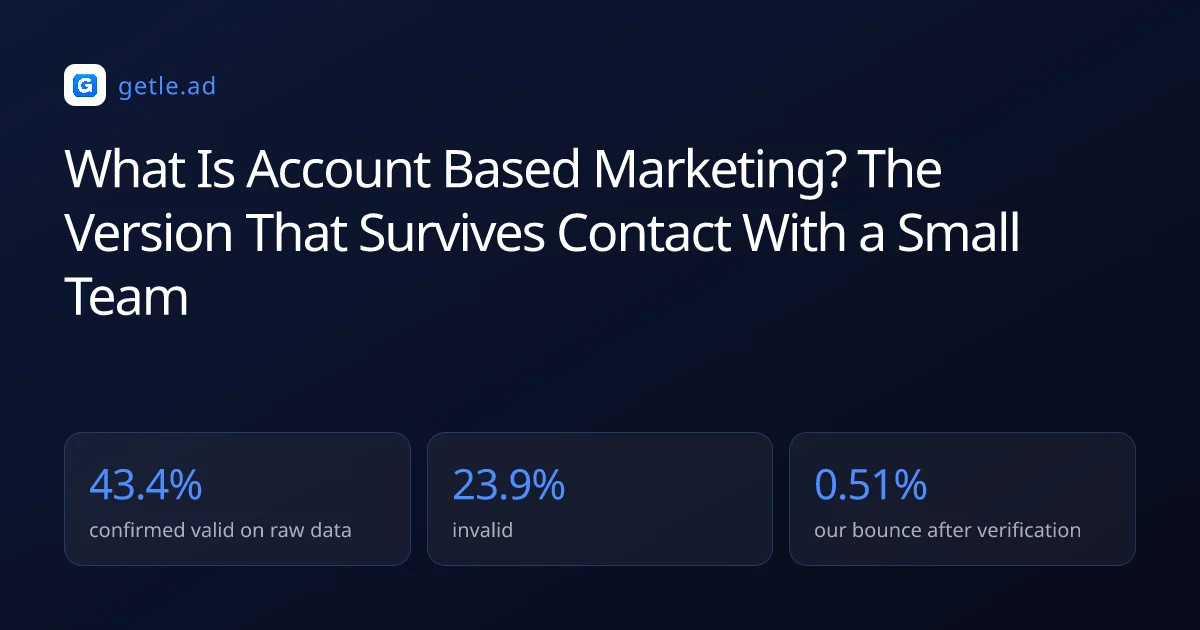
That multiplies the verification requirement. Four contacts at 200 accounts is 800 addresses, and at the 43.4% confirmed valid rate we measure on raw data, sourcing enough to survive verification is the real workload.
It also raises the cost of a mistake. Several people at one company receiving uncoordinated messages reads as a broadcast, and complaints from one account carry the same weight as complaints from anywhere else.
Sources and method
First-party data (Getlead, 2026): the verification split of 43.4% confirmed valid, 23.9% invalid, 16.7% catch-all and 16.0% unknown comes from 383,368 addresses analyzed through live SMTP verification, and the 0.51% bounce rate comes from 34,973 tracked sends, aggregated and anonymized at campaign level. Full method in our cold email benchmark study.
External sources: US commercial email obligations come from the FTC CAN-SPAM compliance guide; the 0.3% spam complaint ceiling and authentication requirements come from the Google Workspace sender guidelines.
Figures were checked in August 2026 and third party benchmarks vary in methodology.
Frequently asked questions
What is account based marketing?
A go to market approach where a named account is the unit of targeting and measurement, with several people inside that account engaged in a coordinated way rather than a single lead being nurtured.
How is ABM different from outbound?
Outbound targets people who fit a profile. ABM targets specific companies and engages a buying group inside each. ABM costs more per account and only pays back when deals are large and the market is finite.
What are the ABM tiers?
One to one covers five to twenty accounts with bespoke research, one to few covers twenty to a hundred in clusters sharing an angle, and one to many covers hundreds with segment level personalisation. Effort should scale with account value.
When is ABM the wrong model?
When the market is large and deals are small. If ordinary outbound with tight segments produces a lower cost per meeting, ABM is buying coordination you do not need at a price the deal size cannot support.
What data does ABM require?
Several named, verified contacts per target account rather than one. Four contacts across 200 accounts is 800 addresses, and only about 43% of raw records survive verification, so sourcing depth is the real constraint.
Does ABM avoid deliverability constraints?
No. Messages to several people at one company still count toward complaint rates, and uncoordinated outreach to a buying group reads as a broadcast, which is exactly what filters and recipients penalise.