ON THIS PAGE
By Efe Berke Colaker, Founder at GetleadReviewed by the Getlead editorial team for accuracy. Last updated August 2026.
Lead generation is used to mean everything from running ads to buying a list, which makes the term almost useless in a planning conversation.
The useful split is by who initiates. That single distinction decides the data you need, the tools you buy and the numbers you should watch.
The definition, and the split inside it
Lead generation is the process of identifying organisations and people who plausibly need what you sell, then creating a first conversation with them.
For example, a company ranking for a buying query is capturing demand that already exists. A company writing to 300 firms that just posted a relevant role is creating it. Both are lead generation and neither substitutes for the other.
What actually counts as a lead
A name and a company is not a lead. Three things have to be present before the record can produce anything.
- A named person, since shared inboxes reach a queue rather than a decision maker.
- A verified contact route, meaning an address confirmed to accept mail.
- A reason to talk, whether the buyer supplied it inbound or you observed it outbound.
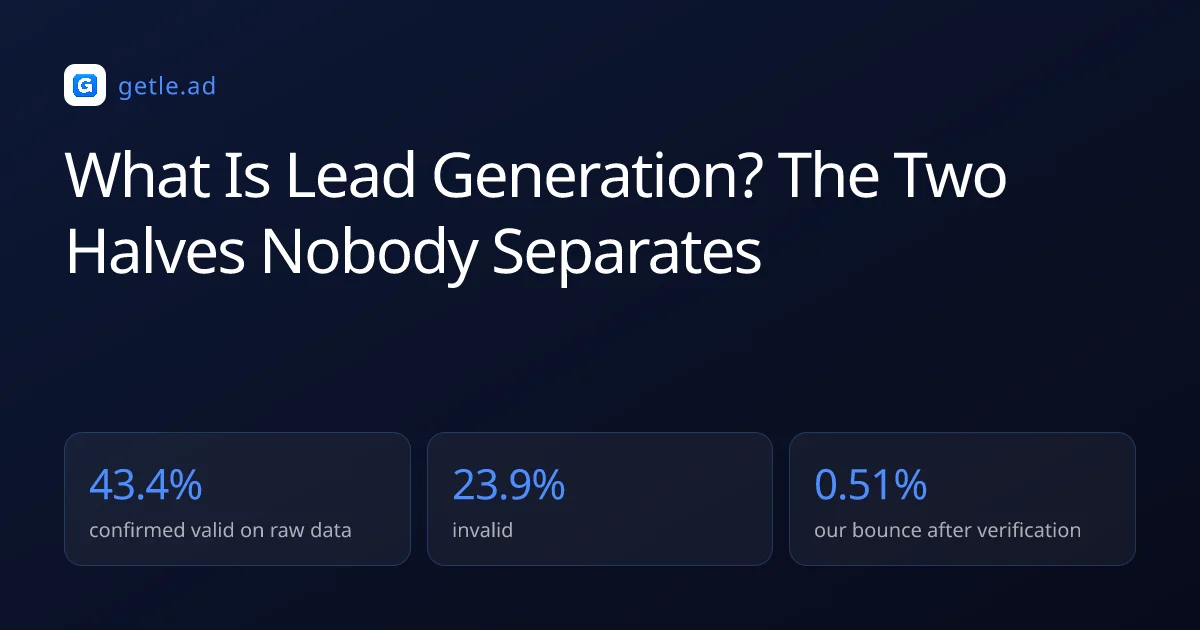
The second condition is where most counted leads fail. In our verification of 383,368 raw B2B addresses, 23.9% were invalid outright, so a quarter of a typical raw list cannot be contacted at all.
Measuring each half honestly
Shared metrics hide which half is working. Split them.
- Inbound: qualified form fills, cost per qualified fill, and time from fill to first contact.
- Outbound: positive replies per thousand delivered, meetings booked per thousand, and bounce rate per segment.
- Both: opportunities created and win rate by source, which is the only comparison that matters at the end.
For example, a team celebrating 400 monthly leads while booking six meetings has a definition problem rather than a volume problem, and splitting the metrics reveals it immediately.
It is a flow problem, not a stock problem
Teams talk about building a database as though it were an asset that holds value. Contact data decays at roughly 2.1% a month, compounding to about 22.5% a year, so the stock shrinks whether you use it or not.
That reframes the work. The question is not how many leads you have, it is how many verified, relevant conversations you can start this month and repeat next month.
Signal based sourcing follows from that. If the trigger is an event rather than a record, the list rebuilds itself and the decay problem largely disappears.
Sources and method
First-party data (Getlead, 2026): the verification split of 43.4% confirmed valid, 23.9% invalid, 16.7% catch-all and 16.0% unknown comes from 383,368 addresses analyzed through live SMTP verification, and the 0.51% bounce rate comes from 34,973 tracked sends, aggregated and anonymized at campaign level. Full method in our cold email benchmark study.
External sources: contact decay of about 2.1% a month compounding to 22.5% a year comes from the HubSpot database decay model built on MarketingSherpa research; US commercial email obligations come from the FTC CAN-SPAM compliance guide.
Figures were checked in August 2026 and provider policies change without notice.
Frequently asked questions
What is lead generation?
The process of identifying organisations and people who plausibly need what you sell, then starting a first conversation with them. It splits into inbound capture, where the buyer initiates, and outbound creation, where you do.
What is the difference between inbound and outbound lead generation?
Who starts the conversation. Inbound captures demand that already exists through content, search and forms. Outbound creates it by contacting people who fit a profile, which requires verified contact data and sending infrastructure instead.
What counts as a lead?
A named person, a verified contact route and a reason to talk. Without the verified route the record cannot produce anything, and in our data 23.9% of raw B2B addresses are invalid, so a quarter of a typical list fails that test.
How should lead generation be measured?
Separately by half. Inbound on qualified form fills and cost per fill, outbound on positive replies and meetings per thousand delivered. Both roll up to opportunities created and win rate by source, which is the only fair comparison.
Why is lead generation a flow problem?
Because contact data decays around 2.1% a month, compounding to roughly 22.5% a year. A database is not a stable asset, so the useful question is how many verified conversations you can start this month and repeat next month.
Is buying a list lead generation?
It is one sourcing method inside outbound, and it works only when the records are verified and the targeting is real. In our verification of raw B2B data, 40.7% of addresses were invalid or unconfirmable before any filtering.