ON THIS PAGE
By Efe Berke Colaker, Founder at GetleadReviewed by the Getlead editorial team for accuracy. Last updated August 2026.
Franchise lead generation means at least three different things depending on who is asking, and the confusion produces campaigns that serve none of them.
Separating the audiences first is what makes the rest tractable, because each one has a different buyer, cycle and metric.
The three problems hiding under one phrase
Franchise development is the recruitment of new franchisees, and it behaves like hiring rather than like selling, with long consideration and heavy qualification.
For example, a campaign optimised for volume of enquiries will bury a development team in unqualified interest, because the constraint there is qualification capacity rather than lead supply.
Franchise development is a qualification problem
The prospect is committing capital and years, so the sales process resembles an investment decision more than a purchase.
- Define financial qualification before any campaign runs, because it removes most enquiries.
- Segment by prior experience, since operators and first time owners need different conversations.
- Use territory availability as a genuine constraint rather than a scarcity tactic.
- Expect a long cycle and instrument it, so early stages are not judged on close rate.
- Track cost per signed unit and nothing shorter at board level.
Volume metrics actively mislead here. A month with fewer, better qualified enquiries is a better month, and a dashboard counting enquiries will report the opposite.
Selling into franchise networks
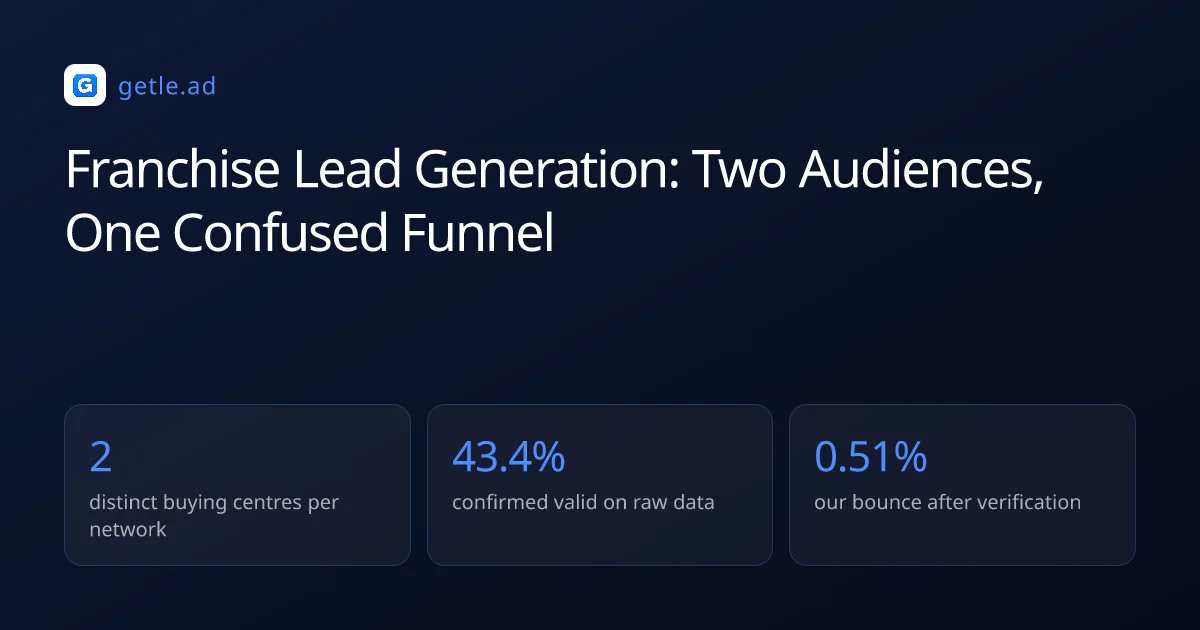
For suppliers, franchise networks are an unusual B2B structure: purchasing authority is split between head office and independently owned units.
Some categories are mandated centrally and some are left to each franchisee, and selling to the wrong level wastes the entire cycle.
The efficient sequence is usually approval first and rollout second. Preferred supplier status converts one sale into a route to every unit in the network.
Reaching individual units
Where the budget sits locally, the target is hundreds of small businesses with a shared brand and independent owners.
That is ordinary small business outbound with one advantage: the network is enumerable, since franchisors publish their unit locations.
Our solutions page for the sector covers how these lists are built inside the platform, and directory scraping fills the gaps where the franchisor publishes less detail.
Data quirks in franchise networks
Franchise contact data has a specific problem: units frequently share a domain with the franchisor while operating independently.
That produces catch-all behaviour and generic addresses, and in our verification 16.7% of addresses sat behind catch-all domains where no confirmation is possible.
Resolve a named owner or manager per unit rather than mailing a branded general address, which is where most franchise outbound quietly disappears.
Sources and method
First-party data (Getlead, 2026): the verification split of 43.4% confirmed valid, 23.9% invalid, 16.7% catch-all and 16.0% unknown comes from 383,368 addresses analyzed through live SMTP verification, and the 0.51% bounce rate comes from 34,973 tracked sends, aggregated and anonymized at campaign level. Full method in our cold email benchmark study.
External sources: US commercial email obligations including accurate headers and a working opt-out come from the FTC CAN-SPAM compliance guide; notice duties when personal data is obtained from a third party are set out in Article 14 of the GDPR.
Franchise structures differ widely by brand and jurisdiction, so treat the buying centre split as a pattern rather than a rule. Checked in August 2026.
Frequently asked questions
What does franchise lead generation actually mean?
At least three different things: recruiting new franchisees, helping existing franchisees find local customers, and suppliers selling into franchise networks. Each has a different audience, cycle and metric, and merging them produces campaigns that serve none.
How is franchise development different from normal lead generation?
It behaves like recruitment rather than selling. The prospect commits capital and years, so qualification capacity rather than lead supply is the constraint, and cost per signed unit is the only board level metric.
Why do volume metrics mislead in franchise development?
Because a month with fewer, better qualified enquiries is a better month. A dashboard counting enquiries reports the opposite, which pushes teams to optimise for exactly the wrong outcome.
How do suppliers sell into franchise networks?
By identifying whether the category is mandated centrally or left to each unit. Approval first and rollout second is usually the efficient sequence, since preferred supplier status converts one sale into a route to every unit.
How do I build a list of franchise units?
Franchisors publish unit locations, which makes the network enumerable in a way most markets are not. Directory sources fill gaps where the franchisor publishes less contact detail.
What is the data problem with franchise outreach?
Units often share a domain with the franchisor while operating independently, which produces catch-all behaviour and generic addresses. In our verification 16.7% of addresses sat behind catch-all domains where confirmation is impossible.