ON THIS PAGE
By Efe Berke Colaker, Founder at GetleadReviewed by the Getlead editorial team for accuracy. Last updated September 2026.
Subcontractors and material suppliers must secure projects before ground breaks, because waiting for bid invitations leaves revenue dependent on existing relationships. A commercial HVAC subcontractor might rely on three general contractors for 80 percent of their annual revenue. If one of those builders loses a major bid, the subcontractor faces an immediate $500,000 revenue shortfall. Building an independent outbound engine protects the business from these sudden pipeline collapses.
Construction lead generation is the systematic process of identifying upcoming building projects and contacting developers to submit bids. For example, a commercial HVAC subcontractor monitors municipal permit approvals to locate new retail build-outs in their territory. They email the assigned general contractor to offer a detailed estimate before the mechanical bidding window closes.
This outbound system replaces passive waiting with a predictable revenue pipeline. Success requires accurate project timing, verified contact data, and a specific bidding proposition.
The data behind construction outbound
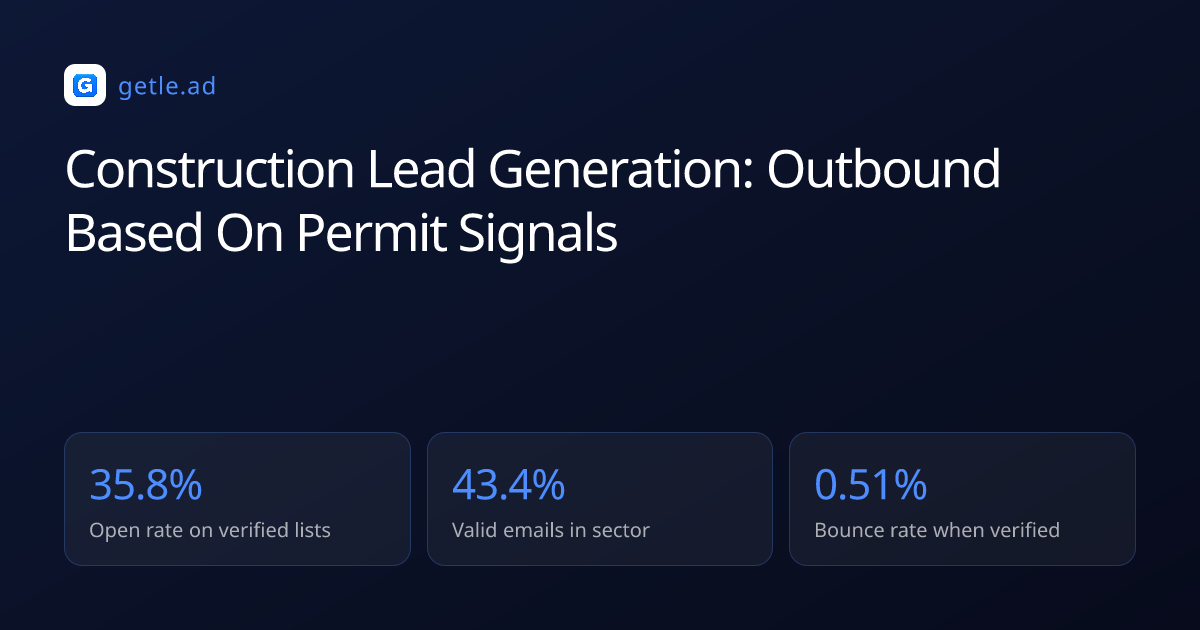
Outbound campaigns in the construction sector rely on accurate project signals. Contact data degrades fast because general contractors reassign project managers frequently across different sites. The performance gap between top operators and failing campaigns comes down to email validation.
Consider a database of 10,000 construction contacts purchased from a standard data broker in January. By June, industry turnover and project reassignments will render approximately 3,000 of those email addresses invalid. A campaign sent to that stale list in July will hit a 30 percent bounce rate on the first day. This bounce spike will burn the sending domain, forcing the team to rebuild their infrastructure.
These numbers reveal a market where more than half of the available contact data is useless. Sending messages to the unverified segment guarantees a high bounce rate and immediate spam placement. Teams that filter their lists before sending achieve higher inbox placement and reply rates.
Fixing the data gap
- Stop buying static lists from vendors who do not refresh their databases monthly.
- Scrape dynamic project signals directly from municipal permit boards and commercial bidding platforms.
- Verify every single email address through a live SMTP check before launching the campaign.
Scraping municipal permit signals
Municipal permit data remains a matter of public record in almost every local jurisdiction. These documents show the exact project scope, the property developer, and the assigned general contractor. Scraping this data requires specific automation because individual counties format their digital databases differently.
A commercial cleaning firm might target post-construction cleanup jobs instead of early structural work. They monitor certificates of occupancy rather than initial building permits to time their outreach. This specific timing ensures they contact the builder when final cleaning services become necessary.
Consider a concrete example of scraping the Chicago Cityscape portal. A roofing subcontractor sets up a Python script using BeautifulSoup to parse the weekly building permit release. The script targets permits with an estimated value over $500,000, extracting the general contractor name and the site address. If the permit description contains keywords like roof, membrane, or shingles, the script flags the project.
This automated filtering yields an average of 14 qualified commercial roofing leads per week. Once the script identifies these 14 leads, the subcontractor exports the data to a CSV file. The file maps the contractor name to a domain search tool to find the corporate website. This step converts raw municipal data into a structured list of target accounts ready for contact discovery.
Many municipal portals use legacy software that requires navigating through multiple search forms to find permit details. A scraping workflow uses a headless browser like Puppeteer to automate these form submissions. The script inputs a date range, clicks the search button, and parses the resulting HTML table. It then iterates through the pagination links to capture every permit issued in the last 24 hours.
Structuring the data extraction
- Identify the top five municipal planning portals in your target geographic service area.
- Build a scraper to extract the project address, valuation, and applicant company name daily.
- Filter the output to isolate projects that match your specific trade capabilities and capacity.
Timing outreach by construction trade
Different construction trades require different municipal permit signals to trigger their outbound sales motions. A demolition contractor needs early municipal notices, while a commercial painter looks for late-stage finishing schedules. Sending a bid too early results in ignored emails, whereas sending too late means the contract is already signed.
Electrical subcontractors monitor specialized permit applications filed weeks after the main structural approval clears. They extract the general contractor details from the initial building permit, waiting for the electrical filing to initiate contact. This specific timing proves to the builder that the subcontractor understands the standard project lifecycle.
Suppliers selling raw building materials face a different challenge than subcontractors selling specialized installation labor. Material suppliers must reach the procurement manager before the subcontractor signs a binding vendor agreement. This strategy requires tracking commercial project announcements in the local business press rather than waiting for permits.
Tracking foundation timelines
For instance, a drywall supplier tracks a 200-unit multifamily development announced in a regional business journal. The supplier knows the framing phase takes approximately 60 days from the foundation pour. They schedule their cold email sequence to hit the procurement manager on day 45 of the framing phase. This 15-day window before drywall installation begins is when the contractor actively compares material quotes.
If the supplier waits for the drywall permit, the contractor has already sourced the gypsum boards. Early outreach based on foundation timelines secures the $85,000 material order before competitors even know the project exists.
A concrete pouring contractor operates on a different timeline than the drywall supplier. The concrete team must secure the contract before the municipal planning board issues the final building permit. They monitor zoning variance requests and preliminary site plan approvals to identify projects in the design phase. Reaching the developer during this early stage allows the contractor to influence the structural specifications.
Finding the correct project estimator
The municipal permit lists the company name, but you need the specific project manager. General corporate inboxes rarely forward unsolicited bids to the correct estimating desk in time. You must find the specific employee handling procurement for that construction site.
Use a dedicated scraping tool to extract employee names from the company website directly. You can also search professional networks for titles like Chief Estimator or Lead Project Manager. Once you have the name, construct the email address using standard corporate domain formats.
A standard contact discovery workflow involves three distinct steps to isolate the decision maker. First, query the general contractor company name on LinkedIn and filter the employee list by the target city. Second, search the filtered list for keywords like Estimator, Preconstruction, or Project Executive. Third, run the identified names through an email permutation tool to generate potential addresses like first.last@company.com.
If the target company has 50 employees, this method usually identifies two or three relevant estimators. You then load these three permutations into an SMTP verification tool to find the active inbox. This precise targeting prevents your bid from languishing in an unmonitored info@company.com address.
Large commercial general contractors often divide their estimating departments by specific trade divisions. A $50 million hospital project will have separate estimators for mechanical, electrical, plumbing, and structural packages. Sending a plumbing bid to the structural estimator guarantees the email will be ignored or deleted. You must cross-reference the employee title with the specific trade package you intend to bid.
Verifying legacy construction domains
Construction companies often use legacy email servers that handle incoming mail poorly. These older servers routinely return unknown or catch-all responses during standard automated verification checks. Sending blindly to these ambiguous addresses damages your sending domain reputation over the long term.
Our internal data shows how severe this infrastructure problem is for outbound teams. When we analyzed 383,368 email addresses, we found 23.9% were invalid. Another 16.7% registered as catch-all addresses, which require specialized secondary verification steps to clear.
Handling catch-all domains
Never send your initial cold email sequence to a list of unverified catch-all addresses. Segment these contacts into a separate campaign and send them from a secondary domain. This isolation strategy protects your primary sending infrastructure from unexpected bounce spikes.
To verify a catch-all address, you must use a specialized tool that performs a mailbox-level ping. For example, if john.smith@builder.com returns a catch-all status, the tool sends a hidden test message. The server response to this test message indicates whether the specific inbox actually exists. This secondary check typically recovers about 40 percent of catch-all addresses as safe to send.
If the secondary check fails, you must discard the email address to protect your bounce rate. A bounce rate above 2 percent triggers spam filters at major providers like Google and Microsoft. Maintaining a strict verification protocol ensures your bids actually reach the estimator.
Some construction firms route their email through aggressive third-party spam filters like Mimecast or Proofpoint. These security gateways often quarantine emails containing attachments or complex HTML formatting. To bypass these filters, your initial cold email must be plain text without any links or PDF proposals. You only send the detailed PDF bid after the estimator replies and establishes a trusted communication thread.
Writing the bid proposal email
Contractors read their emails on mobile devices while standing at active, noisy job sites. Keep your initial message under 50 words to accommodate small mobile screen sizes. State the project address in the subject line to prove your relevance immediately.
Offer a specific material price or labor estimate rather than asking for a meeting. A busy general contractor only wants to know if you can complete the required work. Save your detailed company history and safety records for the formal proposal document later.
Residential home improvement contractors face a similar dynamic when bidding on multi-family developments. The developer wants a clear cost breakdown, not a long introduction about your brand. Clarity and brevity win the contract over complex formatting.
Consider a concrete example of a successful cold email for a plumbing subcontractor. The subject line reads: Plumbing Bid for 1420 Main Street Retail Build. The body states: I saw your permit for the Main Street retail project. We can handle the rough-in and finish plumbing for $42,000, starting November 15. Let me know if you want the full line-item breakdown.
This 42-word email contains the project address, the specific scope, a hard price, and a start date. It requires zero scrolling on a mobile phone and asks a simple yes or no question. The estimator can forward this message to the project manager with a single tap.
Avoid using industry jargon or marketing buzzwords that waste the limited attention span of the estimator. Phrases like synergistic partnership or innovative building solutions immediately mark your email as a generic sales pitch. The estimator evaluates your competence based on your pricing, your schedule, and your safety record. Presenting these three facts clearly demonstrates more professionalism than a paragraph of empty marketing copy.
“If the subject line does not contain my specific project address, I delete the email without opening it.”
Senior Project Manager at a regional commercial builder
Scaling the deliverability infrastructure
Setting up proper email infrastructure prevents your initial bid messages from landing in the recipient spam folder. You must configure SPF, DKIM, and DMARC records for every domain you purchase for outbound. Missing these authentication records guarantees that major mailbox providers will reject your commercial emails.
A single mailbox should send no more than 30 to 50 cold emails per day to maintain a healthy reputation. Scaling your daily outreach volume requires adding more sending domains and dedicated mailboxes to your technical setup. Getlead offers pre-warmed mailboxes from $39 a month for three mailboxes and a domain to simplify this process.
Spread your sending volume across multiple secondary domains to protect your primary company website from negative reputation signals. If a specific campaign generates unexpected spam complaints, your main corporate domain remains safe. This isolated infrastructure is a standard requirement for modern outbound operations across all business sectors.
Warming up secondary domains
To send 500 cold emails per day, you need a specific infrastructure setup to avoid spam filters. You purchase five secondary domains that look similar to your main brand, like getlead-app.com or trygetlead.com. You create two mailboxes per domain, resulting in ten total sending accounts. Each mailbox sends 50 emails per day, keeping the volume safely under provider limits.
Before launching the campaign, you must warm up these ten mailboxes for 14 days. The warmup process involves sending automated messages to a network of trusted inboxes that automatically reply. This simulated activity builds a positive sender reputation with Google and Microsoft algorithms. Once the warmup period concludes, you gradually introduce your actual construction leads into the sending queue.
Monitoring your domain reputation requires connecting your sending domains to Google Postmaster Tools. This free dashboard shows your spam complaint rate and domain reputation score as measured by Google. If your spam rate exceeds 0.3 percent, you must pause the campaign immediately to investigate the cause. Continuing to send with a high spam rate will cause all your emails to route to the spam folder.
Sources and method
The FTC CAN-SPAM compliance guide was used to outline legal requirements for commercial email in the United States. ConstructConnect was referenced for the operational benefits of using commercial project data services.
The US Bureau of Labor Statistics provides baseline data on construction industry employment and firm sizes.
Figures were checked in September 2026.
Frequently asked questions
How to generate leads in construction?
Generate construction leads by scraping municipal permit databases to identify upcoming commercial building projects. Extract the general contractor details from the permit, find the specific project manager online, and send a highly targeted cold email offering a specific bid.
How much do construction lead generation companies charge?
Commercial construction lead generation platforms typically charge between $100 and $300 per month for access to project databases. Agencies that run the entire outbound email motion often charge a retainer of $2,000 to $5,000 per month plus commission.
Is construction slowing down in 2026?
Commercial construction starts show regional variation in 2026, with retail build-outs slowing while industrial warehouse projects expand. Subcontractors must widen their geographic targeting and increase their outbound email volume to maintain the same pipeline of qualified project bids.
What is the best way to contact general contractors?
The best method is a short, text-only cold email sent directly to the project estimator or procurement manager. State the exact project address in the subject line to prove relevance, and keep the body under 50 words.
Why do purchased construction lead lists fail?
Purchased lists fail because construction professionals change job sites and employers frequently, causing data to decay rapidly. Sending unverified emails to these static lists results in high bounce rates, which destroys your domain reputation and prevents future inbox placement.