ON THIS PAGE
By Efe Berke Colaker, Founder at GetleadReviewed by the Getlead editorial team for accuracy. Last updated August 2026.
Industrial buyers are among the easiest to reach and the slowest to decide, which produces a distinctive failure mode: healthy pipeline numbers and nothing closing for two quarters.
Building for that means changing what you measure, not just how much you send.
The shape of an industrial purchase
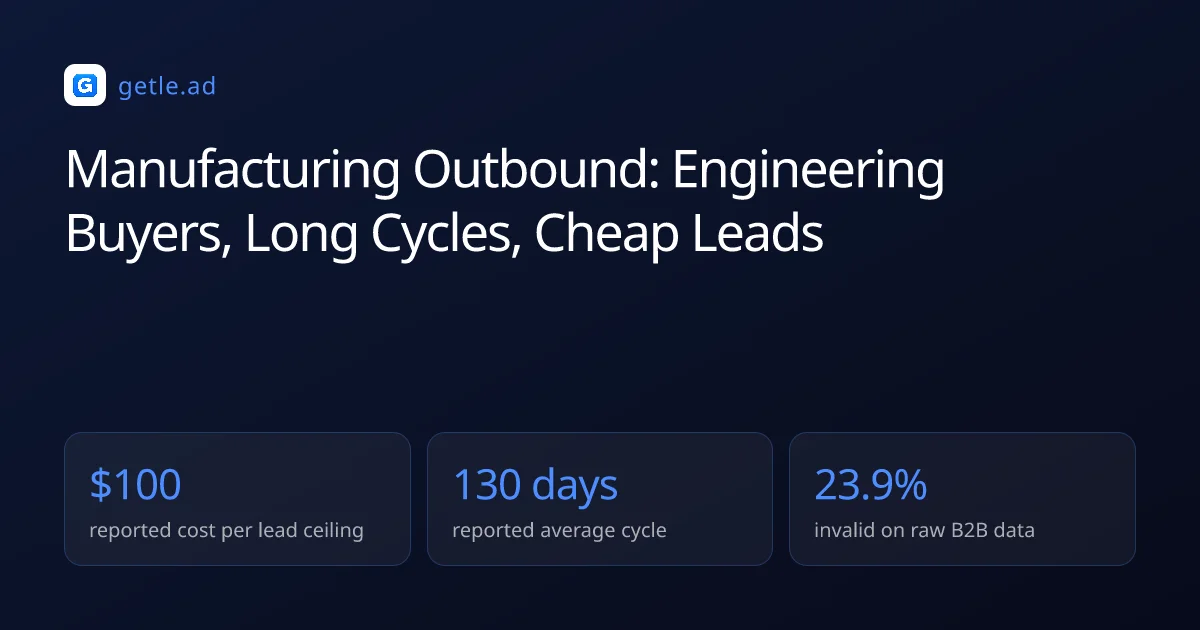
Published 2026 benchmarks put manufacturing among segments below $100 cost per lead, with average cycles near 130 days and a majority of sellers reporting cycles lengthening.
Capital equipment purchases sit at the long end of that distribution, because they involve budget cycles rather than discretionary spend.
Writing for an engineering buyer
The technical evaluator in the room is the one most likely to reject a message on style alone, and marketing language is the fastest route to being ignored.
- Lead with specification, not with outcome adjectives. Tolerances, throughput, materials, compatibility.
- Be exact about limits. Stating what the product does not do buys more credibility than any claim.
- Skip the social proof block unless the reference is a comparable operation.
- Offer documentation rather than a call as the first step.
For example, a message that names the exact interface standard you support is more persuasive to a plant engineer than three sentences about efficiency gains, and it is also shorter.
Procurement asks a different set of questions, and sending them the engineering message wastes the contact. Separate the two threads from the start.
Cheap leads change the risk profile
When cost per lead is low, the temptation is to solve everything with volume. That works until deliverability becomes the limiting factor instead of budget.
In our verification of 383,368 raw B2B addresses, 23.9% were invalid. On industrial directory data the pattern is worse than average, because small suppliers change domains and hosting frequently.
Verify before every send rather than at import. Across 34,973 tracked sends that discipline held bounce at 0.51%, which is what keeps a domain usable at volume.
Timing signals that work in industry
Industrial buying is triggered by physical and operational events, which are more visible than software purchase triggers.
New facilities, line expansions, certification announcements, equipment hiring and regulatory changes all move budget, and most of them are announced publicly or appear in job postings.
A plant hiring maintenance engineers for a second shift is telling you about capacity expansion months before any procurement process starts, which is exactly when a supplier wants to be present.
Managing a program nobody can rush
With a 130 day average and capital purchases running far longer, the main operational risk is abandoning a working program before it produces revenue.
Build a follow up cadence measured in months rather than days for accounts that responded positively without a timeline. Those are not dead, they are early.
Reported MQL to SQL conversion sits near a 13% median with the top quartile far above it, which suggests the gap is mostly qualification discipline rather than channel choice.
Sources and method
First-party data (Getlead, 2026): the verification split of 43.4% confirmed valid, 23.9% invalid, 16.7% catch-all and 16.0% unknown comes from 383,368 addresses analyzed through live SMTP verification, and the 0.51% bounce rate comes from 34,973 tracked sends, aggregated and anonymized at campaign level. Full method in our cold email benchmark study.
External sources: cost per lead segment position, average cycle length, committee composition and MQL to SQL medians come from 2026 manufacturing and B2B lead generation benchmark analyses; US commercial email obligations come from the FTC CAN-SPAM compliance guide.
Third party benchmarks on cycle length, committee size and conversion vary widely by segment and methodology, so read them as directional. Checked in August 2026.
Frequently asked questions
How much do manufacturing leads cost?
Reported 2026 benchmarks place manufacturing below $100 cost per lead, among the lower cost segments in B2B. The constraint in this sector is cycle length rather than acquisition cost.
How long is an industrial sales cycle?
Reported averages sit near 130 days, with capital equipment and specialised components running considerably longer because they follow budget cycles rather than discretionary spend.
How do I write to an engineering buyer?
Lead with specification rather than outcome adjectives, state limits explicitly, skip generic social proof and offer documentation instead of a call. Naming an exact interface standard persuades more than three sentences about efficiency.
Should I send the same message to procurement?
No. Procurement asks about contracting, lead times and total cost, while engineering asks about fit and limits. Sending the engineering message to procurement wastes the contact.
What timing signals work in manufacturing?
New facilities, line expansions, certification announcements and hiring for equipment or maintenance roles. A plant hiring maintenance engineers for a second shift signals capacity expansion months before procurement begins.
Why do manufacturing programs get cancelled too early?
Because a 130 day average means the first two quarters show activity without revenue. Accounts that responded positively without a timeline are early rather than dead, and they need a follow up cadence measured in months.