ON THIS PAGE
By Efe Berke Colaker, Founder at GetleadReviewed by the Getlead editorial team for accuracy. Last updated August 2026.
Most cold email advice ends at the send. The reply is where the return actually is, and it is usually handled by whoever notices the notification first.
Sorting replies into four types makes the workflow obvious and stops the two expensive mistakes: slow answers and missed removal requests.
The four types
A remove request is any message asking not to be contacted again, however it is phrased, and it has to be treated as an opt-out even when it does not use the word unsubscribe.
For example, a one word reply saying stop is a formal opt-out in substance. Treating it as an unclear message and continuing the sequence converts a polite exit into a spam complaint.
Why speed dominates quality here
An interested reply is a short window. The prospect wrote while the message was in front of them, and attention decays through the day.
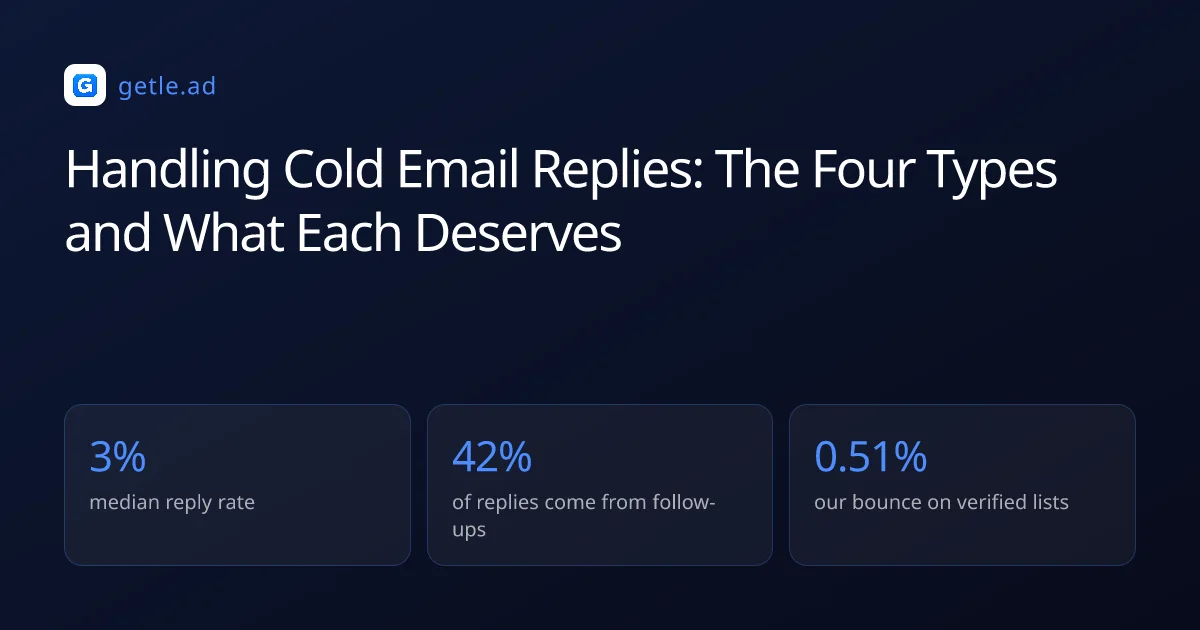
At a median reply rate near 3%, each reply represents roughly 33 sends of effort. Losing one to a two day response time is the most expensive avoidable loss in the whole workflow.
Practical version: one person owns the inbox each day, replies inside working hours, and books rather than negotiating over email. A calendar link in the second message beats a paragraph of availability.
A workflow that survives rotation
- Route every reply to one shared view, even though sends come from several mailboxes.
- Classify into the four types on arrival, by rule where possible.
- Suppress remove requests immediately and globally, across every campaign and mailbox.
- Stop the sequence for any reply that is not an auto responder, since continuing reads as automation.
- Log the outcome on the account record so the next campaign knows what happened.
Sequence stopping is the step most often missed in rotation setups. A prospect who replied and still receives message three has learned that nobody read their answer.
Sources and method
First-party data (Getlead, 2026): the verification split of 43.4% confirmed valid, 23.9% invalid, 16.7% catch-all and 16.0% unknown comes from 383,368 addresses analyzed through live SMTP verification, and the 0.51% bounce rate and 35.8% open rate come from 34,973 tracked sends, aggregated and anonymized at campaign level. Full method in our cold email benchmark study.
External sources: median B2B reply rates near 3% and the finding that roughly 42% of replies arrive from follow-ups come from 2026 cold email benchmark compilations; US commercial email obligations come from the FTC CAN-SPAM compliance guide.
Third party benchmarks vary in methodology and should be read as directional. Checked in August 2026.
Frequently asked questions
How should I handle cold email replies?
Sort them into four types: interested, not now, wrong person and remove me. Answer the first three the same working day, and suppress remove requests immediately and globally across every campaign and mailbox.
How fast should I reply to an interested prospect?
The same working day. At a median 3% reply rate each reply represents roughly 33 sends of effort, so losing one to a slow response is the most expensive avoidable loss in the workflow.
What counts as an opt-out request?
Any message asking not to be contacted again, however it is phrased. A one word stop is an opt-out in substance, and continuing the sequence converts a polite exit into a spam complaint.
Should a reply stop the sequence?
Yes, for anything that is not an auto responder. A prospect who replied and still receives the next scheduled message has learned that nobody read their answer, which ends the conversation more reliably than a bad reply would.
What do I do with a not now reply?
Answer the same day, confirm the timing they gave, and park the record with a date rather than leaving it in the active sequence. A not now with a date attached is a better lead than most new records.
How do replies work across multiple mailboxes?
Route them into one shared view even though sends come from several mailboxes, and keep suppression global. Rotation makes reply handling harder, which is why sequence stopping and suppression must be automatic rather than manual.