ON THIS PAGE
By Efe Berke Colaker, Founder at GetleadReviewed by the Getlead editorial team for accuracy. Last updated August 2026.
Objection handling frameworks come from sales calls, where the other person committed time. A cold email reply is different: they gave you one line while doing something else.
So the goal is not to overcome anything, it is to make the next reply cheap for them.
The five objections
An objection in this context is usually a low cost dismissal rather than a considered position, which is why a long rebuttal performs worse than a short question.
For example, no budget almost never means the budget is fixed at zero. It means the problem has not been priced against anything, and a question about what would change that keeps the thread alive without arguing.
The referral reply is the best outcome
Not the right person is frequently treated as a failure. It is the most useful reply in outbound, because it converts a cold contact into a warm one at the same account.
Ask directly and make it effortless: who owns this, and may I mention you wrote back. That second clause turns the next message from cold outreach into an internal referral.
Then verify the new address before sending, since a name passed along in a reply is not a verified contact and our raw data shows 23.9% of addresses invalid.
When to stop
- Any request to stop. Suppress immediately, globally, whatever wording was used.
- Not interested with force. One acknowledgement, then nothing.
- Three unanswered follow-ups. The sequence has said what it can say.
- A referral that goes nowhere twice. The account is not ready and the contact has done enough.
Stopping is a deliverability decision as much as a courtesy. Complaints are capped at 0.3% of delivered messages, and persistence after a clear no is the fastest route to that number.
Sources and method
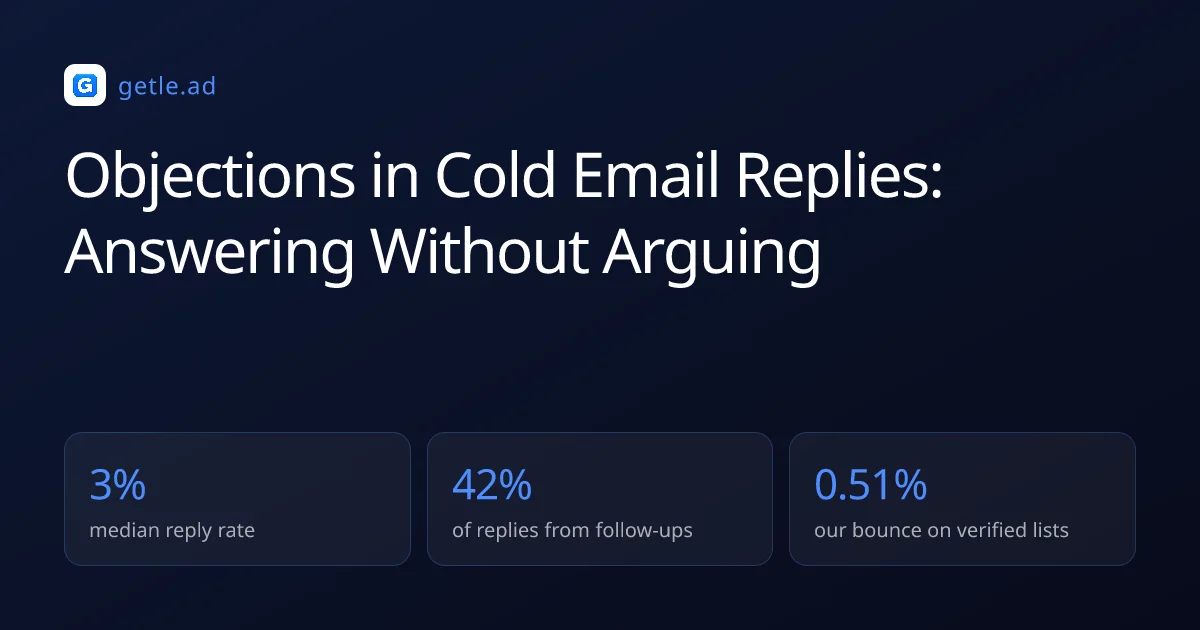
First-party data (Getlead, 2026): the verification split of 43.4% confirmed valid, 23.9% invalid, 16.7% catch-all and 16.0% unknown comes from 383,368 addresses analyzed through live SMTP verification, and the 0.51% bounce rate and 35.8% open rate come from 34,973 tracked sends, aggregated and anonymized at campaign level. Full method in our cold email benchmark study.
External sources: median B2B reply rates near 3% and the finding that roughly 42% of replies arrive from follow-ups come from 2026 cold email benchmark compilations; the 0.3% spam complaint ceiling comes from the Google Workspace sender guidelines.
Third party benchmarks vary in methodology and should be read as directional. Checked in August 2026.
Frequently asked questions
How do I handle objections in cold email replies?
Answer short and ask a question rather than rebutting. Five objections cover nearly everything: no budget, no time, using someone else, not the right person, and not interested. Each has a one line response that keeps replying cheap.
What does no budget usually mean?
That the problem has not been priced against anything yet, rather than that spending is fixed at zero. A question about what would make it a priority keeps the thread open without arguing about money.
Is not the right person a failure?
No, it is the most useful reply in outbound. Ask who owns the area and whether you can mention they wrote back, which converts the next message from cold outreach into an internal referral.
Should I rebut not interested?
No. If there is any force behind it, treat it as an exit: acknowledge once and stop. Persistence after a clear no is the fastest route to a spam complaint, and the ceiling is 0.3% of delivered messages.
How many follow-ups after an objection?
Usually one thoughtful reply, then stop unless they respond. Roughly 42% of replies come from follow-ups overall, but that statistic describes people who have not answered yet rather than people who already declined.
Do I need to verify a referred contact?
Yes. A name passed along in a reply is not a verified address, and 23.9% of raw B2B addresses are invalid in our data, so sending unverified to a referral risks bouncing on the one warm contact you just earned.