ON THIS PAGE
By Efe Berke Colaker, Founder at GetleadReviewed by the Getlead editorial team for accuracy. Last updated August 2026.
Multichannel usually means the same sequence running twice, which doubles the noise and halves the credibility of both channels.
The version that works treats the channels as different jobs rather than different pipes for the same message.
Two channels, two sets of constraints
Multichannel outbound is using more than one channel to reach the same prospect within one coordinated sequence, which only helps when each touch adds something the other could not.
For example, a connection request that arrives after an email referencing the same open role adds recognition. The same connection request sent with the same sentence adds nothing and costs credibility on both channels.
A sequence that uses both
- Email one: the observation and a reply level ask.
- LinkedIn: a connection request with no pitch, two days later.
- Email two: something concrete, such as a benchmark or a short teardown.
- LinkedIn: a short note only if the connection was accepted.
- Email three: the meeting ask, now that context exists.
The ordering matters because email carries detail and LinkedIn carries recognition. Reversing them puts the substance where it scrolls away and the recognition where it needed context.
What breaks it
- Copying the email into a LinkedIn message. Recipients notice immediately.
- Automating connection requests at volume, which risks the account rather than a domain.
- Contacting on both channels the same day, which reads as pressure.
- Ignoring an opt-out on one channel because it arrived on the other.
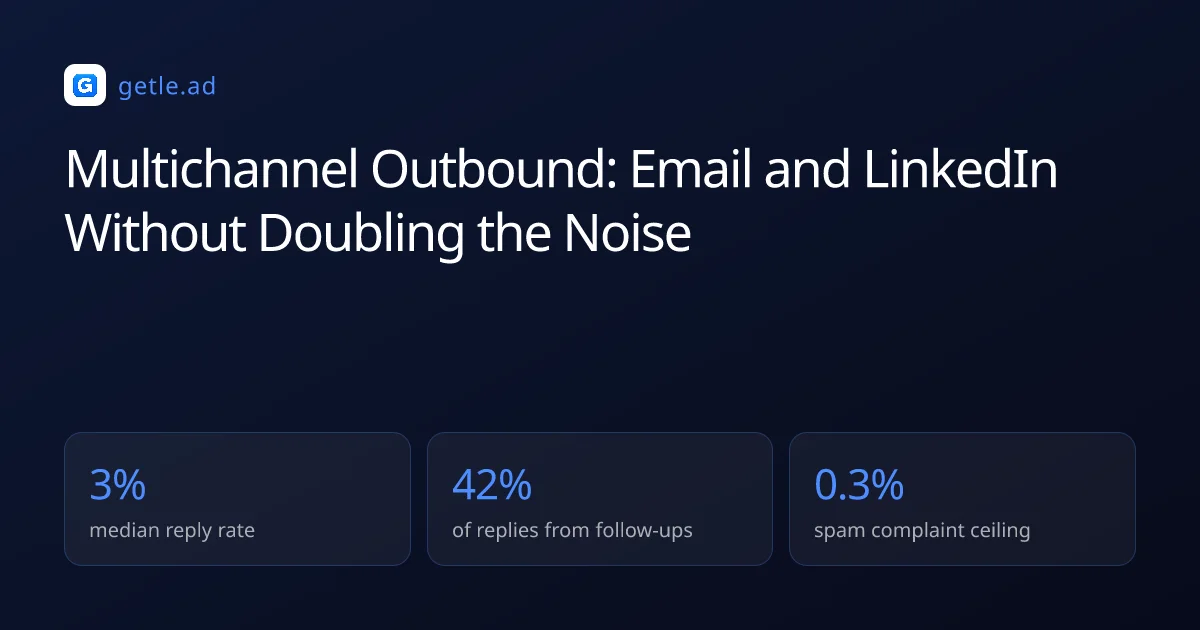
The last one matters legally and practically. A request to stop is a request to stop, and continuing on another channel is exactly the behaviour that produces complaints, where the ceiling is 0.3% of delivered messages.
Sources and method
First-party data (Getlead, 2026): the verification split of 43.4% confirmed valid, 23.9% invalid, 16.7% catch-all and 16.0% unknown comes from 383,368 addresses analyzed through live SMTP verification, and the 0.51% bounce rate and 35.8% open rate come from 34,973 tracked sends, aggregated and anonymized at campaign level. Full method in our cold email benchmark study.
External sources: US commercial email obligations come from the FTC CAN-SPAM compliance guide; the 0.3% spam complaint ceiling and authentication requirements come from the Google Workspace sender guidelines.
Third party benchmarks vary in methodology and should be read as directional. Checked in August 2026.
Frequently asked questions
What is multichannel outbound?
Using more than one channel to reach the same prospect inside one coordinated sequence. It only helps when each touch adds something the other could not, which is why duplicating a message across channels reduces credibility on both.
How should email and LinkedIn be sequenced?
Email first with the observation and a reply level ask, then a connection request with no pitch, then a concrete email such as a benchmark, then a short LinkedIn note if connected, then the meeting ask by email.
Why not send the same message on both channels?
Because recipients recognise it instantly, and it converts a coordinated sequence into visible automation. Email carries detail because it persists, LinkedIn carries recognition because it is short and visual.
Which channel scales?
Email, across multiple mailboxes and domains. LinkedIn is limited to tens of actions per day per account and the cost of an error is the account itself rather than a replaceable sending domain.
Does an opt-out on one channel apply to the other?
Treat it as though it does. A request to stop is a request to stop, and continuing on a second channel is precisely the behaviour that produces complaints and reputational damage.
Is multichannel worth it for small teams?
Selectively. Use it on the accounts that justify the manual effort, since LinkedIn does not scale, and keep the rest on email where volume and measurement are both manageable.