ON THIS PAGE
By Efe Berke Colaker, Founder at GetleadReviewed by the Getlead editorial team for accuracy. Last updated August 2026.
The calling versus email debate is usually about temperament. Underneath it, the two channels differ on three measurable dimensions and the choice follows from those.
Cost per attempt, feedback speed and the constraint that caps volume.
The comparison
For example, a rep can send 40 well targeted emails and make 40 dials in the same day, but the emails keep working while they sleep and the dials do not. The dials, in exchange, produce information the emails never will.
The feedback difference nobody prices
Calling returns information from people who would never reply to an email, including the ones who tell you the offer makes no sense.
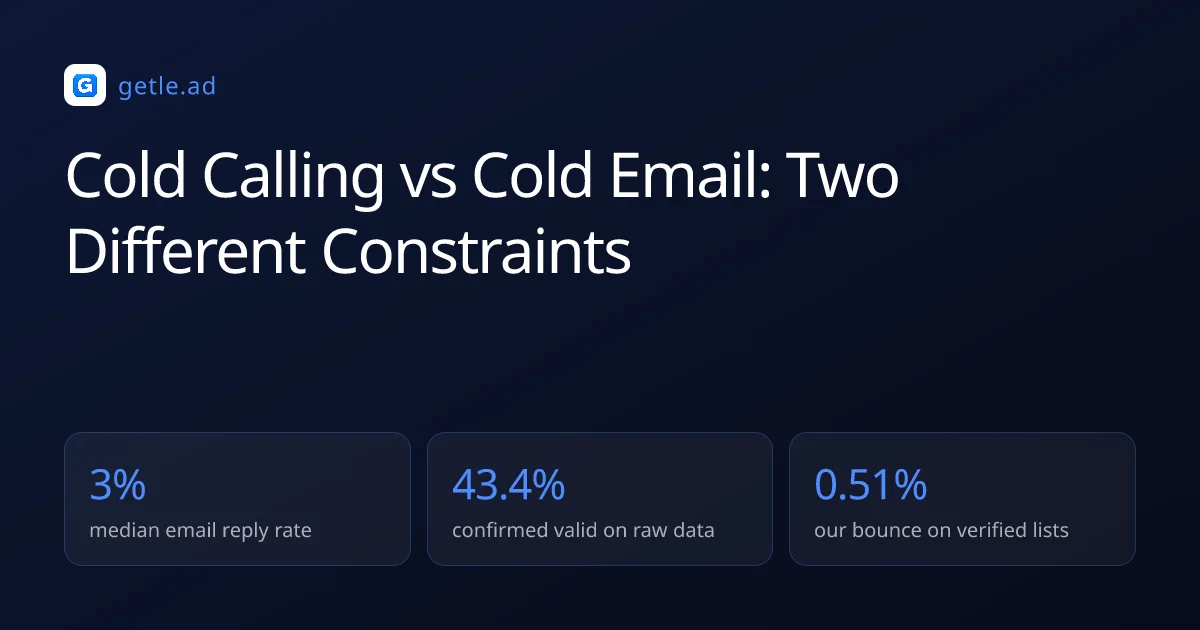
At a median 3% reply rate, an email campaign learns from about three people per hundred. A morning of calls can produce that many conversations before lunch, which makes calling a research tool as much as a sales one.
That is the strongest argument for calling in a new market: not the meetings, but discovering in two days what an email sequence takes six weeks to suggest.
Using both in one sequence
- Email first to the whole segment, since it costs almost nothing per attempt.
- Call the accounts that opened repeatedly or replied ambiguously.
- Email again with something concrete after any call that did not connect.
- Reserve calling for the tier where the deal size justifies human time.
The fourth point is what keeps the model affordable. Calling every record burns hours on accounts that email would have qualified out for a fraction of a cent.
The failure they share
Both channels are downstream of data quality, and both fail the same way when it is poor.
A wrong number wastes a call and a dead address wastes a send, but the second also damages the sending domain. In our verification 23.9% of raw B2B addresses were invalid outright and another 16.7% were catch-all.
Verify before either. It is the one step that improves both channels at the same time, and it costs a fraction of a cent per address.
Sources and method
First-party data (Getlead, 2026): the verification split of 43.4% confirmed valid, 23.9% invalid, 16.7% catch-all and 16.0% unknown comes from 383,368 addresses analyzed through live SMTP verification, and the 0.51% bounce rate comes from 34,973 tracked sends, aggregated and anonymized at campaign level. Full method in our cold email benchmark study.
External sources: median B2B reply rates near 3% and the finding that roughly 42% of replies arrive from follow-ups come from 2026 cold email benchmark compilations; the 0.3% spam complaint ceiling comes from the Google Workspace sender guidelines; US commercial email obligations come from the FTC CAN-SPAM compliance guide.
Third party benchmarks vary in methodology and should be read as directional. Checked in August 2026.
Frequently asked questions
Is cold calling better than cold email?
They solve different problems. Email scales at fractions of a cent per attempt and works while you sleep. Calling produces immediate feedback from people who would never reply to an email, which makes it a research tool as much as a sales one.
Which is cheaper?
Email, by an order of magnitude per attempt. Cost per conversation often favours calling, because a call that connects produces a real exchange while most emails produce nothing at a median 3% reply rate.
When should I call instead of email?
When entering a new market and needing fast feedback, when deal size justifies human hours, and when following up accounts that engaged ambiguously. Calling every record burns hours that email would have saved.
How do the two work together?
Email the whole segment first since attempts are nearly free, call the accounts that showed signals, then email again with something concrete after calls that did not connect. Reserve calling for the tier where the economics justify it.
What do both channels depend on?
Data quality. A wrong number wastes a call and a dead address wastes a send and damages the sending domain. In our verification, 23.9% of raw B2B addresses were invalid and 16.7% catch-all.
Does calling avoid deliverability rules?
It avoids email rules and has its own: national do not call registries and consent regimes vary by country, so calling has a compliance surface rather than none.