ON THIS PAGE
By Efe Berke Colaker, Founder at GetleadReviewed by the Getlead editorial team for accuracy. Last updated August 2026.
Reply rate is the number people quote and meeting rate is the number that decides headcount. The gap between them is where most outbound plans quietly fail.
This walks the chain step by step with realistic ranges, so a plan can be checked before it is committed to.
The conversion chain
For example, a thousand contacts reached at median rates produces about 30 replies, about 10 positive ones and three to four meetings. Strong campaigns in the 5 to 8% reply range roughly double that.
The first step decides the rest
Everything downstream is multiplied by delivery, and delivery is decided by data quality before anything else.
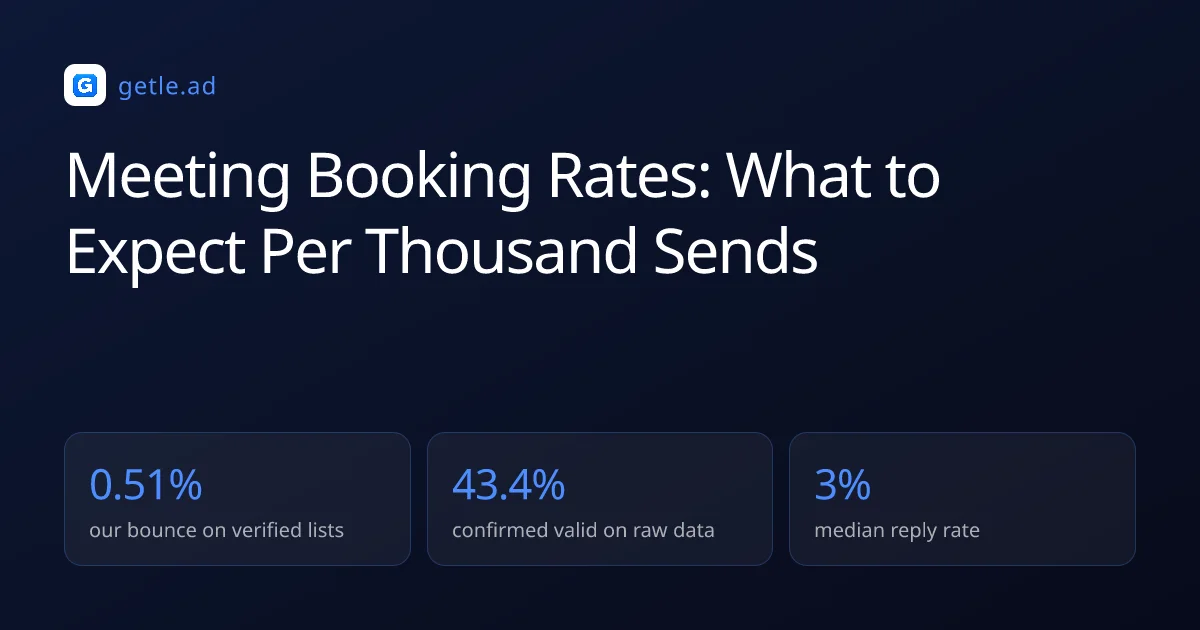
Our sends to SMTP verified lists bounce at 0.51%, while an unverified file carrying the 23.9% invalid share we measure loses a quarter of the audience before any of the later rates apply.
Placement is the invisible part of the same step. A message accepted and filed in spam counts as delivered and converts at zero, which is why seed testing belongs in the plan.
Using the numbers to plan
- Start from meetings needed per month.
- Multiply by three to get positive replies, at roughly a third converting.
- Multiply by three again for total replies.
- Divide by the reply rate you can defend, 3% at median.
- Divide by your confirmed valid rate, about 43% on raw data, for records to source.
For example, eight meetings a month works out at roughly 800 contacts reached and about 1,900 raw records sourced, which is a sourcing plan rather than an aspiration.
Sources and method
First-party data (Getlead, 2026): the verification split of 43.4% confirmed valid, 23.9% invalid, 16.7% catch-all and 16.0% unknown comes from 383,368 addresses analyzed through live SMTP verification, and the 0.51% bounce rate and 35.8% open rate come from 34,973 tracked sends, aggregated and anonymized at campaign level. Full method in our cold email benchmark study.
External sources: median B2B reply rates near 3%, the 5 to 8% range for strong campaigns and the finding that roughly 42% of replies arrive from follow-ups come from 2026 cold email benchmark compilations; US commercial email obligations come from the FTC CAN-SPAM compliance guide.
Third party benchmarks vary in methodology and should be read as directional. Checked in August 2026.
Frequently asked questions
What is a good meeting booking rate for cold email?
At median rates, roughly three to four meetings per thousand contacts reached: about 30 replies, about 10 of them positive, and roughly a third of those converting. Strong campaigns in the 5 to 8% reply range roughly double it.
How do I calculate how many records I need?
Work backwards. Meetings times three gives positive replies, times three again gives total replies, divided by a 3% reply rate gives contacts reached, divided by a 43% confirmed valid rate gives raw records to source.
Why is my reply rate fine but meeting rate low?
Usually offer fit or response speed. Replies include people who are curious or polite, so the positive share matters more, and an interested reply answered two days later frequently does not convert.
Does list quality affect meeting rate?
It affects everything downstream, because every later rate is multiplied by delivery. Verified lists in our data bounce at 0.51%, while an unverified file carrying a 23.9% invalid share loses a quarter of the audience first.
Should I measure meetings per campaign or per thousand delivered?
Per thousand delivered. Per campaign totals reward volume, so a larger campaign with worse targeting can look better than a smaller one that converts at twice the rate.
What role does inbox placement play?
A large and invisible one. A message accepted by the server and filed in spam counts as delivered and converts at zero, which is why seed inbox testing belongs in the plan rather than in the postmortem.