ON THIS PAGE
By Efe Berke Colaker, Founder at GetleadReviewed by the Getlead editorial team for accuracy. Last updated August 2026.
Healthcare is the sector where standard outbound assumptions break hardest. The cycle is long, the committee is large and every member can stop the deal.
None of that makes outbound useless. It makes the metrics you manage by wrong if you carry them over from a faster market.
The shape of a healthcare purchase
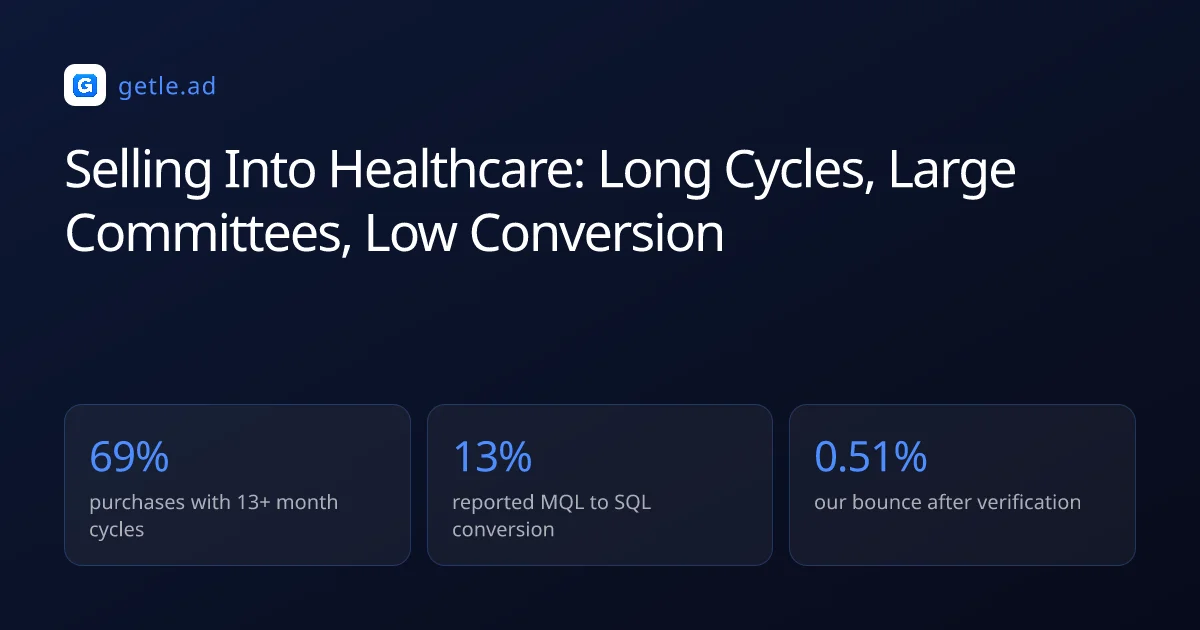
Published 2026 analyses report that 69% of healthcare B2B purchases involve cycles of 13 months or more, with committees spanning clinical leads, IT, procurement, compliance and finance.
A veto holder is anyone who can stop a purchase without being able to authorise it, and healthcare has more of them per deal than almost any other sector.
Multi threading is not optional here
A single champion in a large committee is a single point of failure, and in a 13 month cycle that person frequently changes role before the decision lands.
- Identify the clinical stakeholder who feels the problem daily.
- Identify the IT and security stakeholder who will review integration and data handling.
- Identify procurement, who owns contracting and will arrive late and decisively.
- Identify the executive sponsor who signs and cares about risk more than features.
- Write to each with a different message, since their definitions of success differ.
For example, a message about clinician time saved lands with a nursing lead and does nothing for a security reviewer, who wants to know where data sits and who can see it.
Resolving four named people at one organisation is a data problem before it is a messaging problem, and it is where most healthcare programs stall.
What to measure in a 13 month cycle
Revenue is a lagging indicator so far behind the activity that it cannot steer anything. Use leading indicators that move inside a quarter.
Track named stakeholders reached per target account, meetings held per account, and the count of accounts with two or more engaged contacts. Those move now and predict later.
Judging a healthcare program on closed revenue in its first two quarters guarantees the wrong conclusion, which is how good programs get cancelled early.
Data handling raises the bar
Healthcare buyers evaluate how you handle data as part of the purchase, which makes your own outbound hygiene part of the pitch.
Business contact details of staff are not patient data, and confusing the two produces either paralysis or carelessness. Ordinary B2B rules apply to reaching a procurement manager at a hospital.
That said, a sloppy list is worse here than elsewhere. Bouncing repeatedly into an organisation whose security team is evaluating you is a poor opening argument.
Contact accuracy at large institutions
Large healthcare organisations churn staff constantly and publish general addresses, which is the exact profile that produces unverifiable records.
In our verification of 383,368 raw B2B addresses, 23.9% were invalid and 16.7% sat behind catch-all domains. Hospital domains are frequently catch-all, so an accepted address proves less than usual.
Where the domain is catch-all, resolve the person through a second source before sending rather than trusting the pattern that verified.
Sources and method
First-party data (Getlead, 2026): the verification split of 43.4% confirmed valid, 23.9% invalid, 16.7% catch-all and 16.0% unknown comes from 383,368 addresses analyzed through live SMTP verification, and the 0.51% bounce rate comes from 34,973 tracked sends, aggregated and anonymized at campaign level. Full method in our cold email benchmark study.
External sources: cycle length, committee composition, MQL to SQL conversion and pre contact research behaviour come from 2026 healthcare B2B marketing analyses; US commercial email obligations come from the FTC CAN-SPAM compliance guide.
Third party benchmarks on cycle length, committee size and conversion vary widely by segment and methodology, so read them as directional. Checked in August 2026.
Frequently asked questions
How long is a healthcare B2B sales cycle?
Reported 2026 analyses put 69% of healthcare B2B purchases at 13 months or more, with security reviews and regulatory checks gating progress at several points along the way.
Who is on a healthcare buying committee?
Typically a clinical lead who feels the problem, IT and security who review integration and data handling, procurement who owns contracting, compliance, and an executive sponsor. Each can stop a deal without being able to authorise it.
Why is healthcare conversion so low?
Reported MQL to SQL conversion near 13% is among the lowest of any sector, which follows from committee size and the number of veto points rather than from poor targeting.
How many contacts should I reach per account?
Four at minimum, matched to the committee roles, each with a different message. A single champion is a single point of failure, and in a 13 month cycle that person often changes role first.
What should I measure instead of revenue?
Named stakeholders reached per target account, meetings held per account, and the number of accounts with two or more engaged contacts. Those move within a quarter and predict outcomes the revenue number cannot yet show.
Is emailing hospital staff a compliance problem?
Business contact details of staff are not patient data, so ordinary B2B rules apply to reaching a procurement manager. What does matter is list hygiene, since bouncing repeatedly into an organisation evaluating your data handling is a poor argument.