ON THIS PAGE
By Efe Berke Colaker, Founder at GetleadReviewed by the Getlead editorial team for accuracy. Last updated August 2026.
Most cold emails are fine until the last sentence, where they request 30 minutes from someone who has never heard of the sender.
The ask determines the reply rate as much as the opening does, and it is the easiest part to get wrong because it feels like the point of the message.
The ladder of asks
A reply level ask is one the recipient can answer without opening a calendar, and it is what first touch messages should use unless the offer is unusually concrete.
For example, asking whether someone owns hiring tooling is answerable while walking between meetings. Asking for 30 minutes requires them to decide about you first, which is a decision they have no basis for yet.
Escalating across the sequence
A sequence is the place to move up the ladder. Repeating the same ask three times is what makes follow-ups feel like pressure rather than persistence.
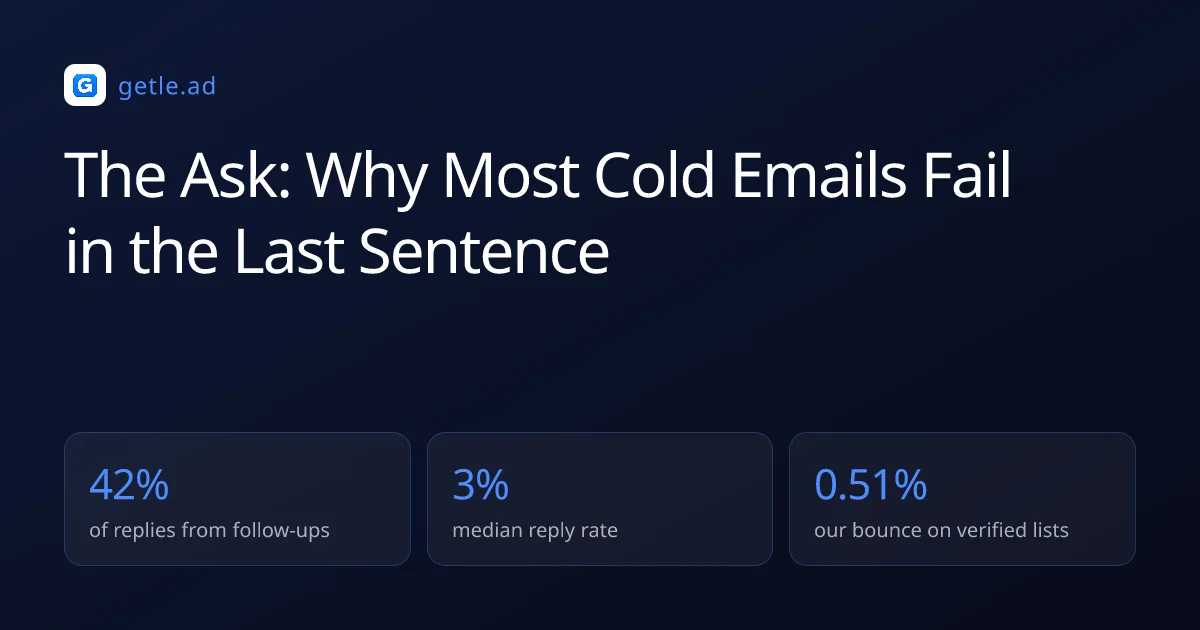
Published benchmarks attribute roughly 42% of replies to follow-ups, so the second and third messages carry real weight and deserve a different ask rather than a bump.
- Message one: confirm ownership or ask for an opinion.
- Message two: offer something concrete, such as a benchmark or a short teardown.
- Message three: the meeting, now that context exists.
- Message four: a graceful close that leaves the door open.
Mechanics that quietly reduce replies
- Calendar links in message one. They imply a decision the recipient has not made.
- Two asks. A call or a resource means neither is the ask.
- Vague timing. Sometime next week is more work to answer than Thursday.
- Tracking links on a fresh domain, which can affect placement before anyone reads the ask.
The last point is a deliverability issue disguised as a copy decision. A newly registered link domain carries no reputation, and unsubscribe and tracking links are exactly where filters look.
Sources and method
First-party data (Getlead, 2026): the verification split of 43.4% confirmed valid, 23.9% invalid, 16.7% catch-all and 16.0% unknown comes from 383,368 addresses analyzed through live SMTP verification, and the 0.51% bounce rate and 35.8% open rate come from 34,973 tracked sends, aggregated and anonymized at campaign level. Full method in our cold email benchmark study.
External sources: median B2B reply rates near 3%, the 5 to 8% range for strong campaigns and the finding that roughly 42% of replies arrive from follow-ups come from 2026 cold email benchmark compilations; US commercial email obligations come from the FTC CAN-SPAM compliance guide.
Third party benchmarks vary in methodology and should be read as directional. Checked in August 2026.
Frequently asked questions
What is the best CTA for a cold email?
One the recipient can answer in a single line without opening a calendar. Confirming whether they own the problem, or asking whether it is a problem at all, outperforms a meeting request in first touch.
Why does asking for a meeting fail in the first email?
Because it requires the recipient to decide about you before they have any basis for it. A calendar commitment is a large request from a stranger, while a one word reply costs nothing.
Should I include a calendar link?
Not in message one. It implies a decision the recipient has not made. Once there is interest, a calendar link removes friction and belongs in the message where the meeting is actually the ask.
How should the ask change across a sequence?
It should escalate: confirm ownership, then offer something concrete, then request the meeting once context exists, then close gracefully. Repeating the same ask is what makes follow-ups feel like pressure.
Can I offer two options in one email?
No. A call or a resource means neither is the ask, and the recipient has to make two decisions instead of one. Single ask per message, escalating across the sequence.
Do follow-ups actually produce replies?
Yes, substantially. Published benchmarks attribute roughly 42% of replies to follow-ups, which is why the second and third messages deserve their own ask rather than a bump on the first.