ON THIS PAGE
By Efe Berke Colaker, Founder at GetleadReviewed by the Getlead editorial team for accuracy. Last updated August 2026.
NeverBounce prices the same commodity as every verifier, and the differences worth knowing are the volume slope and how long a credit stays alive.
That second detail is the one that changes buying behaviour, because it makes purchasing ahead sensible rather than wasteful.
The reported rates
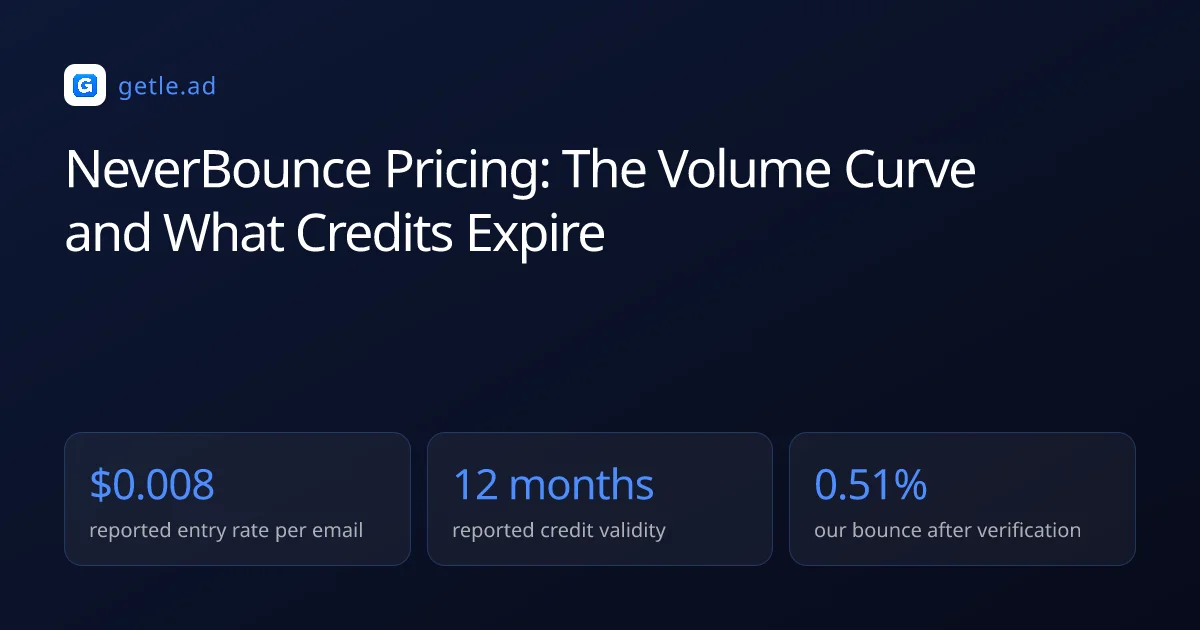
Independent 2026 breakdowns report about $0.008 per email on pay as you go, falling toward $0.004 to $0.005 above 100,000 a month and as low as $0.002 on very large volumes, with credits valid for twelve months.
Pay as you go here means buying a credit block rather than committing monthly, which suits campaign shaped work with uneven volume.
Twelve month credits change the strategy
Most credit systems in this market expire monthly. A twelve month window inverts the usual advice about buying tightly.
- Estimate annual verification volume rather than monthly, since the window covers a year.
- Buy at the volume tier your annual total reaches, not your busiest month.
- Keep a reserve for the list you have not planned yet, which always appears.
- Re-verify before each campaign rather than once at import.
- Track how much of the block you used, and adjust the next purchase rather than guessing again.
For example, a team verifying 8,000 records a quarter buys 32,000 credits once at a better rate instead of four separate small purchases at the entry price.
The sync product and continuous hygiene
Batch verification cleans a list on a date. Continuous sync keeps an integrated database clean over time, and it is priced monthly instead.
Reported sync pricing starts near $10 a month for a thousand addresses and scales up substantially, with a discount on annual billing.
Which model fits depends on where your data lives. A CRM that receives records continuously benefits from sync, while campaign lists assembled per project are cheaper to verify in batches.
What a verification result actually tells you
Every verifier returns a state rather than a guarantee, and the states are more informative than the headline valid rate.
In our verification of 383,368 raw B2B addresses the split was 43.4% valid, 23.9% invalid, 16.7% catch-all and 16.0% unknown. Those last two categories are where judgement is required.
An unknown result usually means the receiving server refused to answer clearly, often through rate limiting. Re-checking later frequently resolves it, and treating unknown as invalid discards usable contacts.
Where it fits against alternatives
The structural question is whether verification should be a separate line item at all. A stack where the database verifies at export removes both the purchase decision and the gap between enrichment and sending.
Sources and method
First-party data (Getlead, 2026): the verification split of 43.4% confirmed valid, 23.9% invalid, 16.7% catch-all and 16.0% unknown comes from 383,368 addresses analyzed through live SMTP verification, and the 0.51% bounce rate comes from 34,973 tracked sends, aggregated and anonymized at campaign level. Full method in our cold email benchmark study.
External sources: per email rates across the volume curve, the twelve month credit validity, the free trial size and sync product pricing come from independent NeverBounce pricing analyses published in 2026.
Prices change without notice and published tiers are frequently renegotiated in practice, so treat every figure here as a starting point for your own quote rather than a fixed rate. Checked in August 2026.
Frequently asked questions
How much does NeverBounce cost?
Reported pay as you go pricing is about $0.008 per email, falling toward $0.004 to $0.005 above 100,000 a month and as low as $0.002 on very large volumes. Entry blocks start near $8 for 1,000 credits.
How long do NeverBounce credits last?
Reported as twelve months, which is unusual in a market where monthly expiry is the norm. That window makes buying at an annual volume tier sensible rather than wasteful.
Should I buy credits or use sync?
It depends where your data lives. A CRM receiving records continuously benefits from sync, priced monthly from around $10 for a thousand addresses, while campaign lists assembled per project are cheaper to verify in batches.
What does an unknown verification result mean?
Usually that the receiving server refused to answer clearly, often through rate limiting. It covered 16.0% of our sample, and re-checking later frequently resolves it, so treating unknown as invalid discards usable contacts.
How often should I re-verify a list?
Before each campaign rather than once at import. Contact data decays continuously, so a verification result describes the day it ran and nothing later.
Do I need a separate verification tool at all?
Not necessarily. A stack where the database verifies at export removes the purchase decision and closes the gap between enrichment and sending, which is where most preventable bounces originate.