ON THIS PAGE
By Efe Berke Colaker, Founder at GetleadReviewed by the Getlead editorial team for accuracy. Last updated September 2026.
Short answer: ZeroBounce costs $39 for 2,000 verification credits ($0.0195 per email), $129 for 10,000, $649 for 100,000 and $3,199 for a million. There is a free plan with 100 credits a month and a ZeroBounce ONE subscription from $99 a month ($79 billed yearly). One credit checks one address, and unknown results are not charged.
ZeroBounce prices verification like a commodity, which it largely is, and the interesting decisions are about volume and about which features quietly cost more.
Getting the arithmetic right matters because verification is the cheapest insurance in outbound, and teams routinely underbuy it.
The per credit rates
ZeroBounce's own pricing page lists pay as you go packs from $39 for 2,000 credits up to $26,998 for ten million, so the rate falls from $0.0195 to about $0.0027 per email, a discount near 86% across the curve.
A credit checks one address, and results that come back unknown are not charged. The ZeroBounce ONE subscription adds warmup and inbox placement tests and takes 15% off pay as you go packs.
The feature that costs twenty times more
Verification and discovery are priced completely differently inside the same credit balance, and mixing them up drains a plan fast.
For example, 500 finder queries consume 10,000 credits, which is five times the minimum purchase and would have verified an entire mid sized list instead.
Deduplicate before uploading. A row is a credit whether or not you have seen that address before, and duplicate rates in inherited files are routinely in double digits.
How much verification you actually need
Buying is easier once you accept that verification is recurring rather than one off, because contact data decays continuously.
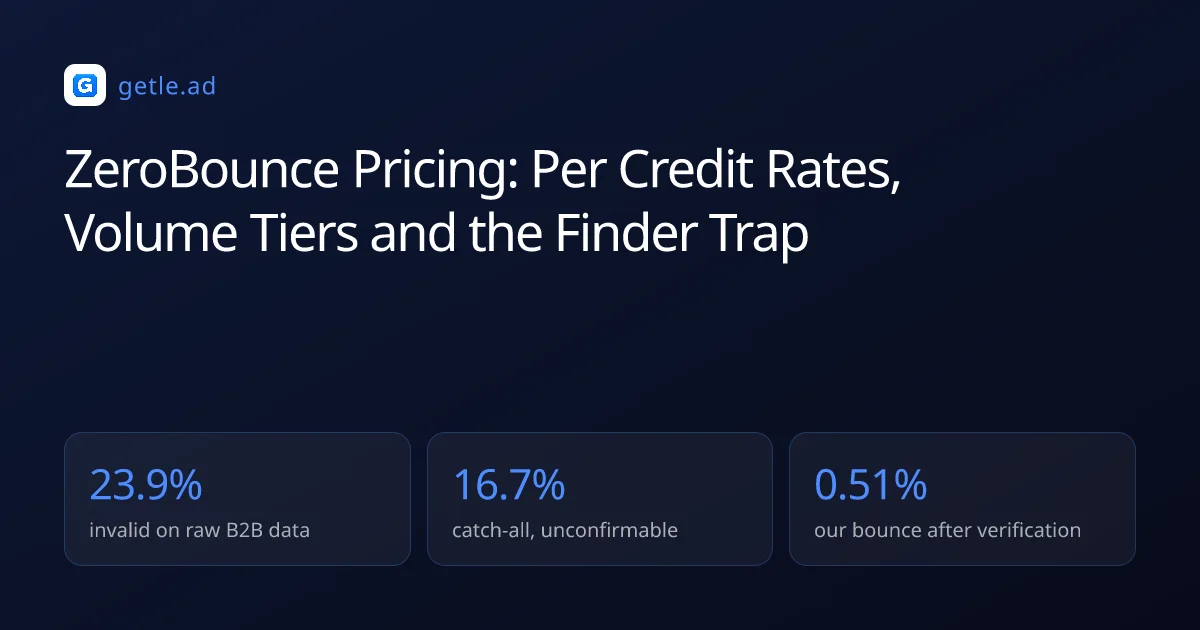
In our verification of 383,368 raw B2B addresses, 23.9% were invalid outright. On a 10,000 record list that is 2,390 messages that would have bounced, against a verification cost measured in tens of dollars.
Across 34,973 tracked sends we held bounce at 0.51%, which is the number that keeps a domain healthy rather than the number that impresses anyone.
What verification cannot resolve
No verifier can confirm an address on a catch-all domain, because the server accepts everything by design.
That state covered 16.7% of the addresses in our sample. Any provider reporting a confidence score for those records is modelling rather than checking, and the distinction matters when you decide whether to send.
Treat catch-all as its own bucket with its own sending policy rather than merging it into either valid or invalid. That decision does more for bounce rate than choosing between verifiers.
Choosing between verification vendors
Accuracy claims across this category are hard to compare independently. The practical test is to run a few hundred known good and known bad addresses through a trial and check the returned states yourself.
Sources and method
First-party data (Getlead, 2026): the verification split of 43.4% confirmed valid, 23.9% invalid, 16.7% catch-all and 16.0% unknown comes from 383,368 addresses analyzed through live SMTP verification, and the 0.51% bounce rate comes from 34,973 tracked sends, aggregated and anonymized at campaign level. Full method in our cold email benchmark study.
External sources: per credit rates, the volume discount curve, the 2,000 credit minimum and the twenty credit email finder cost come from independent ZeroBounce pricing analyses published in 2026.
Prices change without notice and published tiers are frequently renegotiated in practice, so treat every figure here as a starting point for your own quote rather than a fixed rate. Checked in August 2026.
Frequently asked questions
How much does ZeroBounce cost per email?
$0.0195 per email on the smallest pack ($39 for 2,000 credits), $0.0129 at 10,000, $0.0065 at 100,000 and $0.0032 at a million, down to about $0.0027 from five million. The volume curve is the main pricing lever.
Does ZeroBounce have a free plan?
Yes. The free plan includes 100 credits a month, enough to test a sample of your list before buying a pack.
Does the email finder use the same credits?
Yes, but at a very different rate. A successful finder query is reported at twenty credits against one for a verification, so 500 finder lookups consume 10,000 credits, five times the minimum purchase.
Do duplicates cost credits?
Yes. A row is a credit whether or not the address has been checked before, and duplicate rates in inherited files are routinely in double digits, so deduplicate before uploading anything.
How much verification does a campaign need?
More than teams expect, because contact data decays continuously. In our sample 23.9% of raw B2B addresses were invalid, which on a 10,000 record list is 2,390 avoidable bounces for a verification cost measured in tens of dollars.
Can ZeroBounce verify catch-all addresses?
No verifier can. Catch-all servers accept mail for every address by design, which covered 16.7% of the addresses in our sample. Any confidence score on those records is modelled rather than checked.
How do I compare verification vendors?
Run a few hundred addresses you already know to be good and bad through each trial and inspect the returned states. Published accuracy claims across this category are not independently comparable.