ON THIS PAGE
By Efe Berke Colaker, Founder at GetleadReviewed by the Getlead editorial team for accuracy. Last updated August 2026.
Anymail Finder built its pricing around one promise: you are charged for verified addresses and nothing else.
That is a meaningful shift in who carries the risk of a bad lookup, and it is worth reading carefully rather than accepting at face value.
The tiers
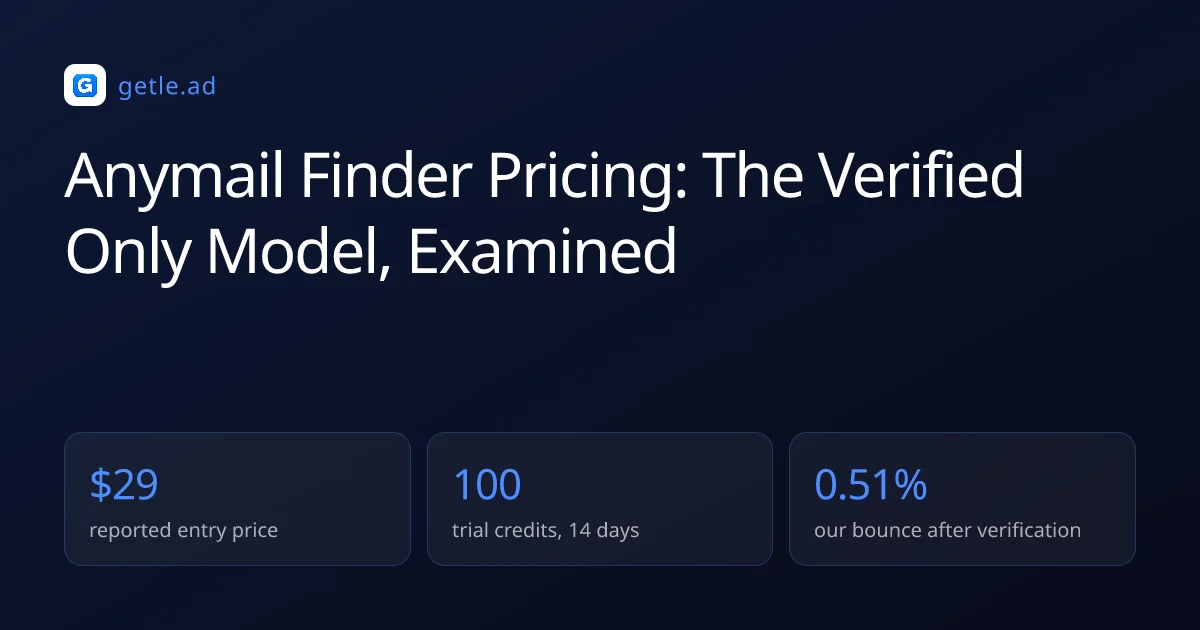
Reported 2026 figures start plans at $29 a month for 400 credits and scale to $199 for 10,000, with annual billing reported at roughly a third off and some variation in tier naming between sources.
A verified credit is spent only when the service returns an address it considers confirmed, which makes the credit count a count of results rather than attempts.
What the verified only model changes
Most finders bill for the search. This one bills for the answer, and the difference compounds on difficult segments.
- Hard segments stop being expensive, since low hit rates cost nothing extra.
- Budget becomes predictable per usable contact rather than per attempt.
- The incentive shifts to the vendor, who now carries the cost of failure.
- Comparing tools requires converting attempt based pricing by its hit rate first.
- Risky results are excluded from billing, which also excludes them from your list.
That last point is easy to miss. Not being charged for a risky result also means not receiving it, so the list you get is smaller and cleaner than an attempt based tool would return.
Reading the accuracy guarantee
The stated guarantee is an accuracy threshold on results marked verified, with a credit refunded when one proves invalid.
A refunded credit is worth what a credit costs. It does not refund the deliverability damage from a bounce, which is the expensive part and cannot be credited back.
Across 34,973 tracked sends we held bounce at 0.51% by verifying close to send, and that discipline sits on top of any supplier guarantee rather than replacing it.
The catch-all question this model raises
Any verified only model has to decide what to do about domains where verification is impossible by design.
Catch-all servers accept mail for every address, so nothing sent to them can be confirmed. In our verification of 383,368 addresses, 16.7% fell into that state.
Ask how those domains are handled and billed. It is the single question that separates a genuinely conservative provider from one applying a permissive definition of verified.
Where it fits in a stack
It is a good component and a poor whole. Pair it with something that decides which accounts and roles to pursue, and keep verification in your own hands before sending.
Sources and method
First-party data (Getlead, 2026): the verification split of 43.4% confirmed valid, 23.9% invalid, 16.7% catch-all and 16.0% unknown comes from 383,368 addresses analyzed through live SMTP verification, and the 0.51% bounce rate comes from 34,973 tracked sends, aggregated and anonymized at campaign level. Full method in our cold email benchmark study.
External sources: tier prices, the pay only for verified results model, free risky and not found results, the accuracy guarantee with credit refund and the annual discount come from independent Anymail Finder reviews and its published pricing page in 2026.
Prices change without notice and published tiers are frequently renegotiated in practice, so treat every figure here as a starting point for your own quote rather than a fixed rate. Checked in August 2026.
Frequently asked questions
How much does Anymail Finder cost?
Reported plans start at $29 a month for 400 credits and scale to around $199 for 10,000, with custom enterprise pricing above that. Annual billing is reported at roughly a third off, which is unusually deep for this category.
What does pay for verified only mean?
A credit is spent only when the service returns an address it considers confirmed. Risky and not found results are reported as free, so the credit count is a count of results rather than attempts.
What is the downside of the verified only model?
Not being billed for risky results also means not receiving them, so the list you get is smaller than an attempt based tool would return. That is usually good for deliverability and bad for raw volume.
How useful is the accuracy guarantee?
A refunded credit is worth what a credit costs. It does not refund the deliverability damage a bounce causes, which is the expensive part, so verification close to send still belongs in your own process.
How are catch-all domains handled?
Ask directly, because it is the question that separates a conservative provider from a permissive one. Catch-all servers accept mail for every address, and 16.7% of the addresses in our verification fell into that unconfirmable state.
Is Anymail Finder a complete solution?
No, it is a finder. It resolves addresses for people you have already identified, so account selection, role targeting and sending all sit elsewhere in the stack.