ON THIS PAGE
By Efe Berke Colaker, Founder at GetleadReviewed by the Getlead editorial team for accuracy. Last updated August 2026.
The scraping versus buying argument is usually settled by whichever the person answering already built. Both have real costs and the comparison is measurable.
Three columns settle it: what it costs to acquire, what it costs to keep usable, and what happens when something goes wrong.
The comparison that matters
Cost per verified, in profile contact is the only figure that compares the two fairly, because it folds in match rate, verification survival and targeting fit at once.
For example, a scraper producing 10,000 rows at a 30% confirmed valid rate yields 3,000 usable contacts. A purchase of 4,000 rows at 60% yields 2,400. The row counts say one thing and the usable counts say another.
The costs each side hides
Scraping hides maintenance. Sites change, blocks appear, and a pipeline that worked in March needs attention in June, indefinitely.
Buying hides quality variance. Two suppliers at the same price can differ by twenty points of confirmed valid, which is a thirty percent swing in real cost per usable record.
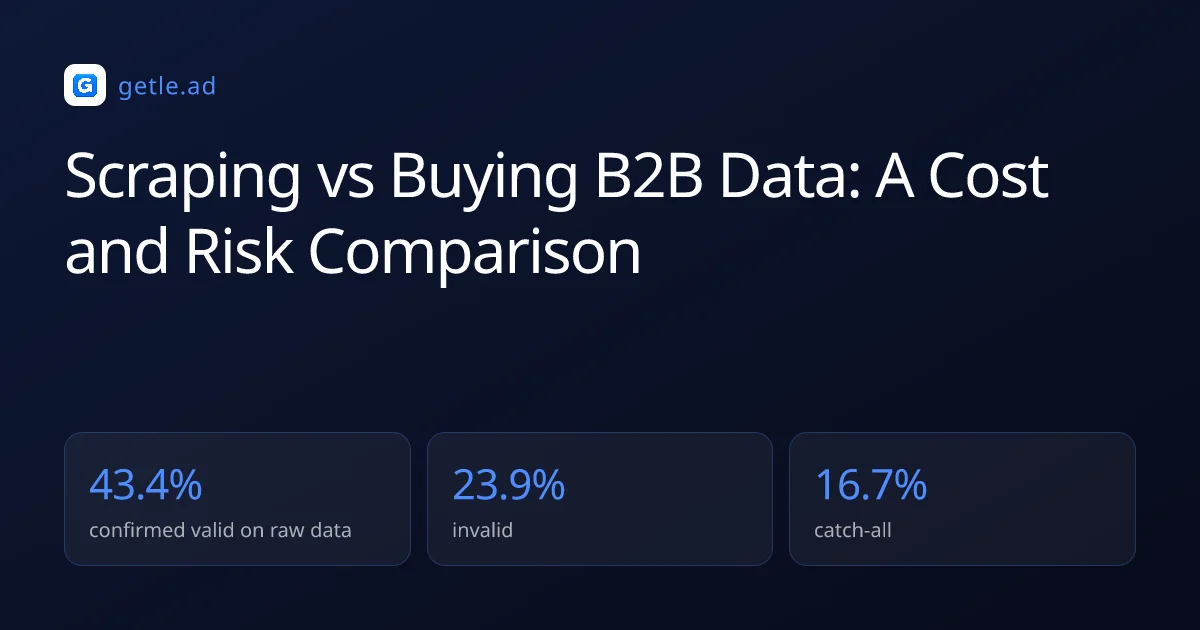
Both hide verification. Whichever route you take, our measurements on raw B2B data show 40.7% invalid or unconfirmable, so the verification line item belongs in both columns rather than in neither.
The risk each side carries
- Scraping: blocks and breakage, terms of service exposure when logged in, and personal data duties that publicness does not remove.
- Buying: no inherited legal basis, unknown provenance if the vendor will not disclose, and resold files that everyone else already mailed.
- Both: deliverability damage if the result is sent unverified, since bounce and complaint thresholds do not care where data came from.
The last one is the practical equaliser. A sending domain does not know whether an invalid address was scraped or purchased, and our verified sends bounce at 0.51% against a roughly 3% danger line either way.
Deciding for your case
- Scrape when the signal is public, time sensitive and specific to your niche, such as job postings or directory listings.
- Buy when you need breadth across a market you cannot crawl, or contact resolution rather than company discovery.
- Do both when the scraped layer supplies signals and the purchased layer supplies verified contacts.
- Never do either without verification in the week you send.
Most teams land on the hybrid, because the two produce different things. Scraping is good at noticing what changed, and databases are good at telling you who to write to.
Sources and method
First-party data (Getlead, 2026): the verification split of 43.4% confirmed valid, 23.9% invalid, 16.7% catch-all and 16.0% unknown comes from 383,368 addresses analyzed through live SMTP verification, and the 0.51% bounce rate comes from 34,973 tracked sends, aggregated and anonymized at campaign level. Full method in our cold email benchmark study.
External sources: the hiQ v LinkedIn outcome on public data and contract terms, and the 2024 Meta v Bright Data decision on logged out access, are summarised in 2026 legal reviews; notice duties for third party sourced personal data come from Article 14 of the GDPR; US commercial email rules come from the FTC CAN-SPAM compliance guide.
This is operational guidance rather than legal advice. Platform terms and prices change without notice, and figures were checked in August 2026.
Frequently asked questions
Is scraping cheaper than buying B2B data?
Only if you ignore maintenance and verification. Scraping costs engineering time upfront and an ongoing obligation as sites change, and scraped records carry the highest invalid rates, so the verification bill lands either way.
What is the right way to compare the two?
Cost per verified, in profile contact. Row counts mislead: 10,000 scraped rows at a 30% confirmed valid rate yield fewer usable contacts than 4,000 purchased rows at 60%.
What does scraping hide?
Maintenance. Sites change their structure, blocks appear and a working pipeline needs attention indefinitely, which is a recurring engineering cost that rarely appears in the original comparison.
What does buying hide?
Quality variance. Two suppliers at the same headline price can differ by twenty points of confirmed valid, which is roughly a thirty percent swing in real cost per usable record, and resold files may already have been mailed by everyone else.
Which is legally safer?
Neither is safe by default. Scraping carries terms of service exposure when logged in and personal data duties regardless of publicness, while buying gives you no inherited legal basis, since you become the controller once the file is yours.
Can I use both?
Most teams should. Scraping is good at noticing dated public changes such as hiring, and databases are good at resolving verified contacts. The hybrid uses each for what it is actually good at.