ON THIS PAGE
By Efe Berke Colaker, Founder at GetleadReviewed by the Getlead editorial team for accuracy. Last updated August 2026.
Dropcontact is unusual in this market because it does not sell you a database. It builds and checks an address on request, which changes both the compliance argument and the billing.
That difference is the whole product. Understanding it is what makes the pricing legible rather than arbitrary.
How the billing works
Credits rather than seats, which suits small teams processing volume and penalises teams that guess their volume badly.
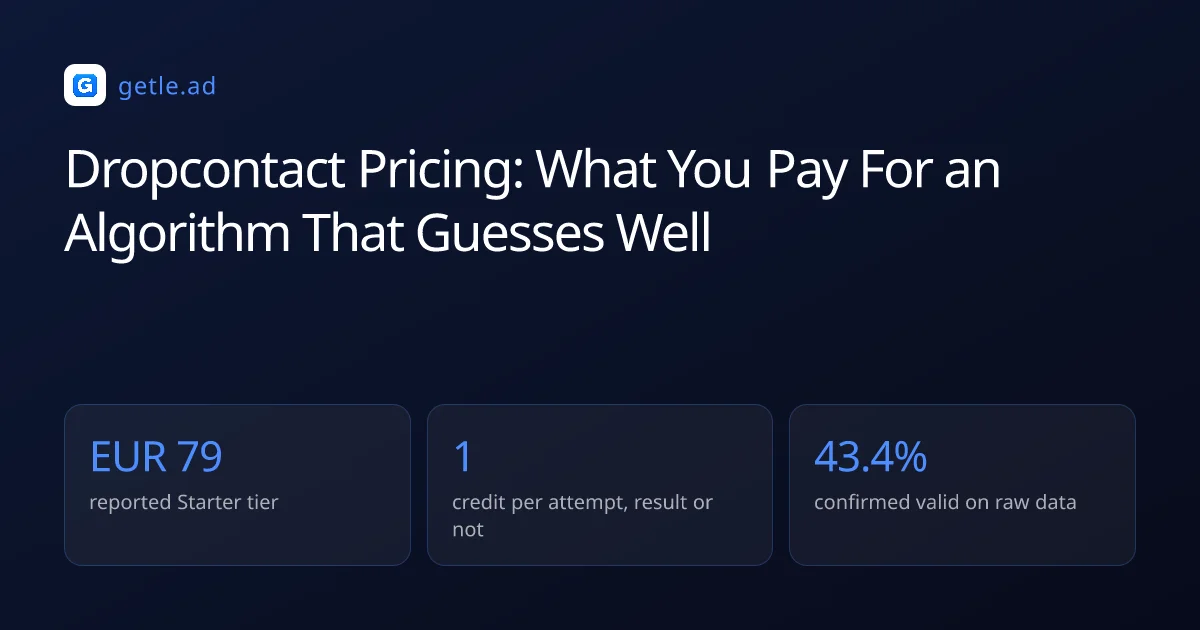
Published 2026 breakdowns report Starter near EUR 79 a month and Growth near EUR 120, with roughly twenty percent off on annual billing and an enterprise tier starting at 200,000 credits.
A credit here is an enrichment attempt rather than a result, and it is consumed whether or not an address comes back.
Paying for attempts changes the arithmetic
Two teams on the same plan can pay wildly different amounts per usable contact, entirely because of the quality of what they submit.
For example, a 5,000 row file with 12% duplicates burns 600 credits reproducing answers you already hold, which is a deduplication problem being paid for as a data problem.
Clean the input first. That single habit moves cost per usable record more than any tier change available on the pricing page.
Expiry, and why over provisioning hurts
Unused enrichments expire at month end on paid tiers, so an unused credit is a purchased credit that vanished.
Outbound volume is lumpy. A team that builds lists in bursts and then sends for three weeks will systematically waste capacity if the plan is sized for the burst month.
Size for the median month and top up in the busy one. That is the opposite of the usual advice for seat based tools, where buying ahead is often cheaper.
The compliance argument, stated accurately
Dropcontact's positioning is that it holds no scraped contact database and generates addresses algorithmically, then verifies them.
That genuinely removes one category of exposure, since there is no third party dataset sitting behind your enrichment. It does not remove your own obligations once a contact enters your database.
You are still the controller for what happens next, so lawful basis, notice and suppression remain yours to document regardless of how the address was produced.
Where verification still belongs
An algorithmically generated address that passes a check is a good candidate, and it ages like any other.
In our verification of 383,368 raw B2B addresses, 23.9% were invalid and 16.7% sat behind catch-all domains where no confirmation is possible. Generated addresses land in that same distribution.
Verify in the week you send rather than the week you enrich. The gap between those two dates is where most preventable bounces come from.
Who it fits and who should look elsewhere
The decisive limitation is the third one. Dropcontact enriches people you have already identified, so a team that needs to discover contacts inside target accounts needs a different starting point.
Sources and method
First-party data (Getlead, 2026): the verification split of 43.4% confirmed valid, 23.9% invalid, 16.7% catch-all and 16.0% unknown comes from 383,368 addresses analyzed through live SMTP verification, and the 0.51% bounce rate comes from 34,973 tracked sends, aggregated and anonymized at campaign level. Full method in our cold email benchmark study.
External sources: 2026 tier prices, the credit per attempt model, month end expiry and the algorithmic no database approach come from independent Dropcontact pricing and review analyses published in 2026.
Prices change without notice and published tiers are frequently renegotiated in practice, so treat every figure here as a starting point for your own quote rather than a fixed rate. Checked in August 2026.
Frequently asked questions
How much does Dropcontact cost in 2026?
Reported tiers put Starter near EUR 79 a month and Growth near EUR 120, with an entry option around EUR 24 for 1,000 credits and roughly twenty percent off on annual billing. Enterprise starts from 200,000 credits a month and is quoted separately.
Does Dropcontact charge for failed lookups?
Yes. A credit is an enrichment attempt rather than a result, so it is consumed whether or not an address comes back. That makes input quality the main driver of cost per usable contact.
Do unused Dropcontact credits roll over?
No. Unused enrichments expire at month end on paid tiers, so over provisioning is a direct loss. Size the plan for a median month and top up during busy ones rather than buying ahead.
How is Dropcontact different from a data provider?
It holds no purchased contact database. Addresses are generated algorithmically and then verified on request, which removes the third party dataset from behind your enrichment and is the basis of its compliance positioning.
Does Dropcontact remove my GDPR obligations?
No. It removes one category of exposure by not sourcing from a third party dataset, but you remain the controller for what you do next, so lawful basis, notice and suppression are still yours to document.
Do I still need to verify Dropcontact results?
Verify in the week you send rather than the week you enrich. Generated addresses age like any others, and 16.7% of the raw addresses in our verification sat behind catch-all domains where no confirmation is possible at all.