ON THIS PAGE
By Efe Berke Colaker, Founder at GetleadReviewed by the Getlead editorial team for accuracy. Last updated August 2026.
Most arguments about outbound team structure are really arguments about which bottleneck is real, and the ratio is where that disagreement becomes visible.
The benchmarks are useful as a sanity check rather than a target, because the right ratio depends on deal size and motion more than on headcount.
The reported ratios
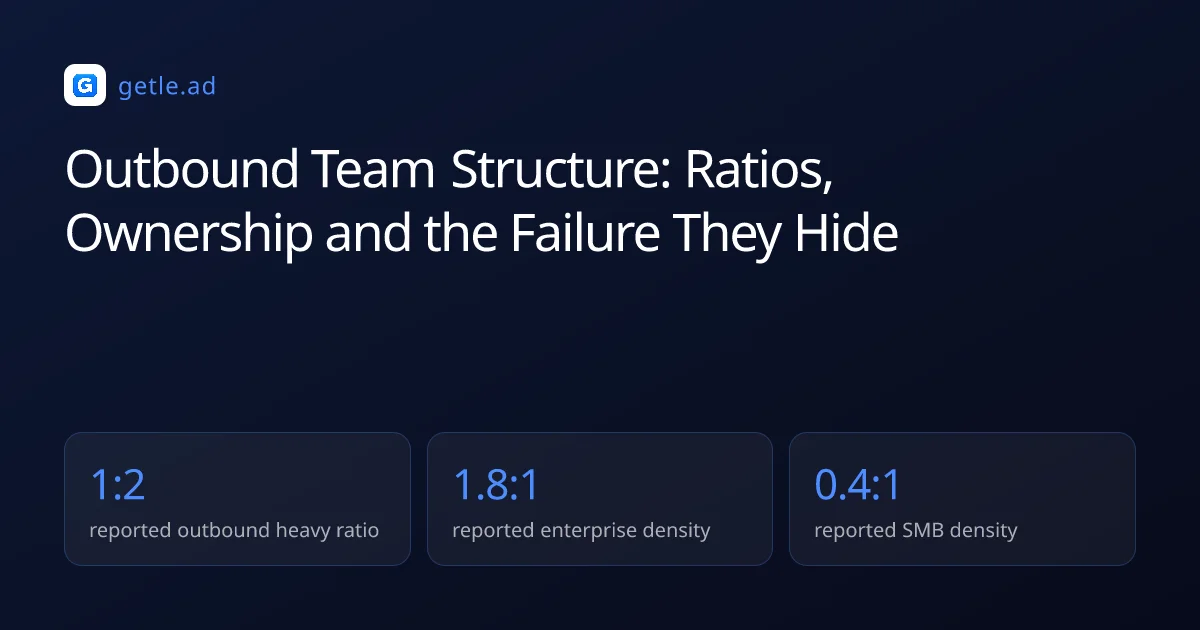
Published 2026 benchmark analyses report outbound heavy teams around 1:2, enterprise inbound teams at 1:3 to 1:4, and a wide spread by deal size across segments.
The SDR to AE ratio describes how much prospecting capacity supports each closing seat, and it only means something alongside the motion it serves.
What a skewed ratio is telling you
Adding prospecting capacity to a team that already cannot work its pipeline creates activity and no revenue, which then reads as an outbound failure.
Reported guidance is direct about this: two or more SDRs per AE usually indicates that AE capacity is the constraint rather than top of funnel supply.
For example, a team with meetings booked rising and meetings held flat has a scheduling and follow through problem, and hiring another SDR makes the gap wider rather than smaller.
The two roles nobody assigns
Ratios describe headcount. What actually breaks small outbound teams is unowned infrastructure.
- Data ownership. Who decides where lists come from, who verifies them and who retires dead records.
- Deliverability ownership. Who watches bounce, complaints, authentication and mailbox health.
- Suppression ownership. Who guarantees an opt-out survives a merge and applies across every sender.
- Reporting ownership. Who defines a qualified meeting so the number means the same thing each week.
Each of those is a small job until it fails, at which point it becomes the only job. Assign them by name even on a team of three.
Full cycle versus split roles
Splitting prospecting from closing buys specialisation and costs context, and which trade is right follows from deal complexity.
Full cycle works where the buyer expects one person to know the product deeply and the deal is not long enough for handoff losses to be recovered.
Split roles work where prospecting is a volume discipline in its own right, and where the skills that book a meeting are not the skills that navigate a committee.
Sizing capacity from the infrastructure up
Sending capacity is a physical constraint on outbound teams, and it is frequently ignored when planning headcount.
Each mailbox carries a safe daily ceiling, so a team's total send volume is set by how many warmed mailboxes it runs rather than by how many people it employs.
Hiring an SDR without adding mailbox capacity and verified data adds a person to compete for the same finite sending budget, which is how a bigger team produces the same pipeline.
Sources and method
First-party data (Getlead, 2026): the verification split of 43.4% confirmed valid, 23.9% invalid, 16.7% catch-all and 16.0% unknown comes from 383,368 addresses analyzed through live SMTP verification, and the 0.51% bounce rate comes from 34,973 tracked sends, aggregated and anonymized at campaign level. Full method in our cold email benchmark study.
External sources: SDR to AE ratios by motion, stage and ACV segment, and the interpretation of skewed ratios, come from 2026 sales team structure benchmark analyses; US commercial email obligations come from the FTC CAN-SPAM compliance guide.
Ratio benchmarks vary substantially between datasets and segments, so use them to check a plan rather than to set one. Checked in August 2026.
Frequently asked questions
What is a good SDR to AE ratio?
Reported 2026 benchmarks put outbound heavy teams near 1 SDR per 2 AEs, enterprise inbound teams at 1:3 to 1:4, enterprise above $100K ACV around 1.8 SDRs per AE, and SMB below $20K ACV around 0.4.
What does a very high SDR ratio mean?
Usually that AE capacity is the real constraint. Reported guidance is that two or more SDRs per AE indicates the pipeline is not being worked rather than that it is too small, so adding SDRs widens the gap.
Which roles should own outbound infrastructure?
Four need names even on a small team: data ownership, deliverability ownership, suppression ownership and reporting definitions. Each is minor until it fails, at which point it becomes the only thing anyone works on.
Full cycle reps or split roles?
Full cycle suits deals where the buyer expects deep product knowledge and the cycle is too short to recover handoff losses. Split roles suit motions where prospecting volume is its own discipline and committee navigation is a separate skill.
Does headcount set outbound capacity?
No, mailbox capacity does. Each mailbox carries a safe daily ceiling, so total send volume follows the number of warmed mailboxes rather than the number of people, and hiring without adding capacity splits the same budget.
How should a small team divide the work?
Assign the four infrastructure owners first, then decide the ratio. A team of three with clear data and deliverability ownership outperforms a team of six where both are assumed to be somebody else's job.