ON THIS PAGE
By Efe Berke Colaker, Founder at GetleadReviewed by the Getlead editorial team for accuracy. Last updated August 2026.
Solar has one of the most developed lead marketplaces in any consumer category, with published prices and well understood quality tiers.
That transparency makes it a good place to see how lead pricing really works, including the part where the cheapest option is rarely the cheapest.
What solar leads cost by channel
Reported 2026 figures put shared marketplace leads at $25 to $100, exclusive leads at $100 to $250 and booked appointments between $150 and $800 depending on qualification depth.
An appointment lead is a scheduled meeting rather than a contact record, which is why it costs several times more and converts several times better.
The rates that turn price into economics
Two conversion rates sit between a purchased lead and a signed contract, and both differ sharply by lead type.
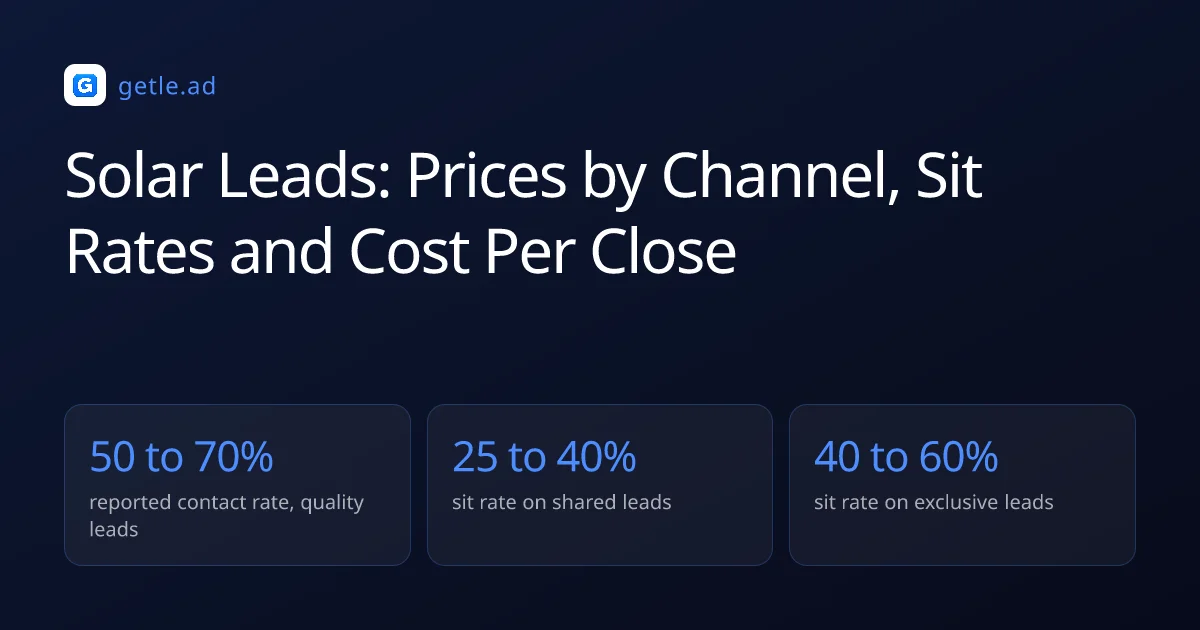
Reported industry figures put contact rates at 50 to 70% for quality leads, with appointment set rates of 25 to 40% on shared leads and 40 to 60% on exclusive ones.
For example, a $50 shared lead at a 30% sit rate costs $167 per appointment, while a $200 exclusive lead at 50% costs $400. Which is better depends on close rate, and nothing on the invoice tells you that.
The only number that settles it
Installers in competitive markets reportedly target a cost per close under $1,500, which is the figure every channel should be judged against.
Work it backwards. Multiply lead cost by the number of leads needed for one close, and compare that against your gross margin per installation rather than against another lead price.
That calculation frequently reverses the intuitive ranking, because low quality leads consume sales capacity as well as budget and capacity is the scarcer resource.
The B2B side of solar
Everything above is consumer demand. The industrial layer above it buys through relationships and outbound rather than through marketplaces.
- Installers and EPC firms, who buy equipment, software, finance and subcontracting.
- Distributors and wholesalers, with procurement cycles tied to project pipelines.
- Commercial and industrial property owners, a genuine B2B solar buyer.
- Developers and asset managers, where public project filings are dated signals.
Our solutions page for the sector covers how installers use the platform, and the same targeting logic applies whether you sell to them or alongside them.
Commercial and industrial rooftop projects are the clearest example. The decision maker is a facilities or finance lead at a company, reachable exactly like any other B2B contact.
Data quality in a fast moving sector
Solar has high company churn, which means contact data ages faster here than in more stable industries.
In our verification of 383,368 raw B2B addresses, 23.9% were invalid outright. Sector lists built from installer directories tend to include firms that no longer trade at all.
Verify immediately before sending, and treat any list older than a quarter in this sector as a hypothesis rather than an asset.
Sources and method
First-party data (Getlead, 2026): the verification split of 43.4% confirmed valid, 23.9% invalid, 16.7% catch-all and 16.0% unknown comes from 383,368 addresses analyzed through live SMTP verification, and the 0.51% bounce rate comes from 34,973 tracked sends, aggregated and anonymized at campaign level. Full method in our cold email benchmark study.
External sources: channel cost ranges, appointment pricing, contact rates, sit rates by lead type and the cost per close target come from 2026 solar lead market analyses; US commercial email obligations come from the FTC CAN-SPAM compliance guide.
Lead prices vary by state, incentive regime and season, so treat every range as directional. Checked in August 2026.
Frequently asked questions
How much do solar leads cost in 2026?
Reported ranges are $25 to $100 for shared marketplace leads, $20 to $100 on Meta lead ads, $80 to $200 for local services ads, $100 to $300 on search, $100 to $250 for exclusive leads and $400 to $800 for booked appointments.
Are exclusive solar leads worth the premium?
Often, because of sit rates. Reported appointment set rates run 40 to 60% on exclusive leads against 25 to 40% on shared ones, which changes cost per appointment more than the lead price difference suggests.
What should a solar installer track?
Cost per close. Installers in competitive markets reportedly target under $1,500, and that figure should be compared against gross margin per installation rather than against another lead price.
Why do cheap leads often cost more?
Because they consume sales capacity as well as budget, and capacity is the scarcer resource. A low sit rate means reps spend their week on appointments that never happen.
Is there a B2B market in solar?
Yes. Installers and EPC firms buy equipment, software, finance and subcontracting, distributors run procurement cycles tied to project pipelines, and commercial property owners are direct B2B solar buyers reachable by outbound.
How fresh does solar contact data need to be?
Fresher than most sectors, because company churn is high. In our verification 23.9% of raw B2B addresses were invalid, and installer directory lists frequently include firms that no longer trade.