ON THIS PAGE
By Efe Berke Colaker, Founder at GetleadReviewed by the Getlead editorial team for accuracy. Last updated August 2026.
Residential real estate lead prices vary by an order of magnitude between channels, which makes the average number in any article close to useless.
The spread itself is the useful information, along with a second market inside property that never appears on a consumer portal.
What each channel costs
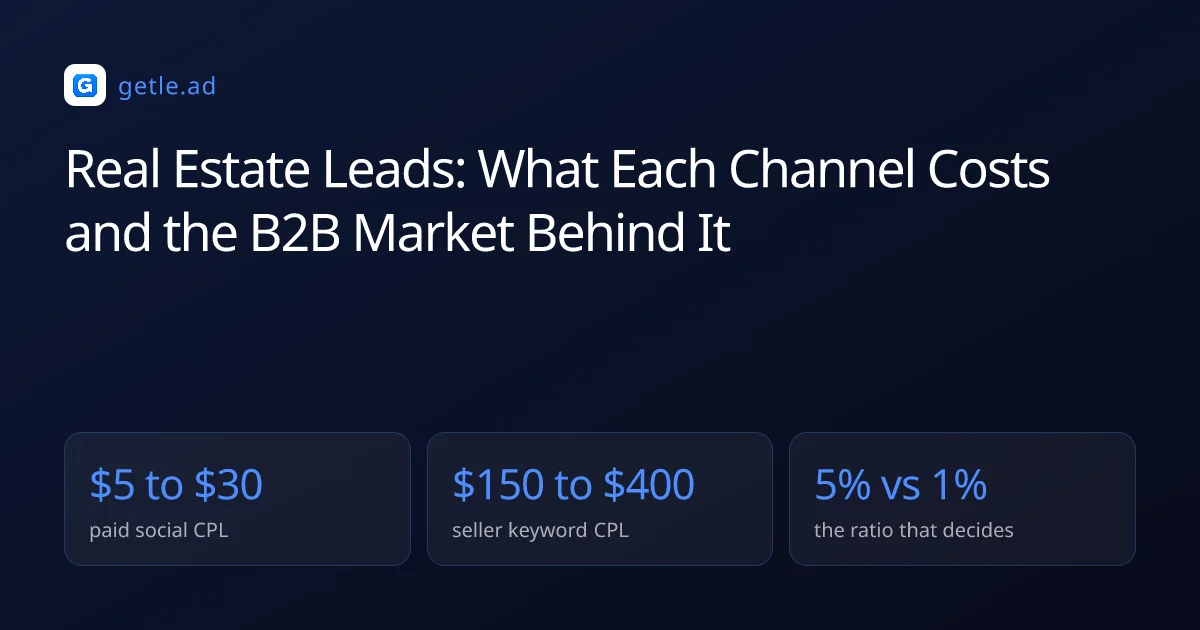
Reported 2026 benchmarks place paid social leads at $5 to $30, Google Ads buyer leads at $20 to $60 and seller keyword leads at $150 to $400, with portal leads frequently above $139.
A seller lead costs more everywhere because listing supply is the constrained side of the market, and every agent is bidding for the same intent.
Why cost per lead is the wrong number
Comparing channels on acquisition cost alone reliably picks the worst one, because conversion varies more than price does.
For example, a $50 lead converting at five percent produces a client for $1,000, while a $20 lead converting at one percent costs $2,000. The cheaper channel is twice as expensive.
Track cost per signed client by source and nothing else at the top level. Every other metric in this category is a leading indicator at best.
Response speed does more than budget
Shared leads are sold to several agents simultaneously, which turns the purchase into a race decided in minutes rather than days.
That makes response process the highest leverage thing an agent controls. A same day reply on a $200 portal lead is worth more than a bid increase anywhere.
The same discipline applies to any outbound reply, where the interval between response and follow up decides whether interest survives.
The B2B market inside property
Residential portals cover one slice. The rest of property is businesses selling to businesses, and it is reached by ordinary outbound.
- Commercial brokers and landlords, who buy services rather than list on consumer portals.
- Property management firms, with recurring supplier needs across a portfolio.
- Developers and construction firms, where project starts are public and dated.
- Investor groups and funds, a professional audience with defined criteria.
For example, a property management firm taking on new buildings has an operational load change that is visible publicly and never appears on a lead marketplace.
Our own solutions page for the sector covers how this segment is built inside the platform, and the data work behind it is the same as any other vertical.
The data side
Property contact data has a specific failure mode: agents move between brokerages frequently, so titles and domains both change.
In our verification of 383,368 raw B2B addresses, 23.9% were invalid and 16.7% sat behind catch-all domains. Sector directories are usually worse than that baseline, not better.
Verify in the week you send. In a market where people change employers often, a six month old address is a coin flip.
Sources and method
First-party data (Getlead, 2026): the verification split of 43.4% confirmed valid, 23.9% invalid, 16.7% catch-all and 16.0% unknown comes from 383,368 addresses analyzed through live SMTP verification, and the 0.51% bounce rate comes from 34,973 tracked sends, aggregated and anonymized at campaign level. Full method in our cold email benchmark study.
External sources: channel cost per lead ranges for buyer, seller, paid social, search and portal leads come from 2026 real estate lead generation benchmark analyses; US commercial email obligations come from the FTC CAN-SPAM compliance guide.
Cost per lead figures vary sharply by metro and season and should be read as directional. Checked in August 2026.
Frequently asked questions
How much do real estate leads cost in 2026?
It depends entirely on channel. Reported ranges are $5 to $30 on paid social, $20 to $60 for Google Ads buyer leads, $150 to $400 for seller keywords and $139 to $300 or more from major portals.
Why are seller leads more expensive?
Listing supply is the constrained side of the market, so every agent bids for the same intent. That competition shows up directly in seller keyword costs, which run several times buyer lead costs on search.
Is cost per lead the right metric?
No. Conversion varies more than price does, so a $50 lead converting at five percent produces a client for $1,000 while a $20 lead at one percent costs $2,000. Track cost per signed client by source.
What is the highest leverage improvement?
Response speed. Shared leads are sold to several agents at once, which makes the purchase a race decided in minutes, so a same day reply beats any bid adjustment.
Is there a B2B market in real estate?
Yes, and it is reached by outbound rather than portals: commercial brokers and landlords, property management firms, developers with dated project starts, and investor groups with defined criteria.
How reliable is property contact data?
Less reliable than average, because agents move between brokerages frequently so titles and domains both change. In our verification 23.9% of raw B2B addresses were invalid, and sector directories usually perform worse than that baseline.