ON THIS PAGE
By Efe Berke Colaker, Founder at GetleadReviewed by the Getlead editorial team for accuracy. Last updated August 2026.
Insurance lead buying is a mature marketplace with published prices, rising costs and a well understood quality gradient.
What gets less attention is that commercial lines are sold the way any B2B product is sold, and the marketplace is irrelevant there.
What leads cost by vertical
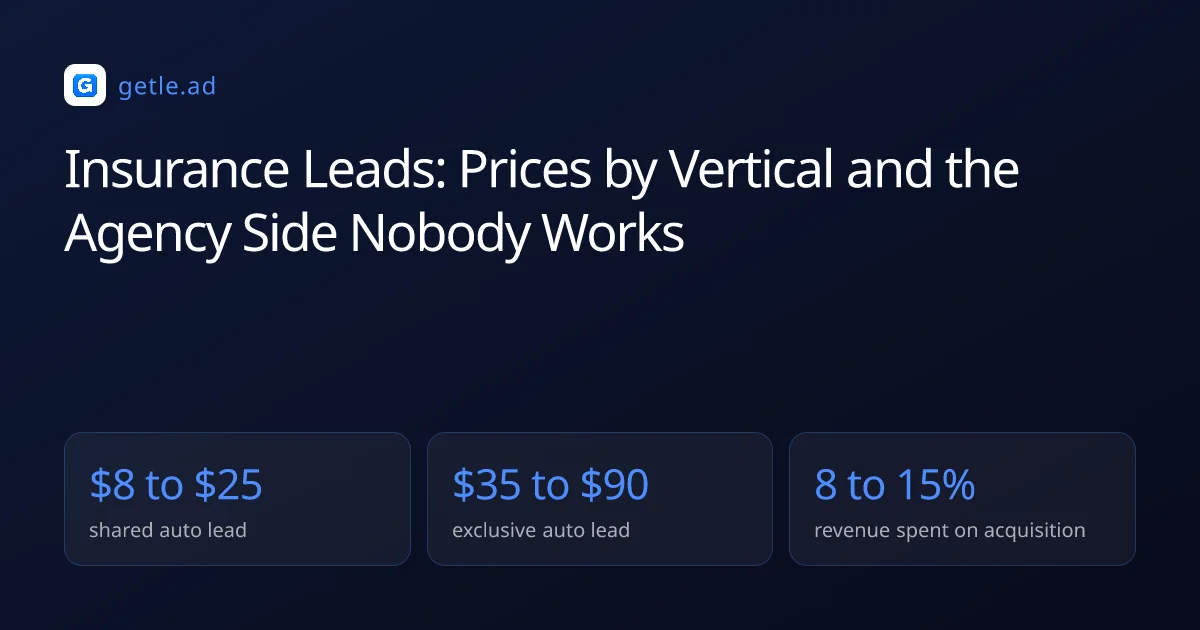
Reported 2026 market data shows shared auto leads that sold for $7 to $12 in 2021 now commonly running $14 to $25, with exclusive auto reaching $35 to $90 depending on geography, and live transfers taking a substantial share of the market.
A shared lead is sold to several agents at once, which makes speed the deciding factor and turns the purchase into a race rather than a relationship.
Track cost per policy, not cost per lead
The spread between shared and exclusive pricing is meaningless without conversion attached, and the same is true across sources within one vertical.
Reported benchmarks put agency marketing and lead acquisition spend at roughly 8 to 15% of gross revenue, rising toward 20% during growth phases, which is the budget the cost per policy figure has to fit inside.
For example, a $20 shared lead that converts at a fraction of a $70 exclusive one is not cheaper. Only the policy count tells you which was, and the invoice never will.
Commercial lines are an outbound market
Business insurance is bought by owners, finance leads and operations managers, and none of them appear on consumer lead marketplaces.
- Segment by industry and headcount, since risk profile and buying process both follow those.
- Use dated triggers: new premises, fleet expansion, hiring pushes, funding.
- Resolve the named decision maker rather than mailing a general office address.
- Verify addresses in the week you send.
- Time renewals where you know them, since insurance decisions cluster around policy dates.
The renewal timing point is the strongest angle available. A message that arrives two months before a renewal is relevant in a way the same message is not in month four.
The compliance overlay
Insurance outreach carries sector rules on top of ordinary email law, and consumer contact is regulated far more tightly than business contact in most markets.
For commercial outbound, the baseline still applies: accurate headers, a physical postal address and an opt-out honored promptly under CAN-SPAM, plus a lawful basis where recipients are in the EU or UK.
Sources and method
First-party data (Getlead, 2026): the verification split of 43.4% confirmed valid, 23.9% invalid, 16.7% catch-all and 16.0% unknown comes from 383,368 addresses analyzed through live SMTP verification, and the 0.51% bounce rate comes from 34,973 tracked sends, aggregated and anonymized at campaign level. Full method in our cold email benchmark study.
External sources: insurance lead price ranges by vertical, the shift toward live transfers and marketing spend as a share of revenue come from 2026 insurance lead market reports; US commercial email obligations come from the FTC CAN-SPAM compliance guide.
Third party cost benchmarks vary by market, vertical and methodology, and should be read as directional. Checked in August 2026.
Frequently asked questions
How much do insurance leads cost in 2026?
Shared leads run roughly $8 to $25 for auto, $15 to $40 for health, $20 to $50 for life and $10 to $30 for final expense. Exclusive auto leads reach $35 to $90 depending on geography, and Medicare and IUL command premium pricing.
Are shared or exclusive leads better?
Neither, until you measure cost per policy. Shared leads are sold to several agents at once, which makes speed decisive, while exclusive leads cost several times more and convert accordingly.
How much should an agency spend on lead acquisition?
Reported benchmarks put marketing and lead acquisition at roughly 8 to 15% of gross revenue, rising toward 20% during growth phases. Cost per policy has to fit inside that envelope to be sustainable.
How do I reach commercial insurance buyers?
By outbound rather than marketplaces. Segment by industry and headcount, use dated triggers such as new premises or fleet expansion, resolve the named decision maker and verify the address in the week you send.
What is the strongest timing angle in commercial insurance?
Renewal dates. Insurance decisions cluster around policy anniversaries, so a message arriving two months before renewal is relevant in a way the same message is not four months out.
What compliance rules apply to insurance outreach?
Sector rules sit on top of ordinary email law, and consumer contact is regulated much more tightly than business contact. For commercial outbound the CAN-SPAM baseline applies, plus a lawful basis for EU or UK recipients.