ON THIS PAGE
By Efe Berke Colaker, Founder at GetleadReviewed by the Getlead editorial team for accuracy. Last updated August 2026.
Recruitment agencies spent a decade competing for candidates. The constraint moved, and the harder problem in 2026 is finding clients with roles to fill.
That shift changes what business development should look like, and most agencies are still running a process designed for the old constraint.
What changed in the market
The reported numbers describe a clean inversion rather than a gradual drift.
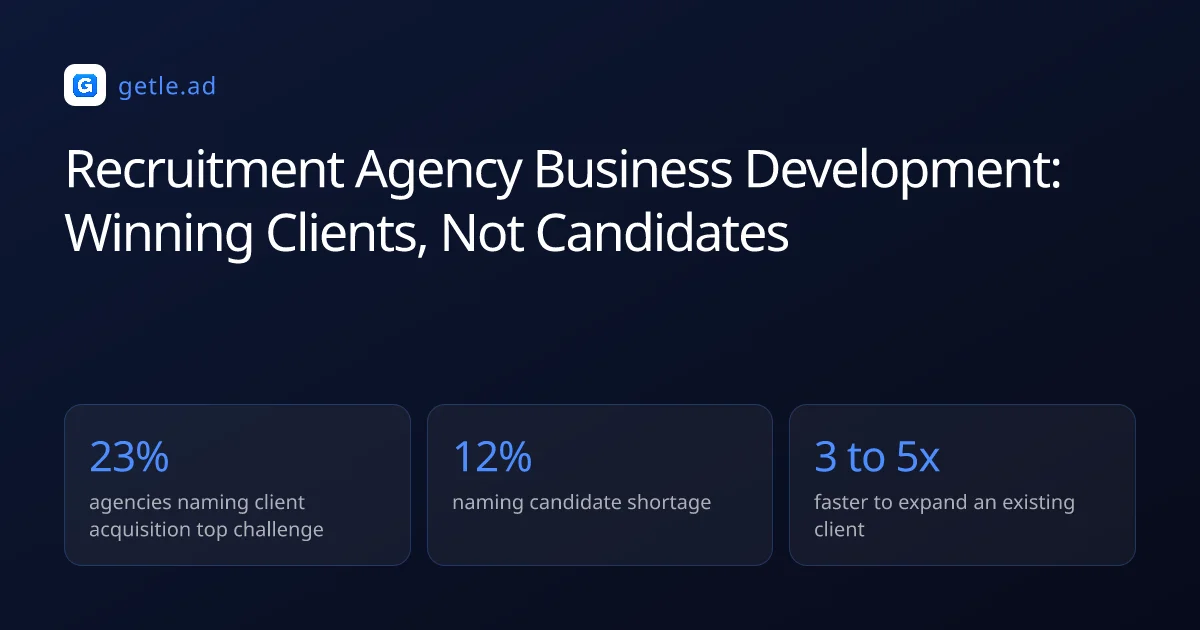
Reported industry research shows client acquisition rising from 16% to 23% as the top challenge while candidate shortage concerns fell from 17% to 12% over the same period.
A full desk recruiter handles both sides, client development and candidate placement, and reported figures put that model at over 40% of agencies, which is why business development often loses to delivery work.
Where the effort should go
Reported guidance for 2026 puts 60 to 70% of business development effort into expansion and referrals and 30 to 40% into net new prospecting.
- Map current clients by unfilled roles rather than by revenue, since that is where the next order sits.
- Ask for referrals at placement, when the outcome is fresh and the relationship is warm.
- Reactivate dormant clients where a role type you fill has reappeared.
- Reserve the remaining time for net new accounts with a dated hiring signal.
- Track new logo cost against expansion cost, because the ratio justifies the split.
Expanding job order volume with a current client is reported as three to five times faster than new logo acquisition, which is the arithmetic behind the recommended split.
That does not remove the need for net new work. It changes its role from primary engine to pipeline replenishment, which is a different weekly rhythm.
The signal recruiters already have and underuse
Almost every prospect announces its need publicly before anyone calls, which is unusual in B2B and specific to this industry.
A live job posting is a dated, public, unambiguous statement that a company has a role to fill and has not filled it yet.
Working from postings rather than from a static list turns prospecting into a queue of accounts with a stated need, which is a different conversation entirely.
Who to reach inside the account
Recruitment is bought by different people depending on company size, and getting this wrong wastes the signal entirely.
- Under 50 people: the founder or the hiring manager directly, since no talent function exists.
- 50 to 250: a head of people or HR manager, usually the budget owner for agency spend.
- Above 250: talent acquisition leads, with procurement involved on preferred supplier lists.
- Any size, urgent role: the hiring manager, who feels the pain the talent function is measured on.
Resolving the right person is the difference between a signal and a placement, and it is ordinary contact research rather than anything sector specific.
The data layer under all of it
Agency prospecting lists rot faster than most because the people who buy recruitment services change jobs at least as often as everyone else.
In our verification of 383,368 raw B2B addresses, 23.9% were invalid and 16.7% sat behind catch-all domains where confirmation is impossible.
Across 34,973 tracked sends we held bounce at 0.51% by verifying close to send, which matters more in a sector where you contact the same market repeatedly.
Sources and method
First-party data (Getlead, 2026): the verification split of 43.4% confirmed valid, 23.9% invalid, 16.7% catch-all and 16.0% unknown comes from 383,368 addresses analyzed through live SMTP verification, and the 0.51% bounce rate comes from 34,973 tracked sends, aggregated and anonymized at campaign level. Full method in our cold email benchmark study.
External sources: the shift in top reported challenge from candidate shortage to client acquisition, the effort split between expansion and net new, the speed advantage of expanding existing clients and the share of full desk recruiters come from 2026 staffing industry benchmark reports.
Industry survey figures reflect the responding sample and will differ by market and agency size. Checked in August 2026.
Frequently asked questions
What is the biggest challenge for recruitment agencies in 2026?
Client acquisition. Reported research shows it rising from 16% to 23% of agencies naming it their top challenge, while candidate shortage concerns fell from 17% to 12% over the same period.
How should agencies split business development effort?
Reported guidance puts 60 to 70% into expansion and referrals with existing clients and 30 to 40% into net new prospecting, because growing job order volume with a current client is reported as three to five times faster.
What is the best prospecting signal for recruiters?
Live job postings. They are dated, public and unambiguous statements that a company has a role to fill and has not filled it, which is a rare advantage in B2B prospecting.
Who buys recruitment services?
It varies by size. Under 50 people it is the founder or hiring manager, between 50 and 250 it is usually a head of people or HR manager, and above 250 it is talent acquisition with procurement involved.
Why does business development lose to delivery work?
Because over 40% of agencies use full desk recruiters who handle both client development and placement. Urgent delivery work always outranks prospecting when the same person owns both.
How fresh does agency prospecting data need to be?
Very. The people who buy recruitment services change jobs frequently, and in our verification 23.9% of raw B2B addresses were invalid with a further 16.7% unconfirmable behind catch-all domains.