ON THIS PAGE
By Efe Berke Colaker, Founder at GetleadReviewed by the Getlead editorial team for accuracy. Last updated August 2026.
A rep's day fills itself with whatever notifies loudest. That is how a role designed to start conversations turns into one that maintains a tool.
Four blocks in a fixed order fixes most of it, and the order matters more than the hours.
The four blocks
For example, a rep who sources in the morning and answers replies at five has inverted the value order. The reply was worth roughly 33 sends of effort and it aged all day.
What the research block actually contains
The research block is where accounts are chosen and first lines are decided, which is the only work in the day that is not repeatable by software.
- Confirming the owning role at each account rather than accepting the title field.
- Finding a dated situation: hiring, launch, funding, a visible tool change.
- Writing the specific first line for the accounts sending tomorrow.
- Discarding accounts that do not survive the check, which is the point of the block.
Discarding is what makes the rest work. A segment that shrinks in research is a segment that will produce a higher reply rate, and reps who never discard are running a volume model with extra steps.
What destroys the schedule
- Notifications during research. The block only works uninterrupted.
- Manual list cleaning inside the day. Verification belongs in the tooling, not in a rep's afternoon.
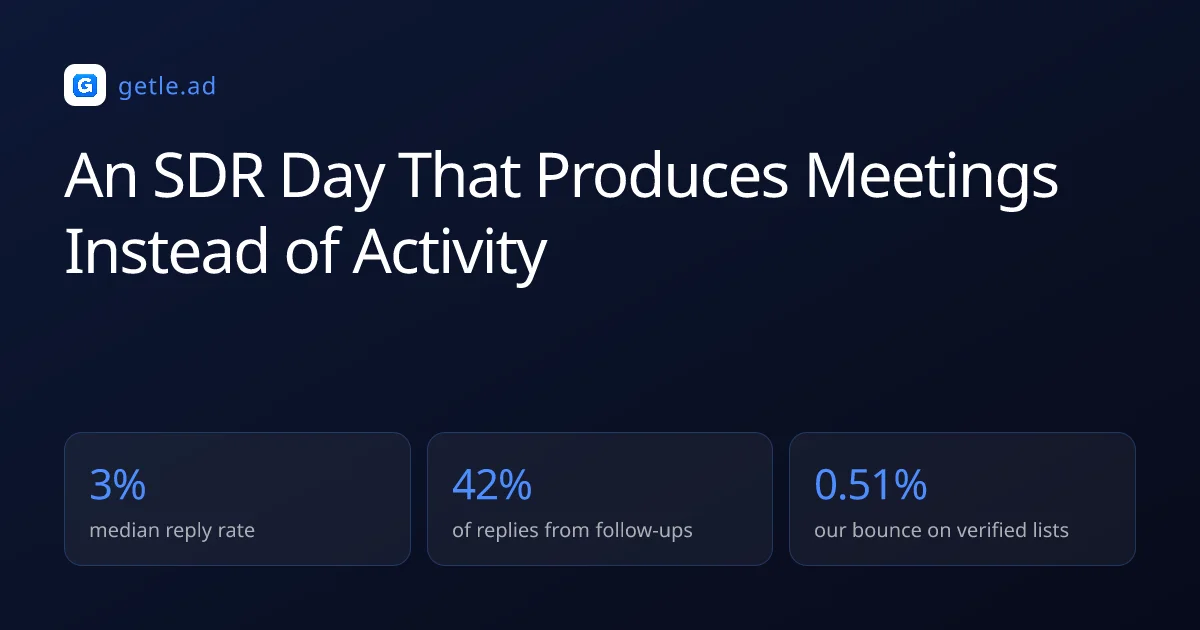
- Sending without follow-ups scheduled. Roughly 42% of replies come from follow-ups, so skipping them halves the return on the same work.
- Reply handling spread across mailboxes, which turns a five minute job into a search.
The second item is the most common. A rep who spends an hour cleaning a CSV is doing work that costs a fraction of a cent per address to automate, and doing it worse.
Sources and method
First-party data (Getlead, 2026): the verification split of 43.4% confirmed valid, 23.9% invalid, 16.7% catch-all and 16.0% unknown comes from 383,368 addresses analyzed through live SMTP verification, and the 0.51% bounce rate and 35.8% open rate come from 34,973 tracked sends, aggregated and anonymized at campaign level. Full method in our cold email benchmark study.
External sources: median B2B reply rates near 3%, the 5 to 8% range for strong campaigns and the finding that roughly 42% of replies arrive from follow-ups come from 2026 cold email benchmark compilations; US commercial email obligations come from the FTC CAN-SPAM compliance guide.
Third party benchmarks vary in methodology and should be read as directional. Checked in August 2026.
Frequently asked questions
What should an SDR do first each day?
Handle replies. At a median 3% reply rate each reply represents roughly 33 sends of effort already spent, and prospect attention decays through the day, so answering first protects the most valuable output of the previous day's work.
How should an SDR day be structured?
Four blocks in order: replies first, protected research second, sends midday, sourcing at the end. Sending is the smallest block because it is mechanical once the list and the message exist.
What belongs in the research block?
Confirming the owning role at each account, finding a dated situation such as hiring or a launch, writing specific first lines for tomorrow's sends, and discarding accounts that do not survive the check.
Why is discarding accounts part of the job?
Because a segment that shrinks during research produces a higher reply rate. A rep who never discards is running a volume model, which moves the outcome toward the median rather than above it.
What destroys an SDR schedule?
Interruptions during research, manual list cleaning that should be automated, sending without follow-ups scheduled, and reply handling spread across several mailboxes instead of one shared view.
Why do follow-ups matter for the daily plan?
Because roughly 42% of replies arrive from follow-ups in published benchmarks. Sending without them scheduled means doing the same sourcing and research work for about half the return.