ON THIS PAGE
By Efe Berke Colaker, Founder at GetleadReviewed by the Getlead editorial team for accuracy. Last updated August 2026.
Cold email gets defined by what people dislike about it rather than by what it is. The result is a category that includes both careful one to one outreach and mass unsolicited advertising, which are different activities with different outcomes.
This is the working definition, the line that separates it from spam, and the measurable conditions under which it functions at all.
The definition
Cold email is an unsolicited business message sent to a named individual who has had no prior relationship with the sender, written for a specific reason relevant to that person's work.
Three parts of that carry weight. Unsolicited means no prior opt-in. Named individual excludes shared inboxes and purchased blasts. Specific reason is what distinguishes it from advertising sent to everyone.
For example, a message to a named head of operations at a 60 person agency referencing three roles they are hiring is cold email. The same message sent to 40,000 addresses with a merge field is advertising, and the mailbox providers score it that way.
Is it legal
Yes, under conditions, and the conditions differ by regime. CAN-SPAM regulates the message: accurate headers, a real physical postal address, an honest subject line and an opt-out honored within 10 business days.
The GDPR regulates the processing rather than the message. B2B outreach in the EU and UK usually relies on legitimate interest, which requires a documented balancing test and immediate handling of objections.
Neither regime requires prior consent for B2B, and neither excuses a missing opt-out. The practical version of compliance is a small set of records you can produce about any single contact.
What decides whether it works
Four numbers, and only one of them is about writing.
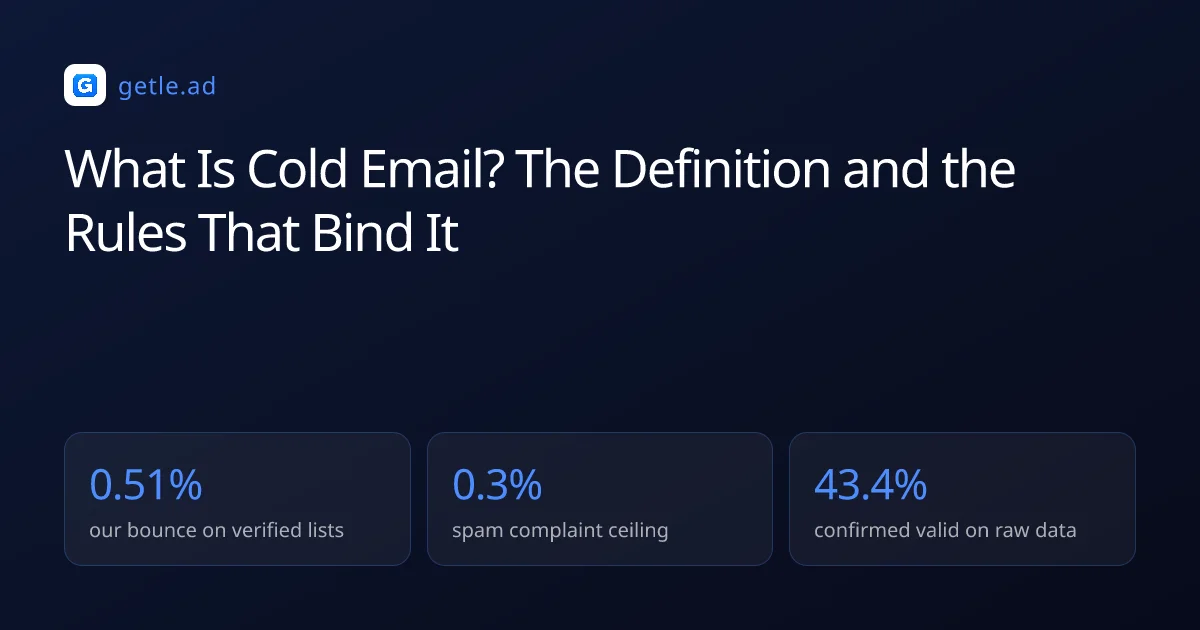
List quality comes first. Across 383,368 raw B2B addresses we verified, 40.7% were invalid or unconfirmable, so an unverified list fails before the copy is read.
Then infrastructure: authentication, a separate sending domain and warm-up. Then targeting. Copy matters last and least, which is the opposite of how most teams allocate their attention. Each of those can be built or bought, and buying it means pre-warmed mailboxes that arrive with the authentication and the sending history already done.
How it differs from adjacent things
- Email marketing goes to people who opted in, so consent and content rules differ entirely.
- Spam is defined by the recipient and the provider, not by whether you had permission.
- LinkedIn outreach reaches the same people on a platform with its own limits and no deliverability layer.
- Transactional email is triggered by an action and is exempt from most marketing rules.
The distinction that matters operationally is the second one. You do not get to decide whether your mail is spam; a complaint rate above 0.3% of delivered messages decides it for you.
Sources and method
First-party data (Getlead, 2026): the verification split of 43.4% confirmed valid, 23.9% invalid, 16.7% catch-all and 16.0% unknown comes from 383,368 addresses analyzed through live SMTP verification, and the 0.51% bounce rate comes from 34,973 tracked sends, aggregated and anonymized at campaign level. Full method in our cold email benchmark study.
External sources: US commercial email obligations including accurate headers, a physical postal address and an opt-out honored within 10 business days come from the FTC CAN-SPAM compliance guide; sender requirements including the 0.3% spam complaint ceiling come from the Google Workspace sender guidelines.
Figures were checked in August 2026 and provider policies change without notice.
Frequently asked questions
What is cold email?
An unsolicited business message sent to a named individual with no prior relationship to the sender, written for a specific reason relevant to that person's work. The named recipient and the specific reason are what separate it from bulk advertising.
Is cold email the same as spam?
No, though the recipient and the mailbox provider decide which it is in practice. Cold email targets a named person for a stated reason, identifies the sender honestly and offers a working exit. Spam does none of those and is measured by complaint rate rather than intent.
Is cold email legal?
Yes in the US, EU and UK under conditions. CAN-SPAM requires accurate headers, a physical postal address and an opt-out honored within 10 business days. The GDPR requires a lawful basis, usually a documented legitimate interest assessment, and immediate handling of objections.
Does cold email require consent?
Not for B2B outreach in the US, EU or UK. What is required is relevance, honest identification and a working opt-out. Consent based rules apply to consumer marketing in many jurisdictions and to all marketing in a few.
What metrics show whether cold email is working?
Bounce rate under 1%, spam complaints under 0.3% of delivered messages with 0.1% as the target, and positive replies per thousand delivered. Open rate is unreliable because privacy features fetch images without a human involved.
Why does list quality matter more than copy?
Because a bad list fails before anyone reads the message. In our verification of 383,368 raw B2B addresses, 40.7% were invalid or unconfirmable, and sending to that produces bounces and complaints that damage delivery for everything else you send.