ON THIS PAGE
By Efe Berke Colaker, Founder at GetleadReviewed by the Getlead editorial team for accuracy. Last updated August 2026.
Free trials attract two kinds of visitor: people evaluating your product and people who want the free tier repeatedly. The second group uses disposable addresses, and the usual response is to buy a blocklist and reject anything on it.
That works about as well as any static defence against a moving target. The domains rotate faster than the lists update. And every rule tuned to catch them eventually catches a real buyer with an unusual email provider.
The workable approach is scoring rather than blocking, and knowing which side of the error you can afford.
Why blocklists are structurally behind
A disposable email service needs domains, and domains are cheap. Providers register them continuously, use them for days, and abandon them before the public lists finish cataloguing them.
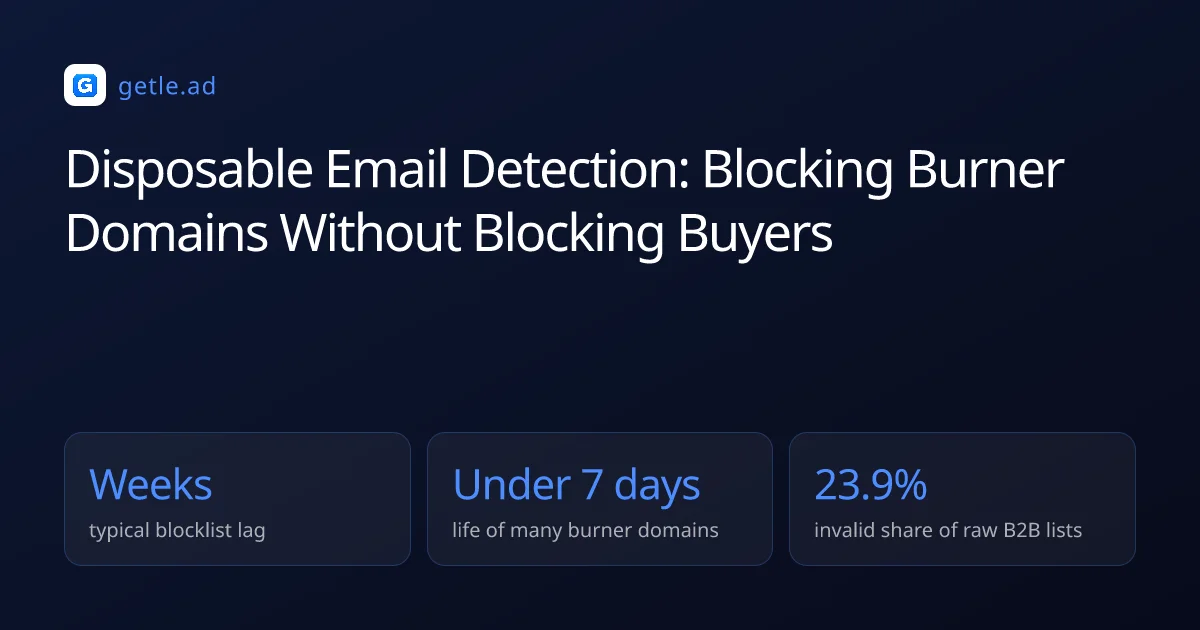
Reporting on the category describes a large share of high risk disposable domains as lasting less than a week, with the gap between a domain going live and appearing on a public blocklist typically measured in weeks. By the time the list catches up, the domain has already served its purpose.
So a blocklist is worth having and is not worth trusting alone. Treat it as one input with a known blind spot rather than as the decision itself.
A blocklist is a maintained set of domains known to belong to disposable email services, consulted at signup.
The asymmetry that decides your policy
Every detection system makes two kinds of mistake, and in B2B they are not equally expensive. Blocking a genuine buyer costs a deal. Admitting a throwaway signup costs some support time and a seat in a usage table.
That asymmetry should shape the whole design. Hard blocking belongs only where the signal is unambiguous. And everything else belongs in a risk score that changes what happens next rather than whether anything happens at all.
- High confidence disposable. Block at signup with a clear message and an alternative route to contact you.
- Medium risk. Allow, but restrict trial limits and skip the sales follow-up until there is engagement.
- Low risk with unusual domain. Allow normally. Small companies use small providers.
- Corporate domain. Allow and prioritise, since a business domain is the strongest legitimacy signal available.
The third case is the one crude systems get wrong. A founder at a two person company on a niche provider looks statistically similar to a burner and is exactly the customer a self serve product wants.
Where hard blocking is still correct
Two cases justify a flat rejection. An exact match against a maintained disposable list, and a domain with no MX record at all. That cannot receive mail and therefore cannot be a working business address.
Everything else is a probability rather than a fact, and probabilities belong in a score. That distinction keeps the block list short, which is also what keeps it maintainable.
The signals worth combining
No single check is reliable. Five together produce a score that survives the domain churn.
Domain age is the most useful early signal, because the economics of disposable services require fresh domains constantly. A domain registered this month with no website and generic MX is a very different proposition from a ten year old domain nobody has heard of.
Behavioural signals are the most accurate and arrive too late to gate a signup. That is precisely why they belong in the loop as feedback. Use them to retrain the score rather than to make the initial decision.
A disposable email address is a temporary mailbox issued by a service that expects to discard it, usually to claim a free trial without leaving a durable identity.
For example, a signup from a domain registered nine days ago, with no website and generic mail hosting, scores high risk on three independent signals at once. That is a very different case from an unfamiliar domain that has been resolving and receiving mail for a decade.
The outbound version of this problem
Disposable detection is a signup concern. In outbound the equivalent risk is different in mechanism and identical in effect: addresses that look fine and are not.
Two categories matter. Invalid addresses, which are 23.9% of raw B2B records in our verification data. And spam traps, which are recycled or purpose built addresses that accept mail specifically to catch senders using stale or harvested lists.
Neither is detectable by pattern. Both are removed by the same discipline: verify immediately before sending, keep provenance per record. And retire anything that has not been reachable in a year.
A spam trap is an address that accepts mail specifically to identify senders using harvested or stale data.
A practical implementation order
Build it in the order that gives value soonest, and resist the urge to start with the hardest part.
- Add a maintained disposable domain list and block only exact matches with high confidence.
- Add domain age and MX checks, and route anything suspicious into a restricted trial rather than a rejection.
- Log every decision with the signals behind it, so you can measure both error types later.
- Review weekly: how many blocked signups complained, and how many allowed ones never returned.
- Feed post signup behaviour back into the score, which is where the accuracy comes from.
- Keep an obvious appeal route, since a blocked buyer who cannot reach you is a lost deal rather than a prevented fraud.
Step three is the one people skip and then regret. Because without logs there is no way to tell whether the system is working or merely firing. A rule that blocks 400 signups a month is either excellent or catastrophic and the logs are the only difference.
Step six is worth a line of copy on the block screen. An address that a person can write to costs nothing and converts an unlucky rejection into a conversation instead of a silent loss.
Measuring both error types
Two numbers make the system accountable. The false positive rate is how many blocked addresses later reached you another way and turned out to be real. The false negative rate is how many allowed signups never verified, never returned and consumed support time.
Neither is knowable without the decision log from step three. With it, both are a query, and the weekly review becomes a tuning exercise rather than an argument about whether the rules are too strict.
Sources and method
First-party data (Getlead, 2026): the verification split of 43.4% confirmed valid, 23.9% invalid, 16.7% catch-all and 16.0% unknown comes from 383,368 addresses analyzed through live SMTP verification. And the 0.51% bounce rate comes from 34,973 tracked sends, aggregated and anonymized at campaign level. Full method in our cold email benchmark study.
External sources: reporting on disposable domain lifespan and the lag before public blocklists catch new domains (IPASIS, 2026); mailbox verification behaviour follows the SMTP specification in RFC 5321.
US commercial email obligations, including accurate headers, a physical postal address and a working opt-out honored within 10 business days, come from the FTC CAN-SPAM compliance guide.
Third party figures on disposable email volumes vary widely by industry and methodology, so treat them as directional. Figures were checked in August 2026.
Frequently asked questions
What is a disposable email address?
A temporary address from a service that lets someone receive mail without a lasting identity, usually to claim a free trial or bypass a signup gate. The domains behind them rotate constantly, and many high risk ones exist for less than a week.
Why do disposable email blocklists miss so many domains?
Because the domains are short lived by design. New ones appear continuously and are abandoned within days. While the lag between a domain going live and appearing on a public list is typically measured in weeks. So the list is catching up to something already gone.
Should I block all disposable emails at signup?
Block only high confidence matches. In B2B the cost of rejecting a genuine buyer usually exceeds the cost of a throwaway signup. So medium risk addresses belong in a restricted trial with a clear appeal route rather than a hard rejection.
What signals detect disposable domains best?
Domain age, MX configuration, blocklist matches, whether the domain resolves to a real site, and post signup behaviour. No single signal is reliable, and behavioural data is the most accurate but arrives too late to gate the signup itself.
Do disposable addresses matter for cold email?
Rarely, because you are choosing the recipients rather than accepting signups. The equivalent outbound risk is stale data: invalid addresses, which are 23.9% of raw B2B records in our verification. And spam traps that accept mail specifically to catch senders using old lists.
Can verification detect disposable addresses?
SMTP verification confirms whether a mailbox exists, and a disposable address usually does exist while it lasts. Detection is a separate check based on domain reputation and age rather than on whether the mailbox accepts mail.