ON THIS PAGE
By Efe Berke Colaker, Founder at GetleadReviewed by the Getlead editorial team for accuracy. Last updated September 2026.
Search for pre-warmed email accounts and the first page is mostly rankings. Read four of them and the pattern is hard to miss: the ranking is usually published by a company that sells one of the entries, and that entry wins. Two of the articles currently on page one were published by sister companies of the products they placed first.
So this one opens with the disclosure. Getlead sells pre-warmed mailboxes. We are on the list, we are not the cheapest on it, and every figure below is the provider's own published number read off their own site on 15 August 2026. Where a provider does not publish something, the entry says not published rather than filling in a guess.
What a pre-warmed mailbox actually is
A pre-warmed mailbox, also sold as a pre-warmed inbox or pre-warmed email account, is a Google Workspace or Microsoft 365 account that has been sending small volumes of opened and answered mail for weeks before anyone sells it to you. The point is the sending history. A mailbox created this morning has no record at all, so the first campaign it sends is the only evidence a receiving server has, and a first campaign looks exactly like a spam run.
That is the whole product. You are not buying better software, you are buying weeks off the calendar. Everything else on a pre-warmed provider's pricing page is packaging around that one fact.
The ten providers at a glance
Ordered by published price, not by preference. Two providers do not publish one at all, which is itself the most useful thing that column says about them.
How we checked these numbers
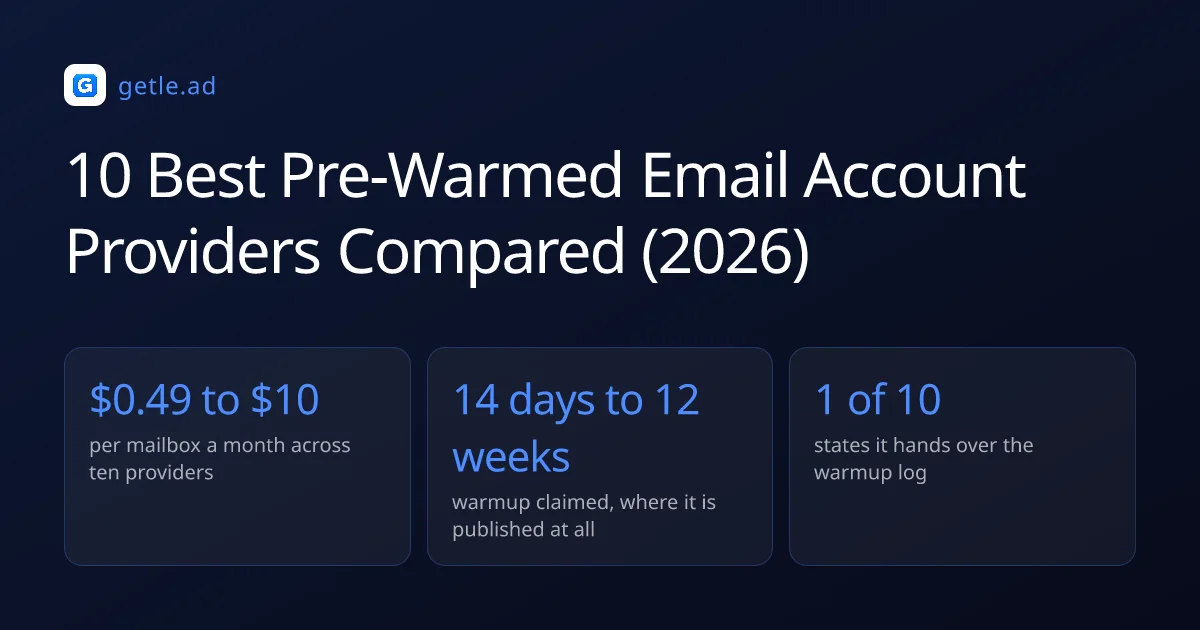
Every figure in this comparison is the provider's own published number, read off their public pricing or product page. First pass on 15 August 2026, re-verified on 21 August 2026. Nothing here comes from affiliate feeds, third-party review sites or sales calls.
- Where a provider does not publish a number, the entry says not published rather than filling in a guess. The gaps are data: what a pricing page leaves out is usually the term that matters most.
- Prices are compared in the unit each provider actually charges. Where billing is yearly (Infraforge) or a fee is one-off (DitLead's domain), that is stated inline rather than averaged away.
- No provider on this list paid to be here and none can pay to move up. Getlead is included with the same treatment, including the column where six providers beat it on price.
- Prices in this market move. We re-check all ten monthly and update the figures and this date when they do, so if you are reading this a while after the date above, verify before you order anywhere.
What each provider publishes
1. Getlead
Packs of three mailboxes to a domain, four to six weeks of warmup, and the warmup log plus a seed placement test handed over with the credentials. The domain is registered in your name and super admin transfers at handover. Warmup keeps running underneath once you start sending, which is the part that matters on weeks where campaign replies are thin. The honest weakness is unit price: six providers below undercut it, and if the only thing being optimised is cost per mailbox, this is not the cheapest way to buy one.
2. Maildoso
The lowest unit price in the market by a wide margin, down to $0.49 a mailbox at a thousand. It does not advertise pre-warmed stock; the warmup runs after purchase, which makes it a volume infrastructure play rather than a way to skip the wait. It also allows up to 99 mailboxes on a single domain while advising no more than eight, and stacking that many behind one reputation is how a single bad list takes out everything at once.
3. DitLead
Three dollars a mailbox with an $8 one-off domain fee, which is the cheapest published price for something sold as pre-warmed. It claims 95% primary placement tested across Gmail, Outlook and Yahoo before handoff, which is more measurement than most of this list publishes. Warmup length is not published, and neither is whether domain ownership transfers.
4. Primeforge
Pre-warmed Google Workspace mailboxes sold per seat at $3.50 to $4.50. Warmup length is not published, and neither are mailboxes per domain or ownership terms. Worth knowing that Primeforge, Infraforge, Mailforge and Salesforge are one company, which is why several of the ranking articles for this search term place them in the top three.
5. Infraforge
Priced through a calculator rather than plans, with a minimum order of ten mailbox slots, and it advises two to three mailboxes per domain, which is the same ratio serious providers converge on. The $4 figure is billed yearly, so the comparison against monthly pricing elsewhere is not like for like. Warmup length is not published anywhere on the pre-warmed page.
6. Puzzle Inbox
The only provider on this list publishing warmup in days rather than weeks: a minimum of 14, running to 18 or 21 on some providers. That is short, and it says so plainly, which is more useful than a large unverifiable number. Microsoft 365 inboxes are priced at $0.50 against $4.50 for Google, a ninefold gap that reflects licence cost rather than mailbox quality.
7. Litemail
Four fixed plans from $39 for five mailboxes on one domain up to $179 for thirty across six, with free domain replacement if one gets blacklisted. Five mailboxes to a domain is more concentration than the three most providers advise. The page states 12 weeks of warmup in its FAQ and four to six weeks in a heading further up the same page, which is the kind of contradiction worth resolving in writing before ordering.
8. Instantly
The most expensive of the mailbox-only providers here at $10, sold only in batches of five, and the convenience argument is real if the sequencer is already Instantly. The term that matters is in its own help documentation: it retains domain ownership and administrator access on pre-warmed purchases and cannot transfer them. That means leaving takes the sending infrastructure with it, and the warmup you paid for does not come along.
9. Zapmail
Publishes the longest warmup claim of anyone here, 12 or more weeks, on Google and Microsoft mailboxes with clean domains and sender names chosen to look real. It does not publish a price anywhere on the site, nor mailboxes per domain, nor whether the domain transfers. A twelve week claim with no log and no price is a lot of trust to extend before the first conversation.
10. Warm Inboxes
Google, Microsoft 365 and Azure inboxes with same day delivery and free domains on some offers, positioned around speed and around rescuing programs whose infrastructure has just burned. Pricing moved behind a login, so there is nothing public to compare, and warmup length is not published either.
The three things almost nobody publishes
Reading ten pricing pages back to back, the interesting part is not what differs. It is the three questions that decide whether the purchase was worth anything, and that eight or nine of these pages simply do not answer.
The warmup log
Every provider states a warmup length. One of the ten states that it hands over the day by day record. Without it, a warmed mailbox and a mailbox that has merely existed for three months are indistinguishable at the point of sale, and you find out which one you bought in week two of a campaign. Ask for it in writing. A provider that warmed the mailbox has the log, because the tool that ran the warmup produced it.
Who owns the domain
Only one page in ten states plainly what happens to domain ownership and administrator access, and the one that does states it retains both. That is not a hidden clause; Instantly documents it openly. But the other eight say nothing, which means the answer has to be extracted before payment rather than discovered at the point of leaving. A sending domain you do not own is a sending domain you rent, and reputation you built is not portable.
Mailboxes per domain
Reputation is scored per domain, so the number of mailboxes stacked on each one sets the blast radius when a campaign goes wrong. Three providers publish a figure: two to three at Infraforge, five at Litemail, and up to 99 allowed at Maildoso with eight advised. The rest say nothing, which in practice means the ratio is whatever fits the order.
Pre-warmed domains vs pre-warmed mailboxes
Half the searches around this market say domains rather than mailboxes, and the two are not the same purchase. Reputation lives at both levels: the domain accumulates a sending record across everything sent from it, and each mailbox rides that record while building its own. A pre-warmed mailbox purchase almost always includes the domain underneath it, because a warmed mailbox on a cold domain would start half its argument from zero.
What is rarely worth buying is a warmed-up domain on its own. An aged domain with no recent sending history is not warm, it is just old, and a domain warmed by someone else's traffic pattern stops matching the moment your campaigns start. If a listing sells domain age as warmth, that is the same unverifiable claim as a warmup length with no log behind it.
- Domain included in the price: Getlead (registered in your name).
- Domain billed separately: Maildoso at $12 a year, DitLead at $8 once, Infraforge at $14 a year, Instantly at $15 a year, Litemail at $15 a year for extras.
- Not published: Zapmail, Primeforge, Warm Inboxes and Puzzle Inbox do not state domain terms on their public pages.
Why a 12 week claim is not twice as good as a 6 week one
Two providers here advertise 12 weeks or more, and it reads like the obvious tiebreaker. It is not, for a reason worth understanding before paying a premium for it.
Warmup works by establishing a normal sending pattern and giving a filter a reputation to attach it to. That curve is steep at the start and flat afterwards. By roughly week four or five, Gmail and Outlook have what they need: a domain that sends consistently, gets opened and gets answered. Weeks seven through twelve add very little a receiving server measures differently, because there is nothing left in the signal to change.
What does still vary is whether the warmup was real. A mailbox exchanging traffic in a closed loop of other warmup accounts produces a very different history from one whose mail gets opened, answered and pulled out of spam by participating inboxes. That distinction is invisible in a week count and obvious in a log, which is why the log is the question and the week count is the marketing.
How to choose between them
Cost per mailbox is the easiest number to compare and the least useful one to decide on. Four questions, in this order, settle it faster.
- Will they show you the warmup log? If not, you are buying a claim. This is the one question that eliminates most of a shortlist in a single email.
- Do you end up owning the domain and the admin account? Get it in writing. One provider on this list documents that you do not, and eight do not address it at all.
- How many mailboxes per domain? Two or three keeps a bad list contained. Eight or more means one campaign mistake takes the whole domain down with it.
- Is the price monthly or annual, and does it include the domain? Infraforge's $4 is billed yearly, DitLead's domain fee is one-off, Litemail's is $15 a year. Three pricing pages, three different units.
Only after those four does unit price mean anything, because only then are you comparing the same object. And if the answer to the first two is unsatisfying, the cheapest option on the list is not cheap, it is a deposit on rebuilding the infrastructure later.
Are pre-warmed mailboxes worth the premium?
A fresh mailbox costs roughly $2 to $3.50 and needs four to six weeks before it can carry a campaign. A pre-warmed one costs roughly $3 to $10 and can send this week. Whether that gap is worth paying depends almost entirely on what the six weeks are worth to you, which is a question about pipeline rather than about mailboxes.
For a team starting outbound from nothing, the honest answer is often no: the six weeks can run in the background while the list, the offer and the sequence get built, and none of that needs a warmed mailbox. For a team replacing burned infrastructure, or scaling a program that already works, the six weeks are six weeks of pipeline and the premium is trivial against them.
What is never worth paying for is a warmup nobody will evidence. That costs the same as a real one and delivers what a fresh mailbox would have, six weeks later than doing it yourself.
If the math works for your volume, you can buy pre-warmed mailboxes with the domain and admin in your name, and see how owned versus rented accounts compare when you switch sending tools.
Frequently asked questions
What is the best pre-warmed email account provider?
There is no single answer, because the ten providers here are optimised for different things. Maildoso and DitLead win on unit price. Puzzle Inbox is the most transparent about a short warmup. Infraforge suits bulk orders of ten or more. Getlead is the one that hands over the warmup log and transfers domain ownership, and it is not the cheapest. Decide on the log and the ownership terms first, then compare price among whoever passes.
How much do pre-warmed email accounts cost?
Between $0.49 and $13 a mailbox a month across the providers checked in August 2026, plus a domain fee of $8 to $15 that is charged once at some providers and yearly at others. Fresh, unwarmed mailboxes run roughly $2 to $3.50, so the pre-warmed premium is a few dollars a mailbox for four to twelve weeks of sending history.
Are pre-warmed mailboxes safe to use for cold email?
The mailbox is not the risk. These are ordinary licensed Google Workspace or Microsoft 365 seats, and buying one properly breaks no terms. What gets accounts suspended is unsolicited bulk mail, unverified lists and missing opt-out handling, and none of that is fixed by warmup. A pre-warmed mailbox sending to a bad list burns exactly as fast as a fresh one, just from a higher starting point.
How long should a mailbox be warmed before cold outreach?
Four to six weeks is the working range, and the shape matters more than the total. Start in the low tens of messages a day and increase gradually. Claims of 12 weeks and more are not proportionally better, because the reputation curve flattens after roughly a month and there is little left in the signal to change.
Do I own the domain when I buy pre-warmed mailboxes?
It depends entirely on the provider, and most do not publish an answer. Instantly's own help documentation states it retains domain ownership and administrator access and cannot transfer them. Others are silent, which means asking before paying. If a provider keeps the domain, the reputation you build is not portable and leaving costs you the infrastructure.
Can I get pre-warmed Outlook or Microsoft 365 mailboxes rather than Gmail?
Yes, at most providers on this list, and at Puzzle Inbox the Microsoft option is roughly nine times cheaper than the Google one because of licence cost. Splitting a fleet across both is usually the better call anyway: Gmail and Outlook filter on different signals, so a fleet on one platform can go quiet all at once when that platform changes something.
How fast can I send from a pre-warmed email account?
The same day the credentials arrive, at the ramped rate the warmup reached, which is typically 20 to 25 cold emails per mailbox per day. What a pre-warmed account does not let you do is jump straight to hundreds a day from one mailbox: the volume ceiling comes from the sending pattern receiving servers expect, and exceeding it burns a warmed mailbox exactly as fast as a fresh one. Scale comes from more mailboxes, not more volume per mailbox.
Do pre-warmed email accounts get banned?
Not for being pre-warmed. Suspensions come from what is sent: unverified lists, missing unsubscribe handling, volume spikes and spam complaints. A warmed history raises the starting reputation but does not protect against any of those. The practical risks specific to buying are different: a provider that kept admin access can lose you the account, and a warmup that never really ran shows up as week-two spam placement. Both are why the log and the ownership terms are the two things to check before paying.