ON THIS PAGE
By Efe Berke Colaker, Founder at GetleadReviewed by the Getlead editorial team for accuracy. Last updated August 2026.
Most cold email platforms charge per connected mailbox, which makes the cost of scaling a sending operation grow with the thing you are trying to grow.
Salesforge prices differently, and that structural choice matters more than the difference between one tier and another.
The two plans
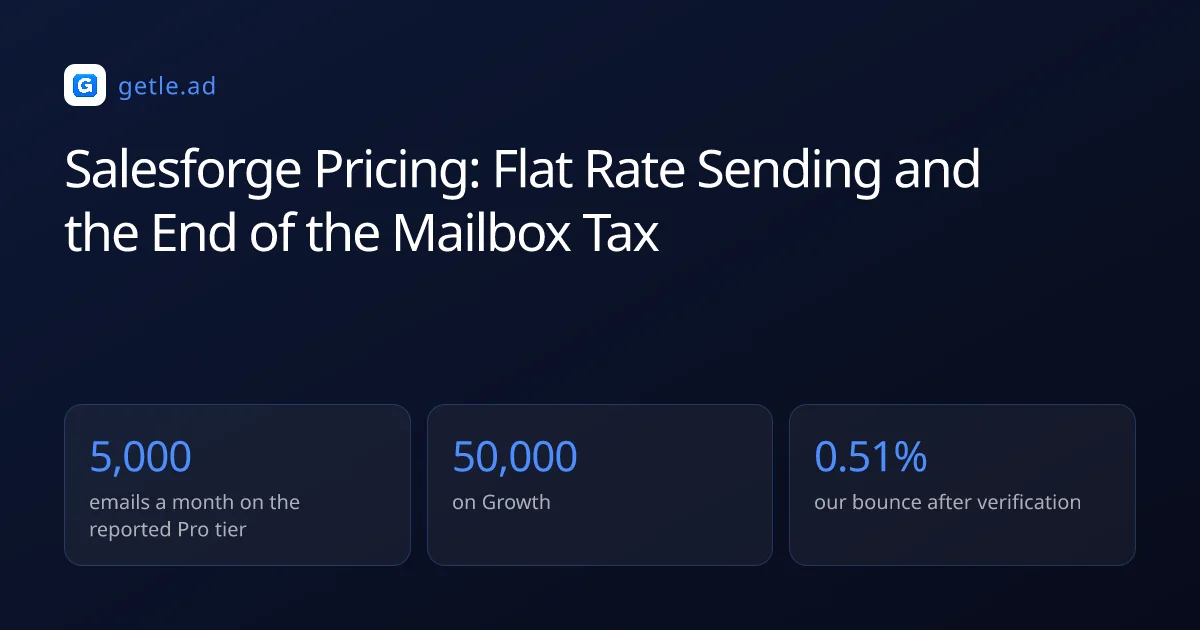
Reported 2026 pricing puts Pro near $40 a month billed annually with 1,000 active contacts and 5,000 emails a month, and Growth near $80 with 10,000 contacts, 50,000 emails, unlimited users and API access.
An active contact is a record currently inside a sequence, which is a different unit from a record stored, and the distinction decides which tier you need.
Why per mailbox pricing distorts everything
Sending volume in cold email is governed by mailbox count, because each mailbox has a safe daily ceiling that has nothing to do with your ambitions.
For example, a team spreading 400 daily sends across ten mailboxes is behaving correctly, and under a per mailbox model it pays ten times more than a team abusing a single inbox.
That is a pricing model working against deliverability. Removing the per mailbox charge aligns the invoice with the behaviour that keeps mail in the inbox. The same logic decides what a mailbox is worth: the number that matters is cost per mailbox per month once the warmup is already done, which is what the pre-warmed provider comparison works through across ten providers.
Reading the volume limits properly
Two numbers cap what a plan supports, and they run out at different times for different teams.
A sequence of four steps means each contact consumes four sends, so 5,000 monthly emails supports roughly 1,250 contacts through a full sequence rather than 5,000.
Work backwards from the sequence, not from the contact count. That single calculation prevents the most common sizing mistake in this category.
Capacity is not the constraint that matters
Cheap sending capacity encourages volume, and volume against a poor list is the fastest way to lose a domain.
In our verification of 383,368 raw B2B addresses, 23.9% were invalid. Sending a full sequence to that share produces exactly the bounce and complaint pattern that mailbox providers act on.
Across 34,973 tracked sends we held bounce at 0.51% by verifying close to send. Any sending tool is only as good as what enters it.
Fit and limits
The pairing question is where the contacts come from. A sending platform plus a separate database plus a separate verifier is three invoices for one workflow.
Sources and method
First-party data (Getlead, 2026): the verification split of 43.4% confirmed valid, 23.9% invalid, 16.7% catch-all and 16.0% unknown comes from 383,368 addresses analyzed through live SMTP verification, and the 0.51% bounce rate comes from 34,973 tracked sends, aggregated and anonymized at campaign level. Full method in our cold email benchmark study.
External sources: the Pro and Growth prices on annual and monthly billing, active contact and monthly email limits, unlimited users and the absence of per mailbox charges come from the published Salesforge pricing page and independent 2026 reviews.
Prices change without notice and published tiers are frequently renegotiated in practice, so treat every figure here as a starting point for your own quote rather than a fixed rate. Checked in August 2026.
Frequently asked questions
How much does Salesforge cost?
Reported pricing puts Pro near $40 a month billed annually and $48 monthly, with Growth near $80 annually and $96 monthly. Pro includes about 1,000 active contacts and 5,000 emails a month, Growth about 10,000 and 50,000.
Does Salesforge charge per mailbox?
No. Mailboxes are not charged individually, which is the structural difference from most cold email platforms and removes the penalty for spreading sends across many senders.
Why does per mailbox pricing matter?
Because safe sending requires spreading volume across mailboxes, each of which has a low daily ceiling. Under a per mailbox model a team behaving correctly pays many times more than a team overloading one inbox.
How many contacts does a monthly email limit support?
Divide by sequence length. A four step sequence means each contact consumes four sends, so 5,000 monthly emails supports roughly 1,250 contacts through a full sequence rather than 5,000.
Is cheap sending capacity a good thing?
Only against a clean list. In our verification 23.9% of raw B2B addresses were invalid, and sending a full sequence to that share produces the bounce and complaint pattern mailbox providers act on.
What does Salesforge not include?
A contact database. It is a sending platform, so lists come from elsewhere, which means a separate data source and often a separate verifier alongside the subscription.